AI Personalization and the Erosion of Shared Brand Experience
Brands now compete for representation in AI systems rather than direct customer attention.

A consumer searching for a project management tool no longer opens three vendor websites. The consumer asks an AI assistant, which names three products, characterizes each in a sentence, and presents a recommendation. The consumer makes a decision without visiting any of the brands involved.
The decision was still made, however. It was simply narrated by an AI system rather than by any of the brands themselves. This shift is structural: AI systems now sit between a brand and its audience, constructing a version of the brand from signals the company did not author and cannot directly control. What matters now is not only how customers perceive a brand but how the AI perceives it. And those two perceptions are not the same thing.
How AI intermediaries have quietly become the primary narrators of brand identity
The path from consumer to brand no longer runs through a brand's own front door. At each step of the journey, discovery, evaluation, and purchase, the AI traverses reviews, creator content, and community conversations on the user's behalf. The brand becomes a summary, not a destination.
The scale of this shift is now measurable. Deloitte Digital's 2026 research found that nearly two-thirds of consumers used AI-powered search tools or assistants to find products and services in the past year. That is not early adoption. It is the default behavior of a majority of buyers.
The consequence for brand control follows directly. By the time an AI-guided consumer signals interest in a brand, that consumer may already hold a formed view, one built by the AI's synthesis rather than by the brand's communication. The AI has decided which story to tell, which details to emphasize, and which competitors to mention first. The brand is no longer present for the first impression.
Why each user now receives a different version of the same brand
Fragmentation compounds the problem. Because AI systems personalize outputs to the individual query context, intent, and user history, the same brand is presented differently to different people. This is not a communication choice the brand made. It is an emergent property of how the AI synthesizes signals, and it means the brand ceases to exist as a single coherent identity.
Personalization has moved from segment-based to moment-based. The Experience Factory episode 3 describes how AI now shapes the customer journey by choosing what story to tell, what product to emphasize, and when to escalate. Those were decisions brand teams once made deliberately, over months of positioning work and creative development. They are now made at inference time, in milliseconds, per query.
The underlying dynamic is identity fluidity. A brand's positioning shifts accordingly. The brand is not simply described differently. It effectively becomes a different brand.
The positioning is also shaped by details the brand never approved. These are subtle editorial choices, but they carry significant weight. A brand that set out to be a category leader can be quietly repositioned as a lagging alternative, without any single source ever making that claim explicitly.
There is a supply-side dynamic as well. The very tools meant to help brands scale their communication are making their identities harder for AI systems to distinguish. The fragmentation across users is compounded by a flattening of the underlying signal.
What AI systems actually use to form their picture of a brand
To understand what brands can influence, it is necessary to understand where AI systems get their information. It is built overwhelmingly from third-party signals: external mentions, community conversations, review platforms, and the authority of the sources that discuss it. Off-site presence is the decisive variable.
The architecture of LLM brand knowledge operates on two layers. A model can hold positive static sentiment, but a retrieved negative review shifts the live response. The brand has no visibility into which layer is driving any given output.
The dominance of off-site signals is stark. The vast majority of brand mentions in AI-generated commercial search come from external domains, not from the brand's owned content. What a company says about itself on its own website matters less than what others say about it elsewhere.
Structured data and freshness function as credibility signals. A page that is fresh signals that it reflects the current state of the brand. Both properties shape whether the AI's picture of a brand resembles what the brand actually is today, rather than what it was months or years ago.
Why the same brand scores differently across different AI systems
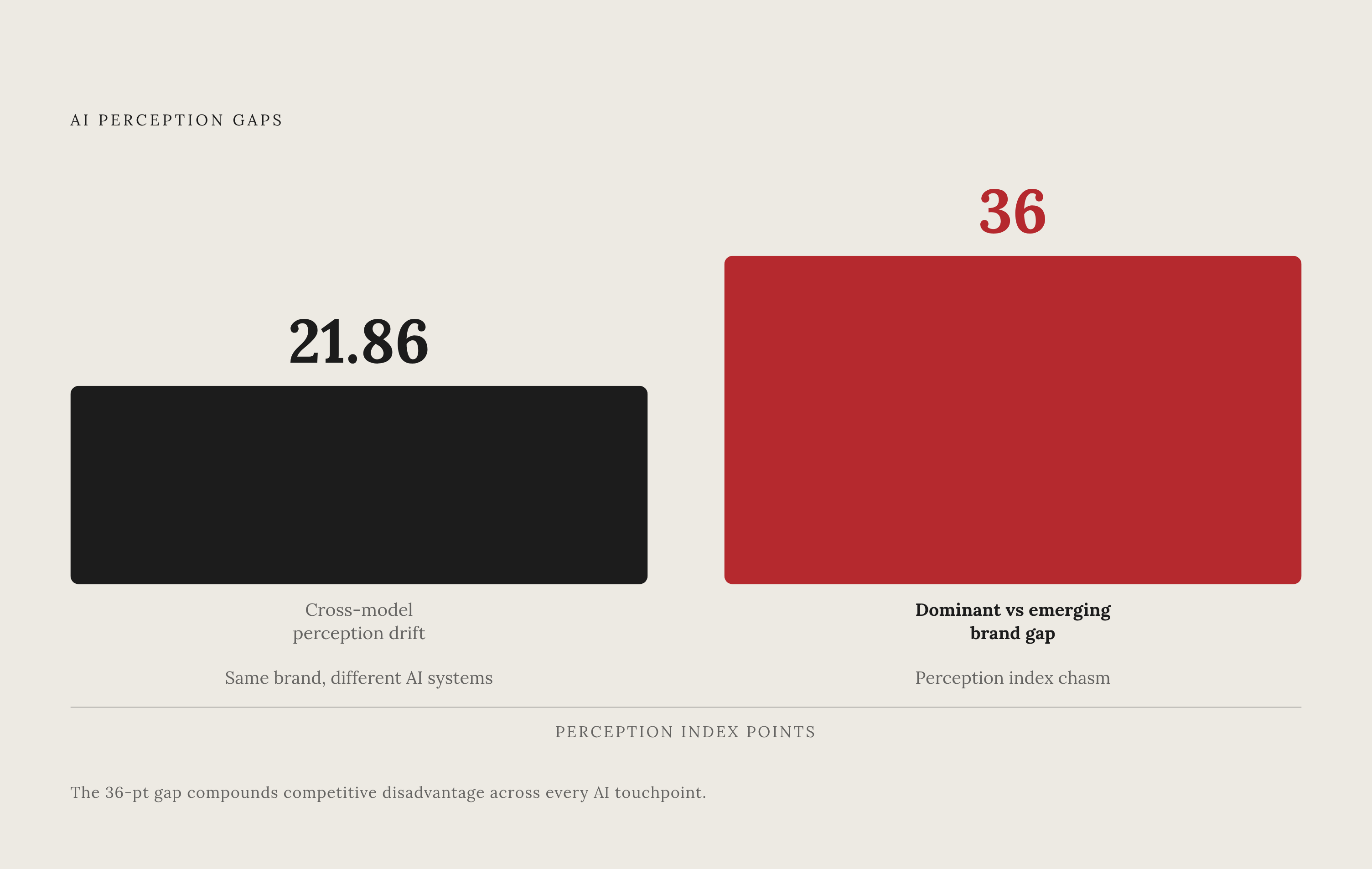
The fragmentation runs on a second axis. It is fragmented across the AI systems themselves. This cross-model perception drift means no single piece of brand content can resolve the incoherence.
The drift is measurable, and it is substantial. The AI Perception Index 2026 reports cross-model perception drift of 21.86 points for the same brand across different AI systems. There is also a 36-point gap between dominant and emerging brands on a multi-point perception index. The findings describe this as validating Perception Control as a category: the discipline of measuring and managing how AI systems semantically represent brands.
The instability exists even within a single system. AI answers for brand-relevant queries are probabilistic, not deterministic. The same question can yield different brands, different orderings, and different characterizations from one query to the next.
The practical consequence is that a brand managing its presence on one AI platform may be substantially misrepresented on another. The attribute accuracy problems compound the issue: AI models may describe a product using outdated pricing, reference deprecated features, or characterize use cases in ways that no longer reflect the current go-to-market strategy. These gaps actively mislead buyers who trust the synthesis.
How the customer's growing reliance on AI recommendations raises the stakes for brands that are misrepresented
Fragmentation would be an academic concern if buyers were not acting on AI outputs. Customers now make consequential purchase decisions on the basis of what AI systems tell them about brands. A brand that is absent from, mischaracterized by, or unfavorably positioned in AI outputs loses buyers it will never have an opportunity to address directly.
Deloitte Digital's 2026 research establishes that as more of the customer journey takes place outside owned channels, brands risk losing pivotal signals. The brand's first opportunity to speak to that customer arrives only after the evaluation has effectively concluded. The customer arrives with a decision, not an open question.
The discovery asymmetry makes this more consequential. Adobe's 2026 AI and Digital Trends report documents that customers are willing to turn to unfamiliar brands if the offer presented to them is compelling. AI-surfaced alternatives are a real competitive threat, because the AI can introduce a brand the buyer has never heard of and that brand inherits the AI's implicit endorsement. This is the trust transfer problem. A brand omitted loses one it may deserve.
Personalization demands compound the stakes. Attentive's 2026 survey of 1,050 shoppers found that shoppers pay attention when marketing reflects what they care about and ignore generic outreach. The brand never learns why.
Why brands cannot see the problem with the tools they currently use
The problem persists because the tools brands rely on are structurally blind to the AI layer. Traffic, rankings, customer surveys, and social listening all measure what happens after a brand has already been selected or dismissed by an AI intermediary. They cannot diagnose the problem that precedes the click.
The measurement gap is fundamental. Traditional click-through rate and ranking signals measure position on a list of ten blue links. Those synthesized answers are increasingly the ones buyers act on. A brand can hold the top organic ranking and still be absent from the AI answer, and no conventional metric will surface that fact.
The journey data gap reinforces the blindness. Deloitte Digital's 2026 research notes that when a consumer arrives via AI-mediated discovery, fewer sessions, page views, and clicks give the brand less data about why the consumer showed up, what led to their decisions, and what might keep them coming back. By the time the customer appears in analytics, the story that shaped their arrival is gone.
The owned-channel blind spot runs deeper. Those are the sources AI systems weight most heavily. A brand can meticulously manage its website and remain ignorant of the conversations shaping its AI representation.
There is also a lag. A product strategy shift you make today will not appear in AI answers for months. In the interim, the AI narrates a version of the brand that no longer exists.
No standard analytics stack captures any of this. KPIs like Share of Model, defined as how frequently and favorably a generative AI mentions a brand in response to relevant category prompts, are not instrumented in any conventional tool. Most brands have no read on this dimension at all. They are flying blind over the most consequential surface where their brand is being defined.
What measuring AI perception actually requires, and what it reveals
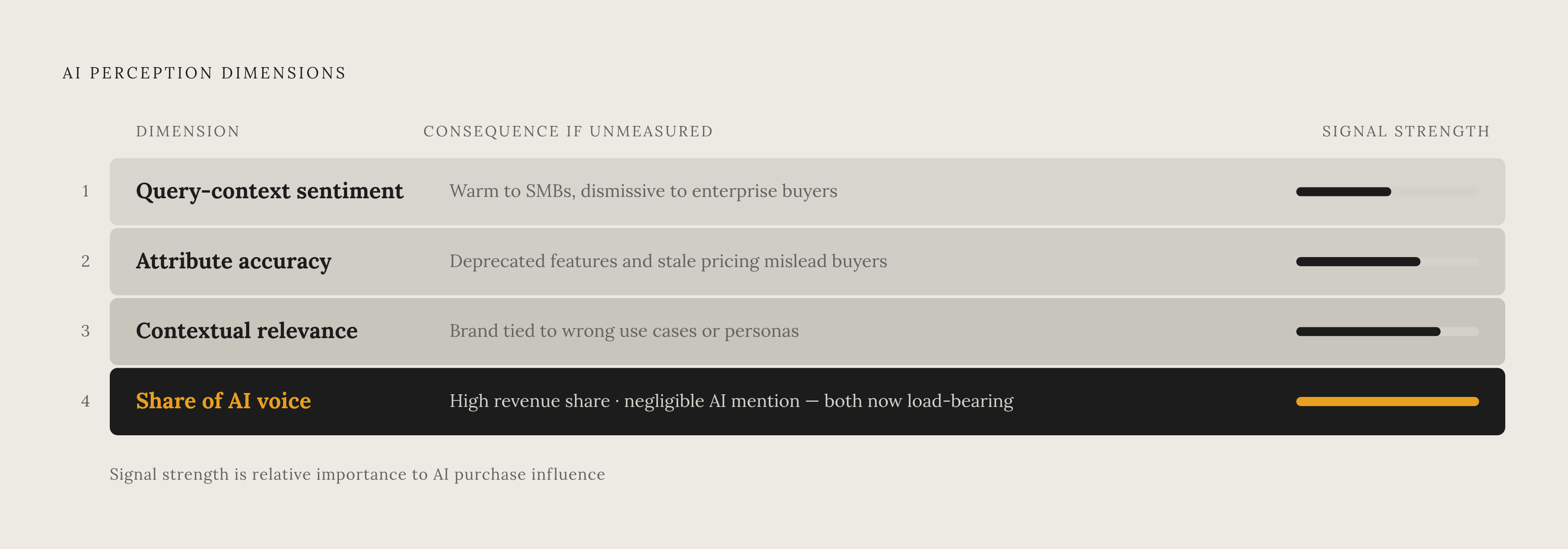
Closing the gap requires a different kind of measurement. A multi-dimensional, cross-model approach must systematically probe how AI systems characterize a brand across query contexts, compare those characterizations to competitors and to factual accuracy, and distinguish static from dynamic brand associations. None of that can be accomplished with a single-platform or single-metric approach.
Four operational dimensions matter. The same brand may be warm in a small-business query and dismissive in an enterprise one. Both are the AI's real output, and both shape buyer decisions.
The second dimension is attribute accuracy. Deprecated features and outdated pricing are common in AI answers, and they directly mislead buyers. A buyer who trusts the AI's description of a product's capabilities may arrive at the brand expecting something the brand no longer sells.
The third is contextual relevance: which use cases and buyer personas the AI connects the brand to. A brand may be well-represented for one use case and absent from another it serves equally well. The AI's associations define where demand can find the brand, independent of where the brand itself claims to operate.
The fourth is share of voice in synthesized answers: how often the brand is named, versus competitors, in AI responses to relevant category queries. A brand can hold significant market share in revenue but negligible share of AI voice. The two measures are now both load-bearing.
How brands can improve their AI perception once they can see it
Improvement follows from measurement. The interventions that move AI perception are distinct from SEO, because they target the signals AI systems actually weight. Off-site authority, structured content legibility, and the quality and recency of third-party corroboration are the levers that do the work.
Off-site presence is the primary lever. Expert bylines on authoritative publications, practitioner coverage, and review-platform profiles all shift how AI systems characterize a brand. The work is relational rather than transactional, and it compounds.
Structured data and content freshness matter at the mechanical level. The practical implication is that AI-visible content requires an active maintenance cadence, not a publish-and-leave approach. A page that was optimized once and forgotten is a page the AI will eventually stop representing.
Community and review platform presence deserves equivalent weight. Ignoring them is not a resource decision. It is abandonment of the primary source.
Narrative consistency across sources builds stability. AI encodes associations from patterns across many sources, so a brand whose expert positioning appears consistently across authoritative external publications builds stronger, more stable AI associations than one whose presence is concentrated on its own channels. Consistency across third-party sources functions as corroboration. It tells the model that the brand's positioning is a consensus fact, not a marketing claim.
Timing is the final constraint. AI perception lags publication by months, so interventions made today will not surface in AI answers immediately. Brands that wait until AI misrepresentation becomes visible in lost deals are already operating months behind. The practical sequence is score, diagnose, intervene, and the brands that manage AI perception effectively are the ones that instrument it before they try to improve it.
The scope of the shift is now clear. Deloitte Digital's 2026 research frames it directly: product pages, posts, and campaigns must be visible, understandable, consistent, and credible not just to customers but to the AI systems now informing them. Brands that optimize only for human readers are leaving the AI audience unaddressed. The AI audience is no longer a smaller audience. It is the audience that arrives first, decides early, and rarely visits the brand's own channels at all.