Customer Retention Economics When AI Personalizes Competitor Offers
Competitors can now poach customers faster than your retention tools even notice they're at risk.

Keeping a customer still beats acquiring one by a wide margin. Acquiring a new customer costs 5 to 25 times more than keeping one, and that arithmetic has not changed. What has changed is the mechanism of loss: competitors can now identify a customer's switching readiness and deliver a tailored offer before the incumbent's retention stack even registers the risk. The economics are fixed. The speed and precision of the threat are not.
Why retention's fundamental math still holds, and why that makes AI-powered competitor targeting so dangerous
The acquisition-versus-retention cost gap is not new. The profit multiplier behind retention has been repeated so often it has become axiomatic. What gives it new strategic weight is the shift in friction on the competitor side of the equation. Competitors can now act on switching intent faster than incumbents can detect it, which means the cost of losing a customer has not changed but the probability of losing one has risen sharply.
Rebuy/Stay.ai's 2026 analysis frames the problem precisely. Acquisition costs are climbing while sustainable success depends on retention, yet the tools competitors use to poach are now the same tools incumbents use to retain. This is the asymmetry that matters. The cost of losing a customer has always been high, but the speed at which a competitor can engineer that loss is now measured in real-time behavioral signals, not weeks of passive comparison shopping. Any mechanism that accelerates loss becomes economically catastrophic even when the underlying unit economics remain unchanged.
How AI has changed the mechanism of loss, not just the speed of it
Traditional retention was reactive. A cancel event or a support escalation triggered a response, and the win-back offer arrived after the customer had already decided to leave. AI-powered competitor targeting now intervenes before churn instead of after it, in a window the incumbent's own retention stack typically cannot see. The competitor's AI now acts upstream, identifying switching readiness from behavioral signals before the customer has consciously decided to leave.
This is the shift Rebuy/Stay.ai describes as the move from "reactive measures (like post-cancel discounts) to predictive strategies that anticipate a customer's intent to cancel and can prevent it." The logic is symmetrical: the same predictive infrastructure that powers retention tools is equally available to acquisition-hungry competitors. Dynamic offer orchestration means a competitor does not need a lower price. It needs better timing and better signal interpretation. A competitor's AI reading price-sensitivity signals, engagement decay, and comparison-shopping behavior can construct a tailored offer, a right-sized plan, a waived fee, proactive outreach, before the incumbent's system registers churn risk.
Consider the switching barrier that once protected incumbents structurally: integrations, data portability, political capital. These moats are weakest precisely where AI adoption is newest. AI-native products have portable prompts and standardized integration connectors, so the lock-in that kept customers for years dissolves the moment a customer starts experimenting with AI workflows. The mechanism of loss has been redesigned, not merely accelerated.
Where AI personalization extracts the most switching leverage: the signals competitors read
A competitor's AI does not need access to your CRM. It reads publicly observable behavioral and perception signals that indicate switching readiness, making your brand's visible credibility a direct input to a rival's targeting model. The behavioral signals that feed competitor AI are specific and legible: skipped or deferred renewals, declining engagement frequency, comparison-shopping queries, support escalations that go unresolved, and category-level research behavior. Each of these is a broadcast.
Capillary's December 2025 analysis identifies the new loyalty signals AI can read at scale: what customers browse, whether they review, which content they return to, how they engage in brand communities. These are micro-behaviors that precede a transaction decision by weeks. The implication is uncomfortable for any brand that treats perception as a soft metric. A brand that is losing topical relevance, accumulating unresolved review sentiment, or delivering inconsistent messaging is broadcasting switching readiness to any sufficiently capable competitor AI.
This is the bridge between retention economics and perception intelligence. A brand's AI-readable credibility signals are not just a marketing concern. They are a competitive vulnerability. The data asymmetry compounds the problem. Brands that have not built compliant zero-party and first-party data collection, preferences, intent signals, behavioral history, cannot match the personalization precision of competitors who have. Privacy regulations and tracking limitations have pushed forward-thinking brands toward zero-party data strategies, as Rebuy/Stay.ai notes, and the brands that collect this data defensively retain the ability to out-personalize a competitor's offensive play.
Why AI discovery has made brand perception a retention variable, not just an acquisition one
When a customer at switching risk turns to an AI system for a recommendation or comparison, the outcome is determined by how that AI has evaluated and encoded both brands. This makes AI-readable brand perception a direct factor in whether retention holds or breaks. LLMs evaluate brands without emotional loyalty. They weight how often a brand appears in authoritative sources, the sentiment of those mentions, how well the brand fits the specific query context, and how legible the brand's structured data is. None of this correlates automatically with how long a customer has been with the incumbent.
The gap between human brand perception and AI brand perception is empirically documented. A brand a human consumer rates highly may be ranked substantially lower by LLMs evaluating the same category, because AI models weight authority signals and content consistency rather than accumulated emotional association. This divergence is already visible in marketing research, and it has specific consequences in retention. Attribute accuracy matters specifically in the switching moment. If an AI system describes a competitor's product using current positioning and describes the incumbent using outdated features or pricing, the comparison works against the incumbent even if the incumbent's actual product is superior. The customer never sees the true comparison. They see the comparison the AI constructed from stale or incomplete data.
How AI-mediated discovery reshapes the competitive window during a switching event
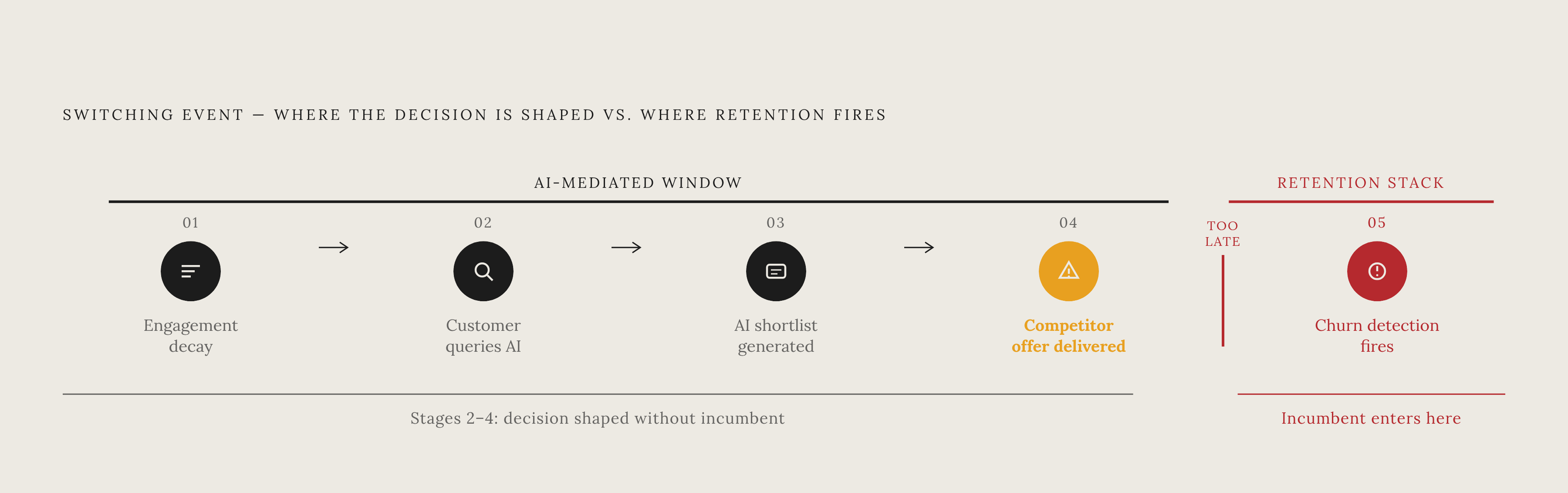
A customer's switching journey now passes through an AI layer that neither the incumbent nor the competitor fully controls, and the brand with better AI-readable signals wins that moment regardless of the underlying product comparison. The typical sequence unfolds in a predictable order: engagement decay, then a comparison query to an AI system, then an AI shortlist of alternatives, then a competitor's personalized offer, and only then does the incumbent's churn detection fire. By that point the decision has been made.
The incumbent's retention stack is usually triggered by a cancel action or a support ticket, events that occur after the AI recommendation has already done its work. The structural disadvantage is not in the quality of the retention tooling but in its position in the sequence. Citation source volatility compounds the problem. The sources an AI engine cites when answering a comparison query change frequently, meaning a brand's AI-readable presence is not a stable asset. It requires continuous management, not a one-time optimization.
Engine-level differences create additional complexity. A brand's representation varies meaningfully across different AI systems because each weights different source types. What performs well in one AI environment may underperform in another, and a customer's choice of AI tool determines which representation they encounter. Subscription and SaaS contexts are where the timing asymmetry is sharpest. Renewal windows, plan-comparison moments, and feature-evaluation queries are all natural occasions for AI-mediated discovery, and they recur on predictable cycles a competitor's AI can anticipate. Rebuy/Stay.ai describes real-time behavior triggers as the evolution from batch campaigns to intent-driven interactions. The same infrastructure that enables retention intervention enables competitor interception at the same moments.
What incumbents' retention stacks miss when they are not measuring AI perception
Retention stacks built for behavioral signals and CRM data cannot see or fix the AI-perception vulnerabilities that decide outcomes in the switching window. The gap is not in execution but in measurement. Conventional churn prediction reads login frequency, feature usage, support contact, purchase history, and engagement decay. None of these signals reveal how the brand is being represented in AI-mediated comparison queries a customer is running in parallel.
A brand can have a fully operational churn prediction model and simultaneously be underrepresented, mischaracterized, or outcompeted in the AI layer where switching decisions are being shaped. These are orthogonal systems with no natural integration. The four dimensions of AI brand perception that retention stacks do not track are specific and measurable in principle: sentiment across query types, attribute accuracy against current positioning, competitive position in AI-generated shortlists, and share of voice in AI-mediated category discussions. Attribute accuracy gaps are a particular retention risk. If an AI system describes the incumbent's product using deprecated features, outdated pricing, or a use case that no longer matches current go-to-market, that misrepresentation actively supports a competitor's offer at the moment the customer is comparing. The measurement problem is structural. A brand can hold top organic search position for a competitive keyword and still be underrepresented or negatively characterized in AI-generated responses. The ranking signal and the representation signal are not the same metric.
Building a retention posture that accounts for AI perception: what measurement must cover
Closing the retention gap that AI-powered competitor targeting has opened requires measuring perception across all three evaluation audiences: algorithms, AI systems, and humans. A gap in any one of them is an exploitable vulnerability at the switching moment. The foundational principle is that measurement must precede optimization. A retention team that cannot score its AI-readable brand presence cannot know whether a competitor's AI has a structural advantage in the switching window.
What a complete AI-perception measurement framework covers is a defined set of signals. First, mention rate and share of voice across AI engines: how often and prominently the brand appears in AI-generated responses to category queries. Second, sentiment by query type: whether AI describes the brand differently on general recommendation queries versus direct comparison queries, which is where switching decisions are being made. Third, attribute accuracy: whether AI systems describe current features, pricing, and positioning accurately, or are encoding outdated or incorrect information that disadvantages the brand in comparisons. Fourth, competitive position in AI shortlists: whether the brand appears in the three-to-five-brand consideration set AI engines surface for category queries, and where it ranks relative to likely competitors. Fifth, cross-model consistency: whether brand representation is stable across different AI systems or whether significant perception drift exists between platforms a customer might use.
Peec AI, the Berlin company that launched its brand perception feature on September 17, 2026, introduced a suite that tracks market prominence and association scores, objections AI models raise against a brand when a buyer is weighing options, and fact-checking of specific claims against registered facts. This is the type of AI-perception instrumentation that complements behavioral retention tooling. Continuous monitoring is required, not periodic auditing. Citation sources in AI systems churn frequently, so a brand's AI-readable presence can degrade between measurement cycles without any change in the underlying product or marketing activity.
Why AI-era retention requires managing both behavioral signals and perceived credibility in parallel
Winning the retention battle in an AI-mediated market requires operating on two fronts simultaneously: the behavioral signals that predict churn, and the perception signals that determine which alternative a switching customer encounters and trusts. The two tracks are not alternatives. They operate at different points in the switching sequence. Behavioral retention tooling fires when engagement signals decay. AI-perception management determines what the customer finds when they go looking, which happens before behavioral signals have fully materialized.
Capillary's 2025 analysis frames behavioral loyalty as something expressed through thousands of micro-behaviors before a transaction. Brands that read and respond to those signals retain customers. Brands that also ensure their AI-readable presence is accurate and credible close the gap where competitor targeting operates. The companies most exposed to AI-powered competitor targeting are those with strong behavioral retention infrastructure but no visibility into how AI systems represent them. They are optimizing the second half of the problem while leaving the first half uncontested.
The practical sequence is straightforward in principle. Measure AI perception to establish a baseline. Identify attribute accuracy gaps and shortlist presence. Correct those gaps through content and authority signals. Then monitor continuously, because the AI-readable environment shifts faster than a periodic audit can capture. The retention economics that opened the argument are now also the argument for investing in AI-perception management. Keeping a customer beats acquiring one, and if the switching decision is partly made in an AI-mediated discovery layer, then any investment that improves how the brand is represented in that layer is a retention investment, not just a brand or marketing one. The math has not changed. The mechanism has, and the companies that recognize the mechanism is now dual-track, behavioral and perceptual, are the ones that retain customers in the AI era.