Share of AI-Generated Answers as a Brand Metric
Brands disappear from discovery when AI synthesizes answers instead of listing links.

Share of AI-generated answers measures something traditional rank tracking was never built to see: whether the large language models sitting between a buyer and a decision, the most influential evaluators in modern discovery, name a brand at all. A keyword ranking tells you where a page is in a list of links, while an AI-generated answer produces a synthesized response in which a brand either appears or doesn't. An AI-generated answer doesn't have a list. It has a synthesized response, and a brand either shows up inside it or it doesn't.
That distinction sounds semantic until you follow the money. Losing a ranking position costs clicks, some percentage of traffic that would have landed on a page. Losing a spot in an AI answer can cost the entire consideration moment, because the answer frequently satisfies the user's intent without anyone clicking anywhere. There's no runner-up prize for being technically indexed if the model never says your name.
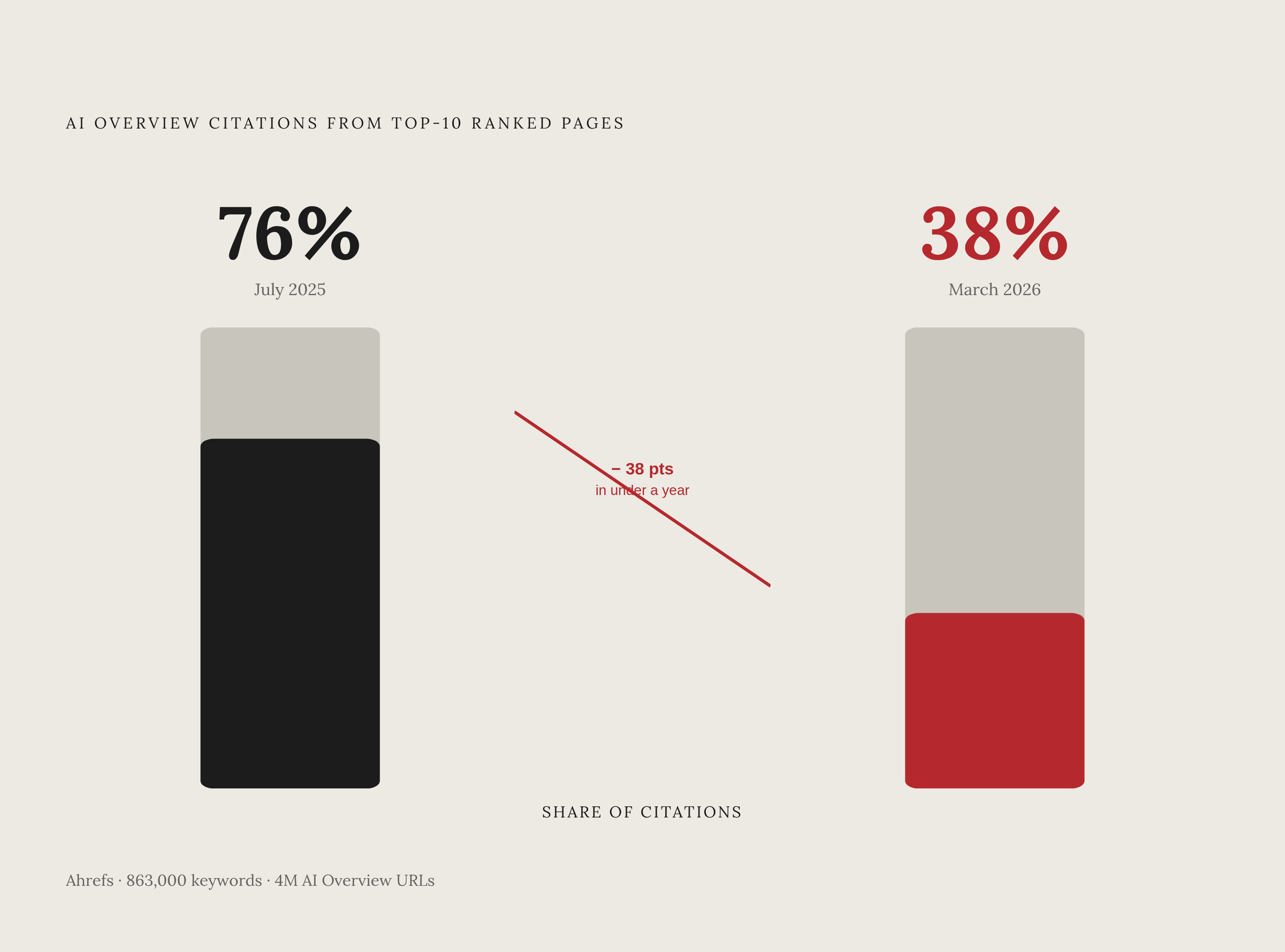
The decoupling between ranking and citation is no longer a theory floated by SEO consultants trying to justify a new line item. Ahrefs analyzed roughly 863,000 keywords and 4 million AI Overview URLs and found that the share of AI Overview citations pulled from top-10 ranked pages fell from about 76% in July 2025 to around 38% by March 2026. That's a structural break in the relationship between ranking well and getting cited. Layer onto that a second finding: only 11% of domains cited by ChatGPT overlap with domains cited by Perplexity.
This piece works through what actually measures the second one, what it leaves out, and how to build a tracking process that survives contact with reality across platforms.
What AI answer share measures
AI Share of Voice, AI SOV for short, is defined as the percentage of AI-generated responses in a given category that mention a brand. The formula is straightforward on its face: brand mentions divided by total brand mentions across a tracked set of prompts, multiplied by one hundred. It measures two distinct sub-types that capture different trust mechanisms, per Cassie Clark's taxonomy.
Cassie Clark's taxonomy splits the metric into two distinct sub-types, and each half tracks a different trust mechanism. Entity-based AI SOV counts how often a brand shows up as a recognized entity in recommendation-style prompts, the "recommend," "best," "top providers" phrasing. It reflects recall, whether the model has absorbed the brand as a known thing, and it's calculated as brand entity appearances divided by total entities listed. Citation-based AI SOV instead tracks how often a brand's own content gets cited as a source inside a synthesized informational answer, calculated as brand citations divided by total citations, times one hundred. That one reflects influence and content trust rather than recall.
These two numbers can diverge sharply for the same brand. A company might be recalled constantly as an entity, the model knows the name and recommends it, while its actual content rarely gets cited as a source. Or the reverse: content gets pulled into answers all the time, but the brand itself never gets named as a recommendation. Each gap points to a different fix, and conflating the two numbers into one figure hides which problem you actually have.
What AI SOV does not measure deserves equal emphasis. It says nothing about citation depth, nothing about whether the recommendation was flattering or lukewarm, nothing about sentiment, and nothing about whether the mention actually moved someone toward a purchase. Those require companion metrics, covered in later sections. The AI Visibility Score is a weighted roll-up combining mention presence, citations, recommendations, and source absorptions across every tracked model, divided by total weighted visibility across all tracked brands, and is a composite figure distinct from raw SOV. That's a different construct, expressing overall standing rather than breadth in a single category. The metric should not be conflated with its optimization: AI SOV is the measurement side of GEO (Generative Engine Optimization), with improvement tactics constituting a downstream discipline.
The scale of the shift that makes this metric urgent
The volume behind these numbers isn't a rounding error. AI search visits grew an estimated 42.8% year over year between the first quarter of 2025 and the first quarter of 2026, climbing from 15.6 billion to 27.4 billion AI Share of Voice: Tracking Brand Citations in AI Answers. Roughly 33% of US consumers now turn to an AI tool at the exact moment they're discovering a product, which happens to be the moment AI SOV carries the most commercial weight AI Share of Voice: Tracking Brand Citations in AI Answers.
Set against that growth, the measurement gap looks almost reckless. Only 14% of marketers currently track AI citations, even though 43% name AI search optimization a core strategic priority for 2026 AI Share of Voice: Tracking Brand Citations in AI Answers. The work has run well ahead of the measurement, and organizations are investing in a discipline they can't yet verify. A 2026 AI SEO report from Fuel Online, analyzing enterprise brands with substantial traditional SEO budgets, found the majority of them invisible to generative AI models despite that investment.
AthenaHQ's State of AI Search 2026 report found the average brand mention rate across AI answers is just 17.2%, while top-performing companies reach dramatically higher rates. Most brands are crowded into a thin bottom tier, competing for scraps of visibility while a small group of outperformers captures most of the mentions. And the organizational response hasn't caught up either. Forrester's B2B Summit data found that 70% of marketers say AI visibility is a top CMO/CEO priority, yet only 30% have defined a discrete owner for answer-engine visibility. The strategic urgency and the operational ownership are badly mismatched.
Taken together, these figures establish that AI SOV is a business indicator operating at scale, not an experimental curiosity. That's why the measurement methodology, covered in the sections ahead, needs the rigor of an actual KPI rather than the shrug of a vanity metric.
Why AI systems behave as endorsers rather than directories
Traditional search environments select from a fixed catalog and rank it. Large language models do something categorically different: they generate a small set of brand recommendations at the moment a prompt is asked, constructing the competitive set on the fly rather than pulling from a pre-built list. Call it emergent choice architecture. The practical consequence is that brand exposure is less transparent, and less predictable, than a search ranking ever was.
That construction changes what a mention actually signifies. When a model names a brand as a good option, it's staking its own credibility on that recommendation, and the answer set it offers is typically one, two, or at most a handful of brands, not ten links to sort through. The AI has stopped acting like a matchmaker introducing every plausible option and started acting like an advisor, willing to vouch for a short list.
Advisors, by nature, are conservative. The smaller the recommendation set, the more consequential each inclusion becomes, and the more consequential each exclusion becomes too.
There's a further complication. The AI Perception Index 2026, published by Tugtekin on SSRN in February 2026, found a 36-point gap in Model Perception Index scores between dominant brands and emerging ones, along with cross-model perception drift reaching 21.86 points for the identical brand evaluated across different AI systems. A brand can look meaningfully different depending on whether ChatGPT or Claude is doing the describing AI Perception Index 2026. The implication is uncomfortable for anyone hoping for a single, stable read on brand perception: no such single fact exists. What exists instead is a set of overlapping but divergent evaluations happening simultaneously, which is the reason multi-engine tracking isn't optional, it's the whole point. And the signals these systems weight to arrive at those evaluations aren't the old SEO signals. Clarity, structural consistency, corroboration from independent third-party sources, and how easily a claim can be extracted and reused semantically, these are what authority gets inferred from now, not a domain rating pulled from a toolbar.
Owned content's limited role in the citation ecosystem
Community platforms carry an outsized share of that weight. Roughly 48% of citations trace back to community platforms such as Reddit and YouTube, and in early-stage brand discovery within commercial search, about 85% of brand mentions originate from domains the brand doesn't control AI Share of Voice: How to Measure Brand Presence in AI. The Machine Relations Index confirms this pattern holds by question shape, not just in aggregate. YouTube is one of six domains, alongside arXiv, Reddit, Medium, LinkedIn, and a single data-governance vendor, that appears across more than one buyer question shape's top ten results. Reddit is in the top three for four of the six shapes tracked. Past those two, the leaderboard reshuffles completely depending on the question type; no other single domain holds consistent dominance.
Sector matters here too, and the variance is wide. Healthcare shows roughly 75% overlap between AI Overview citations and organically ranked content, but finance drops to just 11% overlap, meaning nine out of ten AI citations in finance come from sources that never appeared on page one of a traditional search. Freshness compounds this: content that isn't updated on a regular schedule is materially more likely to fall out of the citation pool, while sequential headings and well-built schema correlate with citation gains.
The practical upshot reframes the whole optimization conversation. Improving AI SOV isn't a publishing exercise aimed at the brand's own domain; it requires managing earned media, cultivating third-party presence, and structuring content so models can extract and reuse it. Measurement has to follow the same logic and look well beyond the brand's own site. Third-party content is the dominant citation source: third-party content gets cited by AI search roughly 3× more than company websites, per Calla Creative's analysis; separately, research found 91% of AI-generated answers cite third-party content rather than brand websites. Brands are 6.5× more likely to earn AI visibility via third-party sources than through owned content alone (AI Share of Voice: How to Measure Brand Presence in AI).
The formula choices that change what you're measuring
Citation-based SOV measures content influence rather than entity recall.
The same brand, on the same underlying data, can score 20% mention-based, 16.8% position-weighted, and 31.4% citation-based, all at once. Each number is a correct answer to a different question, and reporting just one without naming which formula produced it invites confusion at best and false confidence at worst.
Prompt shape compounds the problem. The Machine Relations Index organizes its tracking around six buyer question shapes, applied consistently across its subject categories: best tools, how buyers choose, is it worth it, problem-first research, top lists, and comparisons. Observed runs per shape range from roughly 100 to over 130, and each shape produces anywhere from 101 to 4,025 distinct cited domains. Pool all of that into a single number and the result weights whichever shape happened to run most often, not whichever shape actual buyers rely on most. The research is blunt about the fix: report six numbers and a roll-up, never a single pooled figure, and hold each shape's denominator separate.
Denominator discipline extends further than that. The denominator, total citations across all tracked brands for a defined prompt set, has to be fixed before data collection starts. Skip that step and two teams can report "AI SOV" from the same engines on the same day and land on entirely different numbers, simply because their prompt libraries leaned toward different question shapes. And even a well-built number should carry a caveat: cited domain sets drift somewhere between 40% and 60% month over month in active categories, so a single reading is a snapshot, not a verdict AI Share of Voice: The Ultimate GEO Metric for 2026. There are three competing formula types, each answering a different question. Mention-based (breadth) is calculated as brand mentions ÷ total brand mentions across tracked prompts × 100, the most common approach, measuring whether the brand surfaces at all.
Building a minimum viable measurement system across platforms
Tracking a single engine and calling it done is the most common shortcut, and it's the wrong one. Only 11% of domains cited by ChatGPT overlap with domains cited by Perplexity, so a tool that watches one platform hands back a misleading sense of completeness. Each engine weights its inputs differently: Perplexity draws from the widest domain set and leans heavily on recency, Gemini pulls from Google's index and YouTube, and ChatGPT's overlap with Google's own organic top ten is minimal. Add the 21.86-point cross-model perception drift from the AI Perception Index 2026, and a single-engine audit can misrepresent a brand's overall standing by a wide margin.
Building the prompt library well matters as much as covering the right platforms. The prompts should mirror how a real buyer talks, not the keyword list a marketing team already has lying around, and they should be stratified across the six buyer question shapes so the results aren't quietly biased toward whichever shape was easiest to write.
The calculation itself, per platform, is brand citation count divided by total citations across all brands on that platform, times one hundred, tracked separately per engine and again as an aggregate so gaps by platform stay visible instead of getting averaged away. Sampling discipline matters just as much as the formula. Each prompt should run at least twice per session and get averaged, because LLM output varies between sessions even when nothing else has changed. Only 30% of brands stay visible from one answer to the next, and just 20% remain present across five consecutive runs of the same prompt AI Brand Mentions Are Replacing Share of Voice. A single lucky run tells you almost nothing.
Cadence needs to match how fast the underlying data moves. Cited domain sets shift 40% to 60% month over month in active categories, which makes weekly tracking the floor for anything a team wants to act on AI Share of Voice: The Ultimate GEO Metric for 2026. There's also a structural reason AI SOV deserves to be treated as a leading indicator rather than a nice-to-have: as much as 70.6% of AI-influenced traffic may arrive with no attribution at all, since several major AI platforms pass no referral data downstream. Referral analytics will eventually confirm what's happening, but only after the fact, and only partially. AI SOV is the number that sees it happening in real time. At the scale weekly, multi-engine tracking demands, manual prompt-running becomes impractical fast, and automation is the only realistic path; platforms including Evident can run standardized prompt sets across engines and return per-platform and aggregate AI SOV trended over time. A minimum viable measurement system should build 20–50 prompts that represent actual buyer queries, mixing informational ("what is the best X for Y"), comparison ("X vs. Y"), and recommendation ("recommend a tool for Z") shapes.
AI answer share within a complete brand health framework
Brand perception monitoring in 2026 runs across five surfaces: reviews, search results, news, social, and AI answers. AI answers remain the surface most likely to carry an inaccurate or incomplete picture of a brand, and the one least likely to be watched at all.
AI SOV, on its own, only measures breadth, whether a brand appears across a defined set of prompts. A complete picture needs companion metrics working alongside it. Share of Citation adds the depth dimension: what percentage of AI answers in a category actually cite the brand as a source, rather than simply naming it in passing. LLM perception drift tracks month-to-month change in how models describe and reference a brand, capturing stability rather than raw presence. And the composite AI Visibility Score ties mentions, citations, recommendations, and source absorptions together across every tracked model into one weighted figure, expressing overall standing without erasing the shape of the underlying data.
Brands that earn both mentions and citations show up again across future answers at a materially higher rate than brands earning just one or the other. Presence and citation aren't substitutes for each other; they compound. A brand chasing entity recall while ignoring content citation, or the reverse, is optimizing half the mechanism and wondering why the other half stays flat. Review signals still belong in the wider framework too, though their diagnostic value has shifted: tracking how fast reviews accumulate, rather than the raw total sitting on a profile, now says more about a brand's current trajectory than its historical volume ever did.
Sources
- AI Share of Voice: The Ultimate GEO Metric for 2026
- AI Share of Voice: Tracking Brand Citations in AI Answers
- AI Share of Voice: How to Measure Brand Presence in AI
- AI Share of Voice: How to Measure It in 2026 – Cassie Clark | AI Search Visibility Consultant + AEO/GEO Services
- AI Brand Mentions Are Replacing Share of Voice
- AI Perception Index 2026 How Large Language Models Position Brands in the AI Era by Faruk Tugtekin :: SSRN