Customer Lifetime Value Modeling When AI Accelerates Competitive Switching
AI-driven discovery is making traditional customer lifetime value models dangerously obsolete.

The core assumption behind customer lifetime value has always been simple: the customer sitting in your database today will behave, tomorrow, roughly the way similar customers behaved last year. AI-driven discovery breaks that assumption, and most companies haven't caught up to it. When a shopper can ask a chatbot for alternatives and get a ranked, reasoned answer in ten seconds, the friction that used to keep CLV models honest disappears. The models built for a slower world aren't wrong so much as outdated, and they're quietly overstating how long customers actually stick around.
The AI discovery layer reshaping customer consideration
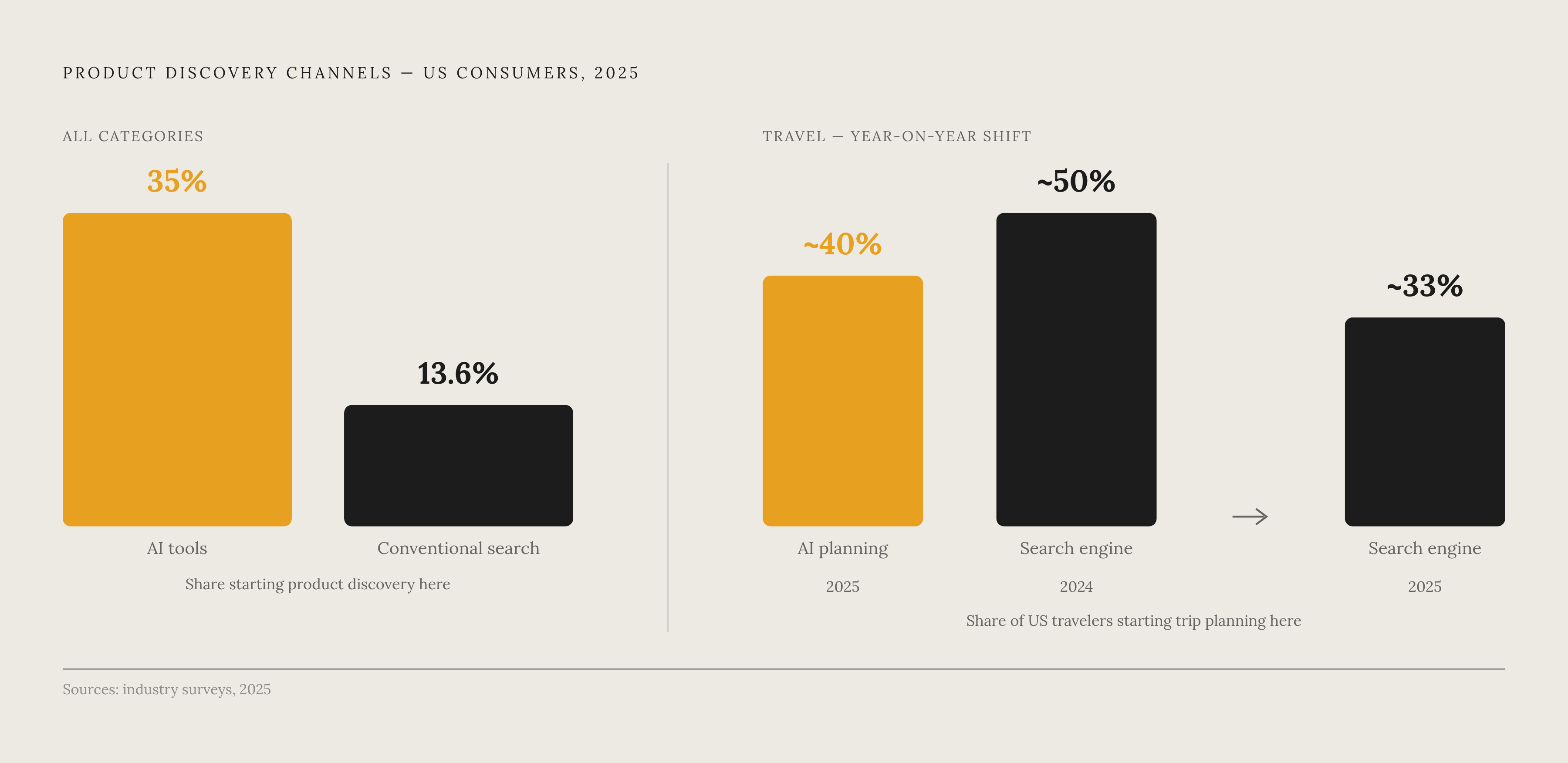
Roughly 35% of US consumers now use AI tools at the product discovery stage, compared to 13.6% who still start with conventional search. That gap is the whole story: the tool people reach for first has changed, and it changed fast enough that most retention models never got the memo. ChatGPT draws over 800 million weekly users, making it a major presence in the discovery landscape. It's a relocation of where buying decisions start.
Travel makes the timeline concrete. Around 40% of US travelers used a generative AI tool to plan a trip in 2025, up sharply from the year before, while the share who started planning at a conventional search engine dropped from roughly half of travelers to roughly a third over that same stretch. A category can flip its dominant discovery channel inside a single year. Anyone still assuming customer habits move slowly should sit with that fact for a second, because the evidence says otherwise.
The mechanics matter as much as the adoption curve. A search engine hands back ten blue links and lets the user sort through them. An AI assistant names one to three brands and explains, in a confident voice, why those are the right ones, which is closer to an endorsement than a listing. That changes what "being found" means for a competitor trying to poach a customer. A Gartner survey found that 69% of B2B buyers still want to check an AI-generated answer with a human sales rep before committing, but that number cuts the other way too: the AI has already built the shortlist by the time a salesperson gets on the phone. The human conversation is a confirmation step now.
What breaks inside the CLV model as switching becomes frictionless
Three assumptions hold up most CLV formulas, simple or advanced, and all three take damage once discovery moves this fast.
Start with churn treated as a historical constant. Standard models take a trailing churn rate, the pace at which customers defected over some past window, and use it to set expected customer lifespan going forward. That works fine when the causes of defection stay stable. AI-accelerated switching produces sudden, cohort-level drop-off, and the trailing window has already booked that damage as normal by the time it appears in the data. Improvado's guide on CLV modeling makes a related point: once a business goes through a real pivot, CLV built on pre-pivot data can miss the true number by 50% or more in either direction. AI-driven discovery counts as exactly that kind of pivot, and by 2026 it applies broadly across categories.
Then there's the behavioral signal set used to flag at-risk customers: login frequency, support tickets, browsing patterns, purchase cadence. Those signals catch a customer who's already halfway out the door. They catch nothing on a customer who opens a new tab, asks an AI assistant to compare their current vendor against three alternatives, and gets a clean answer favoring someone else. That customer isn't logging in less, isn't emailing support, and isn't price-shopping on your own site where your analytics could see it happen. The model reads them as low risk at the exact moment they're most exposed. That's the blind spot the whole model is built around. It's the blind spot the whole model is built around.
The competitive set stops being fixed, too. Traditional CLV models get calibrated against known rivals, the companies your sales team has lost deals to before, the ones that show up in win-loss data. AI tools don't respect that history. They'll surface a two-year-old competitor with strong AI visibility and thin traditional market share right alongside the incumbents everyone already tracks. The competitive set your model assumes and the one an AI assistant actually puts in front of your customer can be two entirely different lists, and most companies are still building retention strategy against the wrong one.
AI perception of your brand as a CLV input
If AI systems are the channel through which competitors reach your customers, then how those systems talk about your brand belongs in a retention model, not a marketing deck. Large language models like ChatGPT, Claude, Gemini, and Perplexity build their answers out of citations: third-party web pages, encyclopedia-style entries, local business listings, and other sources the model treats as evidence. Whatever a brand publishes about itself carries far less weight in that process than what independent sources say about it, and that asymmetry is the whole game now.
A Fuel Online AI SEO report, looking at roughly a thousand enterprise brands, found that 62% of them were invisible to generative AI models, even though 94% of those same companies had put real money into traditional SEO. Spending on the old discipline doesn't buy visibility in the new one. These are different systems running on different rules, and doing well at one says almost nothing about doing well at the other.
The pace of adoption inside a single use case shows how fast this exposure grows. The share of people using AI tools to find local businesses jumped from 6% to 45% in a single year. That makes AI the fastest-growing channel through which a brand's reputation gets built, and, by extension, the fastest-growing source of switching risk that most CLV models still don't measure.
The credibility signals that determine whether AI systems recommend or overlook a brand
AI systems don't evaluate brands the way a person skimming a homepage does. They lean on three kinds of trust signal: how clear and consistent the organization is as an entity across the web, how much credible outside sources vouch for it through citations and coverage, and basic technical markers like security, load speed, and accessibility.
Research into AI Overview ranking factors finds that around 96% of citations come from sources carrying strong E-E-A-T signals (experience, expertise, authoritativeness, trustworthiness). Pages recognized as containing 15 or more distinct entities show a selection probability several times higher than pages without that density, and entity richness is something a brand can actually count and go improve, unlike vaguer notions of "brand strength."
Earned coverage beats owned content in this system, consistently and by design. Retrieval-based AI search tools trust sources that third parties already trust, not sources that simply talk about themselves at length. AI systems rank entities, not pages, and what makes an entity credible to an algorithm (consistent naming, verifiable facts, a web of independent references) is a different set of properties than what makes a page persuasive to a human reader. Optimizing for one doesn't hand you the other for free, and brands that treat AI visibility as an SEO afterthought will keep losing ground to competitors who treat it as its own discipline.
Rebuilding CLV inputs to account for AI-driven switching risk as a structural variable
The fix starts by treating AI-driven switching as a structural feature of the model, not an exception patched in after the fact.
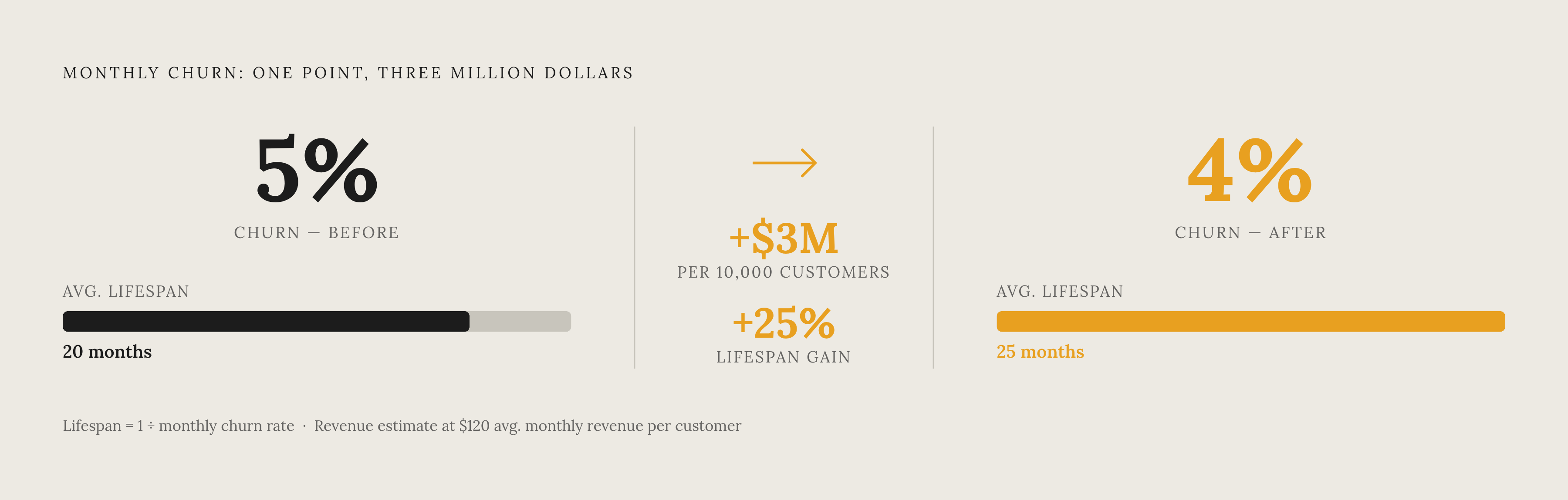
On churn, replace the single trailing rate with cohort-stratified churn that separates customers by when they were acquired relative to AI becoming the dominant discovery channel in their category. Someone acquired last year, in a world where AI comparison tools are routine, doesn't carry the same risk profile as someone acquired five years ago through a sales call and a product demo. Layer a modifier on top, tied to how visible the brand is in AI-generated answers: brands that are hard to find or poorly represented should carry a higher expected churn rate than their trailing numbers suggest, and brands with strong AI visibility should carry a lower one. Improvado's research notes that trimming monthly subscription churn from 5% to 4% extends average customer lifespan by 25% and adds roughly $3 million in revenue per 10,000 customers. A churn input off by even a single point moves real money.
On behavioral signals, keep the standard set. Login frequency, support contacts, and purchase timing still matter, they're just not sufficient on their own anymore. Add leading indicators that track competitive exposure before it shows up in a customer's own behavior: how AI search volume is trending for the category, how often the brand shows up when AI tools answer competitive comparison queries, how review volume and sentiment are moving over time. AI-driven churn prediction tools have been associated with churn reductions within the first year of deployment, and the mechanism behind that gain is earlier detection. Signals drawn from how AI tools describe a brand push detection earlier still, closer to the moment a customer starts looking rather than the moment they've already decided to leave.
On the competitive set, audit which brands actually get surfaced when AI tools answer the questions a customer is likely to ask about your category. That answer is the real competitive set the model should be built against, whether or not it matches the win-loss data on file. AI recommendation patterns shift whenever the underlying models get retrained or a new entrant builds up enough credibility, so that audit needs to run quarterly. Once a year is already too slow, and by the time an annual review catches a shift, the cohort has already been lost.
Where AI-powered CLV tools have a blind spot
None of this argues against AI-driven CLV tools, which have genuinely improved retention outcomes. Companies deploying them report churn falling from around 6.8% to 4.9% after a year of use, per 2026 industry research, and that gain comes from real strengths. These tools process behavioral and transactional data at a volume and speed no rule-based model can match, catch early churn signals inside the behavior they can actually observe, and personalize retention outreach at scale in ways that reportedly lift CLV by 15% to 25%.
The blind spot is structural. These tools train on data generated inside the existing customer relationship: logins, purchases, support tickets, renewal timing. None of that captures a customer quietly running a comparison query through an AI assistant on their own laptop, somewhere the brand's analytics will never reach. That session leaves no trace in any CRM, and no amount of tuning the existing model fixes a gap in what it's able to observe.
That's why the 62% invisibility figure from Fuel Online matters beyond marketing. If most enterprise brands are effectively invisible to the AI systems their customers now consult first, the churn pressure building against them never reaches a behavioral dashboard. It appears later, as unexplained deterioration in a cohort that looked perfectly healthy right up until it wasn't.
Operationalizing the updated model: what to measure, what to act on, and in what order
Start with an audit of the CLV model as it stands right now, before touching a single retention campaign.
Check the vintage of the churn inputs first. Were they pulled from cohorts acquired before AI discovery took hold in the category, or after? Then check whether the behavioral signal set includes anything that functions as a leading indicator of competitive exposure. If it doesn't, treat that gap as proof the model is running with a built-in lag, not as a minor omission to fix later. Map the competitive set the model assumes against what AI tools actually name when asked the questions real customers ask, and write down the gap between the two lists in plain terms, since that gap is the risk the current model can't see.
From there, build a baseline for the brand's AI and algorithmic visibility. This is the input most CLV models are currently missing entirely, not just measuring poorly. Score visibility across the major LLMs and AI search surfaces the brand's customers are likely to use. Assess entity richness, given that pages with sufficient entity density show a 4.8× higher selection probability in AI Overviews, making it a high-priority number to move, alongside earned media coverage and how recent and positive the brand's reviews are running. That baseline becomes the missing variable, the one that finally lets a CLV model account for a customer who hasn't churned yet, but has already started asking somewhere else.