Human Brand Intuition Versus Algorithmic Validation in Positioning Decisions
Human instinct and AI don't read brands the same way anymore.

What brand intuition does well
Positioning has always run on instinct, the kind honed by years of watching a category move. That instinct now answers to a second judge: the large language model, which forms its own view of a brand from signals no strategist directly controls. The two don't agree by default, and figuring out where they diverge is the actual work now.
Intuition is how differentiation gets invented. Reading a cultural shift before it fully lands, spotting the white space in a crowded category, picking a narrative that makes someone feel something instead of just understand it: none of that comes out of a regression model. Most positions that have lasted decades, the ones taught as case studies, came from someone making a creative call ahead of the evidence, before anyone waited for data to confirm what competitors had already noticed.
That track record earned its reputation inside a specific kind of world, though: one where the audience sat at the far end of a human chain. Editors decided what got covered. Buyers decided what got shelved. Salespeople decided what got pitched to whom. Every checkpoint in that chain gave a strategist something to watch and adjust against, a place to see the position land or fail.
Most brand teams still haven't absorbed that the large language model breaks that chain. Nobody sits in on the moment it forms an impression of a brand. There's no meeting to observe and no editor to call and ask why a mention got cut. Strategists can't see which third-party sources fed the answer, and they can't tell if the position they spent months refining survived the model's synthesis into a paragraph. That blindness didn't exist five years ago, and it's now structural to how brands get discovered.
How LLMs form a view of a brand
Calling an LLM a search engine undersells what's happening. At the moment someone types a question, the model assembles a small, specific set of brands to recommend, built fresh each time from whatever it decides is relevant. There's no shelf to walk down, no ranked results page to scroll past, no static inventory sitting there waiting to be inspected.
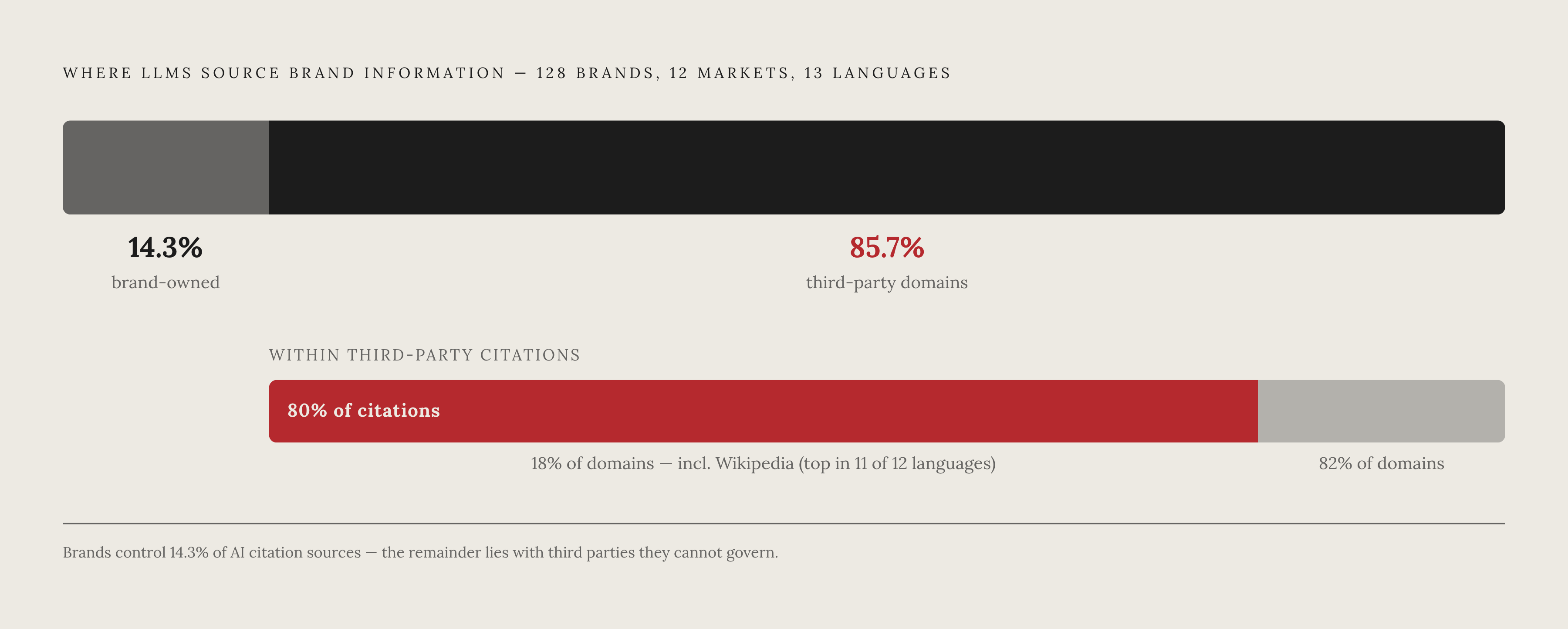
That material comes from somewhere, and mostly not from the brand itself. Across one large study spanning URL-grounded citations across 128 brands, 12 markets, and 13 languages, 85.7% of AI brand citations pointed to third-party domains. Only 14.3% pointed to sites the brand actually owns. If a company's positioning lives mainly on its own homepage, the model is reading someone else's account of that company, filtered through whatever that third party chose to emphasize, and nothing guarantees that emphasis matches the brand's own.
The third-party layer isn't spread evenly either. Citations follow something close to a power law: roughly 80% of them trace back to about 18% of domains, and Wikipedia alone dominated citation share in 11 of the 12 languages studied. A brand's reputation, as far as the model is concerned, gets built on a strikingly narrow substrate, one a marketing team rarely controls and often doesn't monitor. That narrowness is the whole story: most brands are betting their AI visibility on a handful of pages they've never once edited.
The signals that determine whether a positioned brand gets retrieved
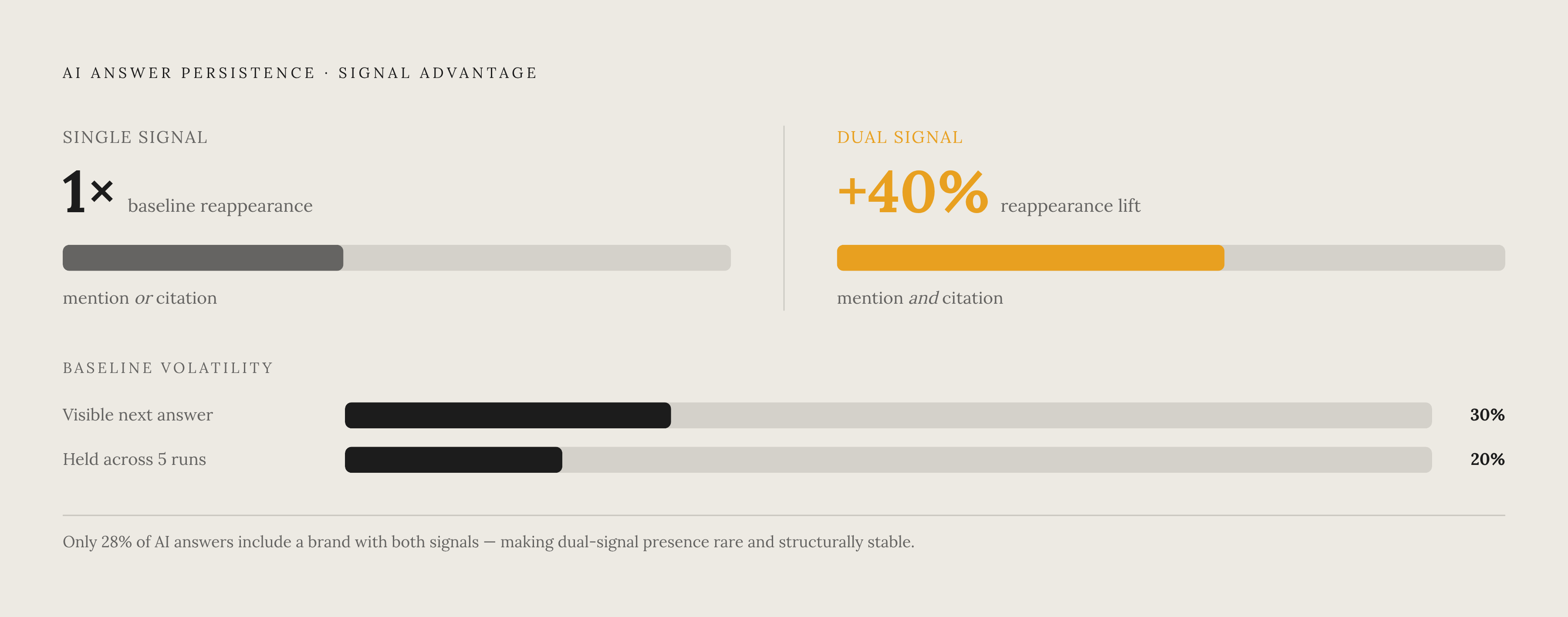
Getting cited once proves almost nothing. These systems are volatile by default: in the same study, only 30% of brands stayed visible from one AI answer to the next, and just 20% held their place across five consecutive runs. A single favorable mention is closer to noise than to a trend line worth reporting to a marketing executive, and treating it otherwise is the most common mistake in this whole discipline right now.
A few structural factors tilt the odds, and they're the levers a content team can actually pull. Pages that hadn't been updated on roughly a quarterly cadence were three times more likely to lose their citations. Pages built with clean sequential headings and rich schema markup showed citation rates several times higher than pages without that structure. Neither guarantees anything alone, but together they separate brands that persist from brands that flash once and vanish.
The more telling finding involves mentions and citations working in combination. Brands that earned both showed a 40% higher likelihood of reappearing across subsequent answers, compared to brands with only one or the other. Yet just 28% of answers actually included a brand with that dual-signal profile. Most brands showing up in AI answers at all are doing so on a thinner, less durable basis than they probably assume, and mistaking a single appearance for a foothold is how teams end up chasing a signal that was never stable to begin with.
The gap between intended position and AI-perceived position
The scale here makes this hard to wave off. ChatGPT crossed 900 million weekly active users as of 2026, and Google AI Overviews now appear in more than a quarter of all searches. These are mainstream paths to purchase, not experimental corners of the internet, and the traffic converts at 14.2%, against 2.8% for ordinary Google organic search. The channel carrying the most purchase intent is, for most brands, also the one with no deliberate strategy behind it.
That mismatch survives because nothing alerts a company when it fails. In enterprise research, 62% of brands turned out to be invisible to generative AI models, despite 94% of those same companies investing heavily in traditional SEO. A ranking drop in classic search throws off a visible signal: position 3 becomes position 11, and somebody on the marketing team notices within a week. Omission from an AI answer produces no such alarm. The brand simply isn't there, the buyer moves to whichever competitor was there instead, and nobody at the omitted company ever learns it happened.
Consumer psychology raises the stakes further. Among Gen Z users, 58% say they consider AI recommendations objective. Absence doesn't read as a random gap in coverage. It reads as disqualification, an implicit verdict that the brand wasn't good enough to mention. Because these answers often reach buyers before they land on a company's own website, the objections and comparisons are already locked in place before a prospect ever clicks through. That is the real cost of the invisible gap: not a lost impression, but a verdict rendered before the brand gets to make its case.
What rigorous measurement of AI-perceived brand position looks like
Reputation platforms have already built a working model for this, and the credit-score analogy is the right one. A credit score isn't meaningful because the number itself carries some inherent truth. It matters because it's trackable, comparable across time, and it moves when the underlying behavior changes. An Online Reputation Score works the same way: it rolls up review volume, star ratings, sentiment trend, response rate, and listing accuracy into a single figure whose value comes from what it does over months, not what it reads on a given Tuesday.
The inputs feeding that score, across most platforms in use today, cluster around a familiar set. Review volume and ratings across major platforms matter, as do social engagement, sentiment polarity and its trend line, share of voice against named competitors, response rate, and response time.
Response rate deserves its own attention because it's both measurable and genuinely fixable, unlike most of what shapes an LLM's impression of a brand. Roughly 90% of customer reviews go unanswered, and that's not merely a customer-service lapse. Unanswered reviews are exactly the raw material an LLM might draw on when characterizing a brand, so a response-rate problem becomes a trust-signal problem the moment a model starts reading that same review thread as evidence.
Aggregate sentiment scores hide more than they reveal, and this is where most measurement efforts go wrong. A single number conflates complaints about pricing, gripes about customer support, and worries about product reliability, three separate problems that get handled by three separate teams. Aspect-based sentiment analysis, which breaks a score down by the specific attribute under discussion, turns a vague reputation problem into one a team can actually assign and solve. Skipping that step turns the score into decoration, a dashboard number nobody quite knows how to act on.
Using algorithmic validation as a reality check on positioning decisions, not a replacement for them
None of this argues for creative constraint. Algorithmic validation is a feedback mechanism, and treating it as a design system instead is where teams go wrong next. It tells a team whether the position they built survives contact with the information environment a buyer runs into before ever hearing the brand's own pitch.
Research from Malthouse et al. offers a useful diagnostic here. Brands omitted from a standard LLM query can, in some cases, become conditionally retrievable again once distinctive cues tied to their intended positioning get fed to the model. That's a direct, testable measure of whether a brand's differentiation is legible to the system reading it, distinct from its legibility to a human strategist reading a brand deck.
When the gap between intended and perceived position turns out to be moderate, the fix is executional rather than strategic. Entity consistency across the web, earned coverage in the narrow set of high-citation domains that dominate AI citation pools, structured content, and a real cadence of updates: these are the levers, and pulling them means making the same positioning legible to a machine that reads nothing like a human editor does.
If AI systems keep describing a brand in language it doesn't recognize as its own, or keep leaving it out of categories where it genuinely competes, that failure says something specific: the positioning never generated enough independent, third-party validation to survive outside the brand's own account of itself. That finding belongs back at the strategy table. Handing it to engineering to solve with better markup treats a positioning failure as a technical one, and no amount of schema fixes a story nobody outside the company ever bothered to repeat.