AI Visibility Score Reliability for Brand Strategy Decisions
AI visibility scores influence major business decisions but rest on unstable foundations.
Brands now get evaluated three times before a human ever picks up the phone: once by a search algorithm, once by an AI system deciding whether to name them at all, and once by the person reading whatever the AI hands back. That third evaluation increasingly happens without a click. Semrush found that 58.5% of U.S. Google searches ended without a click in 2025, and when an AI Overview showed up on the results page, that number jumped to 83%. Gartner expects zero-click behavior to hit 75% by 2026. AI chatbots and the reach of AI Overviews have become a primary discovery surface, not a side experiment anymore, and the arithmetic of that surface is brutal: a traditional results page could fit ten links, but an AI answer typically names two or three brands. Missing the list means exclusion from consideration entirely, not a dip in ranking. It's exclusion from the conversation.
The business response has been fast. BusinessWire reports that 70% of enterprise buyers now use AI search platforms to research vendors, and 62% of CMOs have already added AI search visibility to their budget KPIs. Scores are moving up the chain into board decks and quarterly reviews. Which raises the obvious question: what exactly do these scores measure, and can they carry the weight being put on them?
What AI visibility scores measure, and what they do not
An AI visibility score, at its core, tries to answer how often, how prominently, and how favorably a brand shows up in AI-generated answers, across ChatGPT, Perplexity, Gemini, Google AI Overviews, Claude, Copilot, and DeepSeek, among others. Most scoring systems build that answer from four ingredients.
Mention rate, or prompt coverage, measures breadth: run a defined set of prompts and see how many return the brand. Share of voice measures competitive standing: when the category comes up, what slice of the references belong to this brand versus its rivals. Recommendation rate measures depth, drawing a line between a brand that's merely acknowledged as existing and one the AI treats as a genuine option worth choosing. Sentiment alignment measures tone, comparing the language surrounding a brand against the language that brand actually wants attached to its name.
The gap between citation and recommendation turns out to matter commercially. Airops' 2026 State of AI Search report found that brands earning both mentions and citations in AI answers were 40% more likely to resurface across consecutive queries than brands that only got cited. Being quoted as a source and being chosen as a solution are not the same event, even though most dashboards blend them into a single number.
There's also a category of activity no dashboard touches: dark discovery, the agent-to-agent conversations that platforms like YouScan's Moltbook monitoring have started to surface, plus the finer shades of sentiment that fall between "positive" and "negative," and the difference between a citation that recommends a brand and one that warns readers away from it. Researchers building these tools tend to be blunt about the limits: the scores measure what large language models cite, not what real people think of the brand. Citation mix is an input to reputation, filtered through a system nobody fully controls. It's an input to reputation, filtered through a system nobody fully controls.
Why the measurement problem is structural, not just a tooling gap
Traditional search leaves a paper trail. Search Console reports impressions, clicks, and average position against an index that behaves the same way for every query, every time. AI answer engines hand over none of that: no query logs, no source-selection data, no position record. A brand asking why it didn't get cited on a given prompt is asking a question nobody, including the platform itself in most cases, can fully answer.
Worse, the same prompt produces different answers on different runs, on the same platform, let alone across platforms. That means any single score is a statistical sample of something that varies, not a count of something fixed. Getting a usable sample requires testing across a prompt library large enough and varied enough to smooth out that noise. Skipping that step means a brand is making decisions off what amounts to an anecdote dressed up as a metric.
Then there's model divergence. ChatGPT, Gemini, Claude, DeepSeek, Grok, and Llama each run on different training data and different inference architecture, and Perplexity complicates things further by orchestrating several third-party models rather than running one of its own. Superlines' 2026 research found citation volume for the same brand varying by an enormous factor between platforms. A score built from one platform is a snapshot of that platform, and calling it anything broader overstates what it can tell you. It's a snapshot of that platform, and calling it anything broader overstates what it can tell you.
Even the ground underneath a single platform keeps moving. Backlinko's November 2025 research tracked an 80% shift in LLM citation sources over just two months, so a score accurate in January can describe a world that no longer exists by March. And there's a gap between measurement tools and lived experience: practitioner reporting out of communities like r/seogrowth notes that API-based trackers produce results 20 to 25% different from what shows up in the consumer-facing ChatGPT app. A tool optimizing against the API is optimizing for a version of AI search that the actual user rarely sees.
The disconnect between Google rankings and AI citation
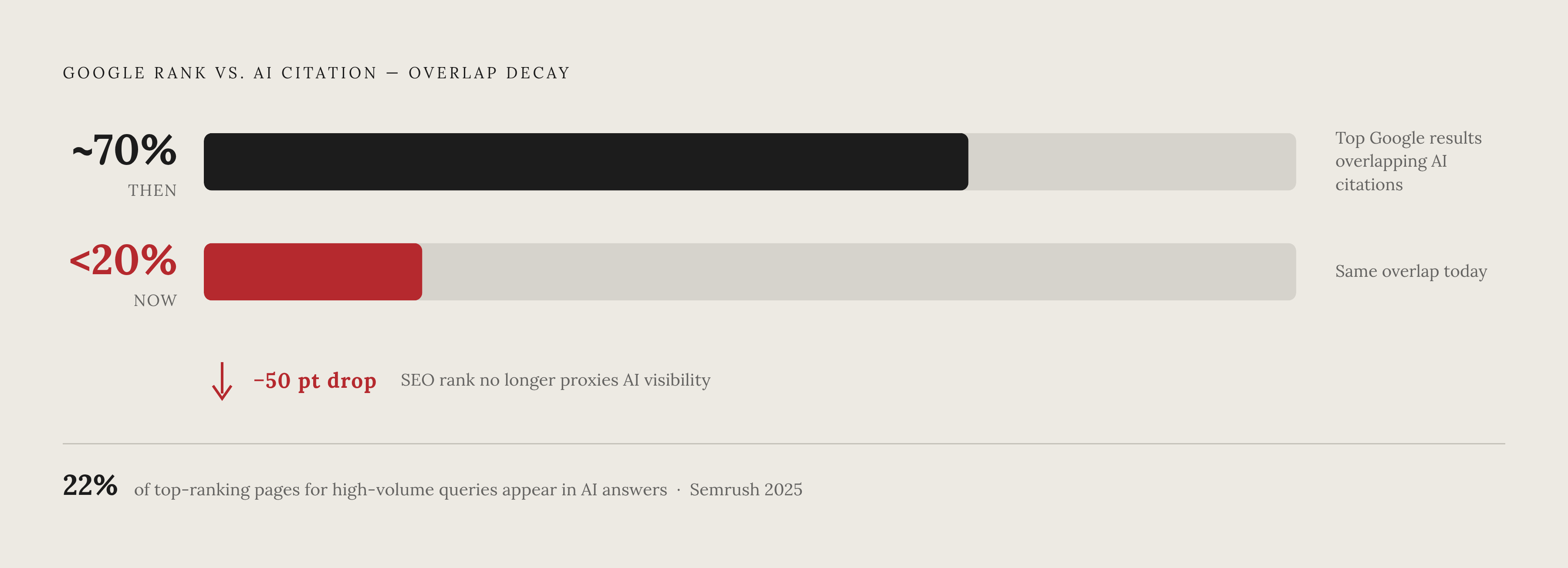
Wellows' 2025 GEO Visibility Research found that over 73% of brands with zero mentions in AI-generated responses were still ranking on page one of Google, a finding that should stop anyone treating Google rank as a proxy for AI visibility. Page-one rank buys nothing in the AI answer, at least not reliably. Semrush's 2025 data adds another layer, finding that only 22% of top-ranking pages for high-volume queries show up in AI-generated answers. A competitor ranking below a brand on Google can still walk away with the majority of AI citations in that category.
The overlap itself has been collapsing. Brandlight's analysis, cited in 5WPR's GEO Practice Guide, put the overlap between top Google links and AI-cited sources at roughly 70% at one point, now under 20%. Treating SEO performance as a stand-in for AI performance isn't just outdated, the data says it's flatly wrong.
The reason traces back to how each system actually works. Traditional search leans on keyword matching and link authority accumulated over many years. AI retrieval runs on something else entirely: semantic understanding and content representation methods that differ fundamentally from link-graph logic. Content structure and what practitioners call "chunk extractability," how cleanly a passage can be pulled out and used, affects citation more than where a page sits in the link graph. A page ranked lower in Google but written in tight, well-labeled sections can beat a page ranked higher but buried in dense, unstructured prose.
Where does the AI actually go for brand information? A Yext analysis of 6.8 million AI citations across ChatGPT, Gemini, and Perplexity found that 86% came from sources brands already control, with first-party websites accounting for 44% and business listings for 42%. Reviews and social posts accounted for 8%, and forums like Reddit made up just 2%. A low AI visibility score often reflects a content structure problem or a listings problem rather than brand quality. It's frequently a content structure problem, or a listings problem, both fixable without touching the brand's underlying reputation.
Which brand strategy decisions AI visibility scores can and cannot support with confidence
Some decisions hold up under this kind of measurement, and some don't. Conflating the two is where budgets get wasted, so they should be kept separate.
Scores are reliable for diagnosing competitive gaps. If a brand is structurally absent from a category's AI conversation across a well-built prompt set, that absence is visible consistently in the results even as the exact percentage wobbles run to run. Scores are also reliable at the platform level: a brand invisible on ChatGPT but present on Perplexity has a specific, addressable gap, and that directional read tends to hold steady. Citation source analysis, meaning which third-party domains are driving competitor mentions, points PR and content investment toward outlets that actually carry weight in that category; a citation earned in a trusted publication is a durable, causal input, not something that evaporates with the next model update. And sentiment monitoring works as an early warning system: a pattern of hedged or negative language around a brand in AI answers is worth investigating before it hardens into broader public perception.
Where scores fall apart is anywhere near attribution and short-term tracking. A visibility score can climb while clicks fall, because the score doesn't map onto pipeline without added instrumentation, like tracking how AI-referred visitors actually convert. Week-over-week score movement is mostly noise, not signal, given that Backlinko documented an 80% shift in citation sources over two months; a score bump or dip inside that window is as likely to reflect model retraining as anything the brand did. And a score built from a single platform, treated as though it represents AI visibility in general, will misread the competitive landscape almost by design.
The stakes here aren't abstract. Studies tracking AI-referred traffic have found conversion rates 23 to 31% higher than organic search traffic: the audience arriving via AI answers is unusually high-intent. Knowing whether a score reflects real presence or a measurement artifact is a revenue question, not a metrics-hygiene footnote. At the same time, consumer behavior argues against over-investing based on visibility alone. A meaningful share of consumers remain skeptical of AI search results, and many B2B buyers still want to validate AI-generated insights through direct channels before committing. AI visibility shapes early consideration. It doesn't close the deal, and strategy should be sized accordingly.
How rigorous AI visibility measurement differs from dashboard-level monitoring
The foundation of any credible score is the prompt library behind it. Too narrow, and the score reflects one use case dressed up as a category verdict. Too broad, and the signal gets diluted into mush. The library needs to span the buyer journey: broad category questions at the top, sharp head-to-head comparison queries near the bottom.
Cross-platform scores should stay broken out by platform rather than getting averaged into one tidy number. A strong ChatGPT showing can mask a total blank on Gemini, and that gap is exactly where the strategic opportunity sits, so collapsing it away defeats the purpose of measuring.
Because AI answers are non-deterministic, score movement lags behind whatever caused it, and it arrives noisy. Tracking the causal inputs alongside the score, things like third-party citations earned, structured data coverage, and consistency of entity signals, gives a team something to act on before the score itself catches up.
No single snapshot captures the picture; timing changes what a score shows. A brand holding steady share of voice while total category mentions grow is holding its ground. A brand with a rising score but shrinking share is gaining in absolute terms while actually losing competitive position, and only longitudinal tracking tells those two stories apart.
Some measurement platforms have started building toward this by scoring across multiple individual signals spanning different evaluation layers, rather than compressing everything into a single index number. That multi-signal, multi-audience structure is what turns a score into something diagnostic, a ranked list of what to fix first, instead of a number that just gets read aloud in a meeting. Brands that skip past baseline measurement and jump straight into optimization tactics risk chasing the wrong platform, the wrong prompts, or signals that don't move citation odds in their category.
The signals that durably improve AI visibility, and the ones that are commonly overestimated
Start with where the leverage actually sits. That earlier figure, 86% of AI citations coming from sources brands already control, first-party sites at 44% and business listings at 42%, means the highest-return work often has nothing to do with outside PR. It's fixing the site and the listings a brand already owns.
Earned media is the second real lever. Industry data has put roughly a third of AI citations coming from PR and media coverage sources, news outlets and trade publications a brand can actually influence. Wikipedia shows up as ChatGPT's most-cited source overall, at 7.8%, with Forbes and G2 trailing at 1.1% each. Landing a mention in a trusted reference source carries outsized weight relative to its frequency.
Content structure functions as a multiplier on top of both. AI retrieval systems favor material that parses fast: clean HTML, direct summaries, sections labeled clearly enough that a retrieval system can pull the right chunk without guessing. A page ranked lower but structured cleanly can out-cite a page ranked higher but written as one long undifferentiated block.
Schema markup gets more credit than the data supports. Ahrefs research found that adding schema to pages did not produce meaningful citation gains, and AI Overview citations for the schema-added group actually fell. Schema is table stakes. It's not a lever anyone should be betting a strategy on.
Entity consistency is the quieter, more durable signal. Large language models build something like brand memory from the patterns in their training data, so keeping the brand's category, capabilities, and credentials described the same way across every source, owned and third-party alike, reinforces the associations that eventually produce confident, specific recommendation language rather than vague or hedged mentions.
The pattern across all of this points one direction. Brands chasing the score itself, tweaking for whatever a dashboard rewards this week, get a number that moves and little else. Brands investing in the causal layer, earned placements in trusted outlets, cleanly structured owned content, consistent entity signals, produce this durability because these signals build visibility that survives the next model retrain and the next sampling swing. And the payoff isn't confined to AI channels either: brands cited in AI Overviews have shown substantially higher organic and paid clicks than brands left out, which makes this a cross-channel investment, not a siloed one. The practitioners getting real value from AI visibility scores treat them as a diagnostic instrument, measured continuously, read with some humility about what the number can and can't prove, and used to chase the underlying causes rather than the metric itself.