What Separates Brand-Building Creative From AI-Optimized Content
AI systems cite brands based on machine-readable signals, not human storytelling.
AI search traffic jumped 527% year-over-year between January and May 2024 versus the same window in 2025. That's not a slow drift in how people find information, it's a rotation. Gartner forecast a 25% drop in traditional search volume by 2026, a trajectory that the broader pattern of AI search growth appears to be tracking. The consequence for anyone building a brand is straightforward: the content that makes a human trust you and the content that makes an AI system cite you are not the same thing, and most companies are only building one of them. Worse, most can't tell which one they're missing.
The shift changes what "being found" even means. When a buyer asks ChatGPT which vendor to trust, the model doesn't hand back ten blue links, it produces a narrative, and that narrative shapes the shortlist before a sales rep ever gets a call. G2 puts a number on the channel switch: 51% of software buyers now start research with an AI chatbot more often than with Google. A search engine returns options. An AI advisor narrows the field to one, two, maybe three names it's willing to stake its own credibility on. That's a different bar entirely, and it means brand content now has two separate jobs, serving two audiences that don't judge by the same rules. Confuse the two, or ignore one in favor of the other, and the perception gap that opens up is one most teams can't even see forming.
What brand-building creative actually does, and the signals that govern it
Brand creative is the advertising, the storytelling, the tone-of-voice work, the campaign trying to make a human being feel something about a company and remember it. Its signals are subjective and experiential: emotional tone, whether the narrative holds together across touchpoints, whether it feels like a real person made it.
Coca-Cola's AI-assisted "Holidays Are Coming" campaign shows this dynamic clearly. Marketing coverage documented the online reaction, and it wasn't really about the ad's craft, it was about authorship: a wave of commentary questioning what AI-assisted production does to the authenticity of a holiday spot people have watched for decades. That reaction is the human trust gap playing out in real time, on a campaign that almost certainly reached its audience at scale.
The data explains why that reaction happened. Research into consumer attitudes toward AI-generated brand marketing has found that when people notice AI-generated content, they are substantially more likely to trust the brand less than more. A significant share of consumers said they view a brand less favorably once they can tell AI made the creative. Ninety-three percent said it matters that communications feel like they came from an actual person, and Many consumers said an unscripted moment, a stumble, an unexpected laugh, makes content feel more likable. The same research found that publishing unfiltered testimonials, including critical ones, consistently correlates with higher consumer trust. Polish isn't the currency anymore. Imperfection is, which is a strange thing to have to say out loud about marketing.
Perceived human authorship is becoming a quality signal in its own right. In a media environment where AI-generated content is now the default assumption, a visible human fingerprint works like a kind of premium stamp. None of that, though, is what makes content legible to a machine. Brand creative isn't built for schema markup, entity clarity, or citation velocity, and it was never meant to be. Those signals live in a completely different system, and pretending otherwise is where most of this goes wrong.
How LLMs learn what they know about a brand, and why that knowledge is fragile
Large language models pick up brand knowledge two ways: parametric knowledge baked in during training, and real-time retrieval, commonly called RAG, that pulls in fresh information at the moment of a query. Each path opens a different door for a brand trying to shape what gets said about it.
The company website is the most direct source available, but most brands only feed it half of what AI systems actually check. Leadership profiles, case studies, service descriptions, and product documentation all get evaluated right alongside the blog. And even then, owned content is a minority player. University of Toronto research found AI search engines lean heavily toward third-party sources over brand-owned ones, citing earned media roughly five times more often than a company's own site, a gap researchers describe as systematic rather than incidental. Wikipedia alone accounts for 7.8% of citations in ChatGPT, with Forbes and G2 each around 1.1%. Community platforms like Reddit and YouTube supply 48% of citations, and 85% of brand mentions come from pages the brand doesn't own at all.
That's a fragile setup by design. Only 30% of brands stay visible from one AI answer to the next, and just 20% hold visibility across five consecutive runs. There's no cruise control here: presence has to be maintained actively, or it decays, quietly and without warning.
Most of that decay traces back to something mundane: entity confusion. A brand's name spelled differently across platforms, an "about" page that says one thing on the website and another on a partner listing, missing leadership bios, incomplete organization schema. None of that looks like a crisis day to day, but it's exactly the kind of noise that makes an AI system mix up who a company is or misdescribe what it does. A brand can rank on page one of Google and still show up garbled, or missing entirely, in an AI answer. The two systems aren't grading the same paper, and treating them as one exam is the mistake that costs the most.
The signals that determine whether AI systems cite and recommend a brand
Research into AI citation patterns narrows the field to five signals that decide whether a brand gets cited, and they are machine-readable infrastructure, content structured for citation, named entity density, an off-site trust footprint, and how fresh the content is. Pages built with sequential headings and rich schema see citation rates several times higher, a gap that's almost entirely invisible to a human scrolling the page and reading it for tone.
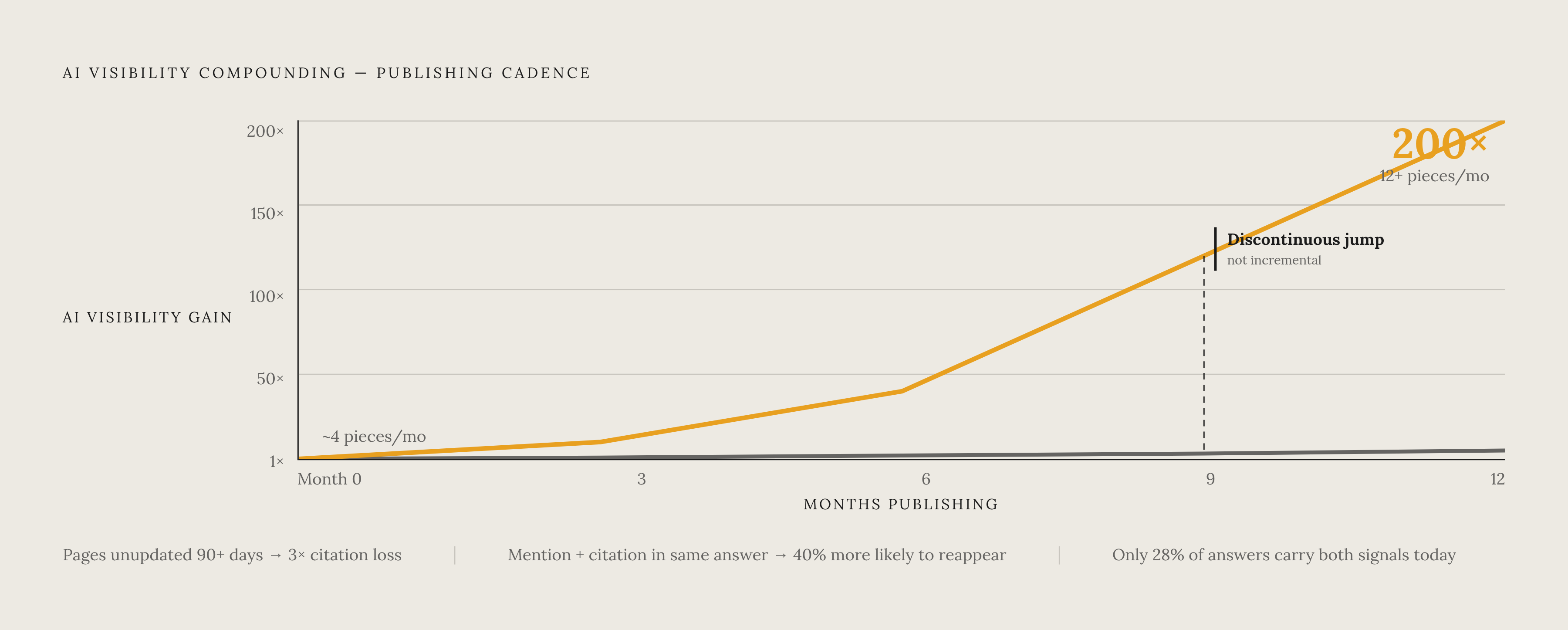
Freshness carries real weight too. Pages that go a quarter without an update are 3× more likely to lose citations they'd previously earned. Volume matters at scale as well: Brandi AI data shows brands publishing 12 or more new or optimized pieces a month see visibility gains 200× faster than brands publishing around four. And there's a compounding effect for brands that manage to earn both a mention and a citation in the same answer, those brands are 40% more likely to reappear in future answers. Only 28% of current answers include that dual-signal combination, so most brands are leaving that multiplier sitting on the table, unclaimed.
None of this is purely technical, and treating it as a technical problem is the wrong call. Generative engine optimization runs roughly 80% strategic, positioning, ecosystem presence, earned authority, against 20% technical fixes. Schema, headings, freshness cadence: that work matters, but it serves a bigger positioning question rather than replacing one. Some of the old SEO discipline carries over intact. E-E-A-T, the experience, expertise, authority, and trust framework, still applies: transparent author bios, credible citations, regular updates. Those overlap with what builds human trust, but a different judge reads them.
The scale of the miss is bigger than most marketing teams assume. Fuel Online's 2026 analysis of 1,000 enterprise brands found that 62% were invisible to generative AI models, despite 94% of those same brands investing heavily in traditional SEO. That's not a case of AI visibility work still being early. The infrastructure that gets a company found on Google and the infrastructure that gets it cited by an AI model are structurally different builds, and a company can max out one while leaving the other completely bare. The metric taking shape to track this is Share of Model: how often a brand shows up in AI-generated answers relative to competitors on the queries that matter, share of voice rebuilt for a search environment now shaped by AI-generated answers rather than ranked links.
The reason the two content types fail when they are confused for each other
Run brand creative through the AI evaluation lens and it usually falls short in a specific way. A campaign page can be emotionally gripping and still carry none of what a citation engine needs: no schema, no named entities, no third-party corroboration anywhere. It's brilliant, and it's invisible to the machine layer.
Run it the other direction and the failure looks different but lands just as hard. Content built for machine legibility, structured, factually dense, heavy on named entities, often reads like it was produced by an algorithm, because in plenty of cases it was. The consumer trust research already shows what that costs: a meaningful jump in reduced trust once people spot AI authorship. That asymmetry can play out even for high-reach campaigns: wide human exposure offers no protection against authenticity concerns, regardless of how the content might perform in a citation index.
The gap runs both directions, and neither side fixes itself. A brand can win the affection of its human audience and remain a stranger to AI systems, or it can be perfectly legible to a model and still get met with suspicion by the people reading its marketing. The Fuel Online finding, 62% of enterprise brands invisible to AI despite heavy SEO spend, is exactly this problem measured at scale: money and effort poured into human-facing discoverability while the machine-facing layer sat untouched.
What makes this hard to catch internally is that the teams responsible usually can't see it happening. Marketing teams chasing emotional resonance have no metric for AI citation on their dashboard. SEO teams building structured, schema-rich pages have no way to tell whether a human reader finds the result authentic or robotic. The strategic gap survives because the measurement gap hides it, and it hides it well.
Measuring AI perception alongside human trust so gaps become visible
A baseline exists in the idea of an online reputation score, a numerical read on social presence, reviews, and general digital footprint. But no single agreed method produces it, and that absence of consensus is why any single score deserves scrutiny. Providers differ on basics, like whether an unverified Google review even counts toward the number, so any single score deserves some skepticism before anyone builds a strategy on top of it.
More specific tools are showing up on the AI side. Britopian has proposed AI-specific reputation metrics aimed at auditing how a model actually talks about a brand rather than simply whether it mentions the name at all. Similarweb's 2026 Generative AI Brand Visibility Index took a sector-specific approach, running 11,000 prompts in the finance category alone and tracking 113 brands across six sectors using brand mention share, the percentage of AI answers that include a given brand name, as its core metric.
On the human side, narrative intelligence has moved past simple sentiment scoring. Six metrics are now in active use: narrative topic share, sentiment velocity, share of positive narrative, emerging clusters, narrative reach by audience community, and crisis narrative exposure. That's a picture of how meaning actually gets built around a brand in public conversation, the fuller shape of that construction, including whether the mood reads positive or negative on a given day.
One data point ties both sides together neatly. Research has found that roughly 90% of reviews go unanswered. An unanswered review erodes human trust in the obvious way, but it also quietly damages AI discoverability, since that review content feeds into the same third-party ecosystem models pull citations from. It's a rare case of one neglected habit doing damage on both ledgers at once.
There's a blind spot no platform currently reaches, too. Forrester's research found 82% of B2B buyers trust colleagues and internal peers above any other source of information, and those conversations happen in workplace messaging channels and hallway chats no monitoring tool can see. Any measurement approach leaning on a single platform is going to miss that entirely, which is the argument for scoring across algorithmic, AI, and human evaluation dimensions together rather than picking one lens and calling it complete. A gap you can't see is a gap you can't fix. That's the whole case for measuring all three at once instead of defaulting to whichever one already has a dashboard.
What a company that manages both content types deliberately looks like in practice
The brief for brand creative and the brief for AI-facing content should read differently on paper, even while they're pointed at the same goal. One gets judged on emotional resonance, the other on citation rate and Share of Model. Different success criteria, same underlying ambition: shape how the world sees the company.
The foundation for the AI-facing side is unglamorous, and it's the part almost everyone skips. Company information pages, leadership profiles, case studies, service descriptions: exactly the pages AI systems check most closely, and exactly the pages marketing calendars tend to leave untouched in favor of another blog post. Entity consistency belongs on that list too, and it's not a project with an end date. Brand name, "about" copy, leadership bios, organization schema, all need to match everywhere they appear, because model knowledge keeps updating and any drift becomes a new source of confusion. Given that a large majority of brand mentions come from third-party pages, building out earned media, a presence on Reddit and YouTube, and citations from sources with real standing is essential AI visibility infrastructure. It's AI visibility infrastructure, full stop.
On the human-facing side, the Klaviyo and Datalily numbers point in one clear direction: lean into visible human authorship. Named authors, testimonials that keep the critical parts in, formats that don't sand off every rough edge. That's the differentiator precisely because AI-generated content is now the default assumption a reader brings to anything put in front of them.
Cadence deserves its own dedicated budget line. Twelve or more new or optimized pieces a month is the volume threshold Brandi AI ties to real visibility gains, and that publishing rhythm has almost nothing in common with how campaign creative gets produced. Trying to run both off the same production calendar is how one of them quietly starves while nobody notices until the numbers are already bad.
The companies that close this gap treat AI perception as a measurable, ongoing part of brand health. Everyone else is optimizing for one evaluator while guessing at the other, and in an environment where a model narrows the field to one, two, maybe three names before a human ever gets involved, guessing is an expensive way to run a brand.