Brand Architecture Choices for Multi-Product AI Discoverability
AI visibility now hinges on how a brand organizes its product names and web presence.
Multi-product companies are making a branding decision that doubles as an AI visibility decision, whether anyone in the room realizes it or not. Whether a company puts one name on everything, keeps its products under separate identities, or lands somewhere in between now shapes whether large language models can identify, trust, and recommend those products at all. That's no longer a side effect. It's the main event.
The shift driving this is fast, and it's large. Fairing's Q2 2025 data shows "How Did You Hear About Us" responses citing AI platforms increased more than tenfold between January and mid-July of that year. Yotpo's research puts the number of consumers using generative tools for product discovery at 58 percent, a majority now skipping the search-and-scroll routine to ask a model directly. LLMs don't hand back ten blue links the way a search engine does. They generate endorsements, typically naming only a handful of brands per answer. A model acts like an advisor giving a recommendation to a friend, not a matchmaker laying out every option, and that makes the whole interaction more conservative and more exclusionary. Getting parsed correctly by the model has become essential. It's the entry ticket.
Most companies aren't clearing that bar. Fuel Online's research, cited by ALM Corp, found that 62 percent of enterprise brands were invisible to generative AI models despite 94 percent of them investing heavily in traditional SEO. That gap, all that SEO spend producing so little AI visibility, is structural at its root. It's structural, and brand architecture sits right in the middle of it. Yotpo's 2026 report even flags "Share of Model" as the metric replacing Share of Voice, a sign that the whole competitive field has moved somewhere new.
How LLMs build and store a brand's identity
Two separate memory systems govern how a model understands any given brand. Parametric knowledge is what got baked in during training: slow to shift, shaped by whatever the model absorbed across the web at the time it was built. Retrieval-augmented generation pulls in real-time material from sources that are crawlable, structured, and current. Brand architecture touches both. It shapes the long-term entity record sitting inside the model's weights, and it shapes the live signal environment the model draws from when answering a question today.
LLMs build internal entity representations from sources such as Wikipedia references, news coverage, and structured data. A brand with a well-formed entity representation gets cited more often. A brand with a fragmented or ambiguous representation is harder for a model to assess confidently, which can lead to that brand being skipped rather than cited.
Wikipedia's dominance here is hard to overstate. It's the most-cited domain in 11 of 12 languages tested in arXiv research, and brands with complete Wikipedia entries were cited 3.7 times more often than comparable brands without one. Semrush's data, cited by Jottler, found branded web mentions correlate with AI Overview citations at 0.664, against just 0.218 for traditional backlinks. Entity signals have overtaken link signals as the thing that actually drives AI visibility, a real break from a decade of SEO orthodoxy built almost entirely around links. Anyone still pouring budget into backlink acquisition while ignoring their Wikipedia entry is optimizing for the wrong decade.
There's a persistence problem baked into this too. Forum complaints, early product reviews, and old press coverage can stay lodged in training data long after a company fixes the underlying issue. A product that resolved its reliability problems two years ago can still get flagged as unreliable in a model's summary, because parametric memory doesn't self-correct on any schedule a company controls. Architectures that produce ambiguous or overlapping entity signals make this worse, since the model tends to anchor on whatever version of the story is most consistent across its sources, not whatever version is most current.
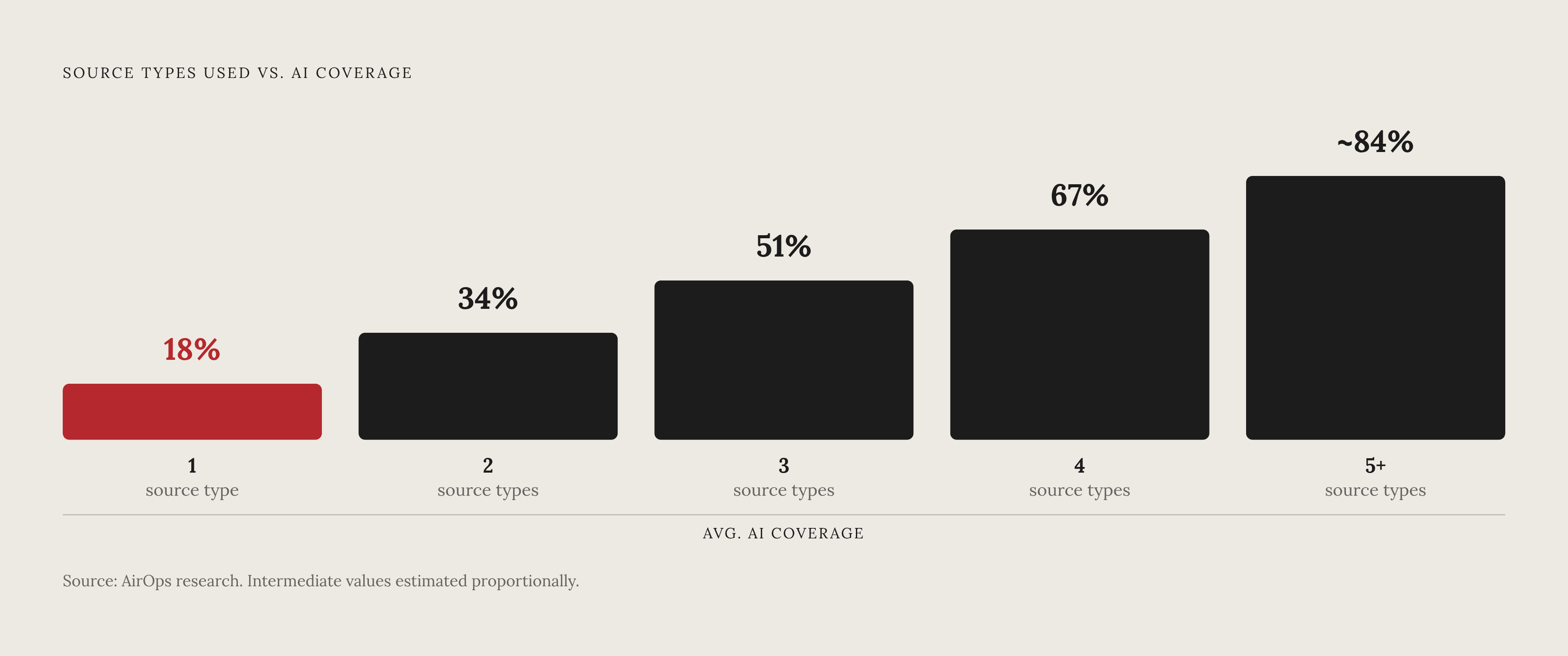
Source diversity compounds the effect. AirOps' research found brands relying on a single source type reach only 18 percent average AI coverage, while brands with five or more source types reach substantially higher coverage. Architecture decisions either concentrate a brand's web footprint into something coherent enough to compound, or splinter it into pieces too thin for any one source to carry weight.
What the three architecture models look like to an AI system
Branded house describes one master brand, where every product carries the parent name: Apple's product naming, FedEx's divisional color-coding, Google stretching one brand across an expanding product line. To an AI system, this setup produces a concentrated, self-reinforcing entity signal. Every mention of every product adds weight to a single record. This setup produces what can be described as automatic trust transfer, where Google's monolithic identity lends its technological credibility to whatever new product launches under that name. The risk runs the other direction too, though: a reputational hit to one product can affect how the model represents everything else under that same entity. On the domain side, the subdirectory model (brand.com/product) is generally considered to pass SEO and entity authority most efficiently of the available structures.
House of brands is Unilever and Procter & Gamble: a master brand with no visible tie to its sub-brands, each carrying a completely distinct identity. To a model, each sub-brand has to build its entity record from nothing. There's no inherited authority, no automatic citation transfer from the parent. That builds a firewall against reputational contagion, but it comes at a real cost: a sub-brand the model hasn't encountered often enough simply won't get mentioned. Research into AI citation behavior flags a sharper risk for multi-product portfolios here too. Similar competitor names, multiple legal entities, or a history of rebrands can make it harder for a model to resolve which brand to cite, or lead it to avoid citing anyone at all. Separate domains mean each brand starts its entity authority at zero, with nothing passed down from the parent.
Hybrid is what Coca-Cola exemplifies: the parent name appears on some products and stays absent from others, usually the result of years of acquisitions and organic growth rather than one clean plan. To an AI system, this produces mixed, unpredictable signals about what the parent entity actually covers. Partial endorsement relationships are genuinely harder for a model to resolve than either a fully monolithic structure or a fully siloed one, and hybrid setups can leave a company represented inconsistently depending on which product got asked about. Of the three, hybrid is the one companies rarely choose on purpose, and it shows.
The pressure across all this runs one direction. The house of brands model has long been considered a gold standard for risk containment, built on the logic that isolating brands protects the parent from any single product's failure. AI-era dynamics are reversing that logic, because customers and models increasingly encounter a company as a single entity rather than a shelf of unrelated products. Customers, and the models answering their questions, increasingly see one entity rather than a shelf of unrelated products. A company still defaulting to house of brands purely for risk containment is optimizing against a threat model that AI search has already made obsolete.
How entity clarity determines whether AI systems cite or skip a brand
Research into AI citation behavior points to what these systems weigh when deciding whether to cite a brand: coherence of the entity across platforms, corroboration from independent and credible sources, authority specific to the topic being asked about, semantic completeness backed by structured data, and consistency that lowers the model's perceived risk in citing it. Every one of those criteria rewards clarity and punishes fragmentation.
Disambiguation is the failure mode that actually breaks things. The Sharp Digital's 2026 research found that a brand carrying multiple legal entities, a name close to a competitor's, or a history of rebrands loses citation accuracy: sometimes cited under the wrong name, sometimes not cited at all. That's not a content quality issue. It's an entity architecture issue, and house of brands structures with similarly named sub-brands sit most exposed to it.
Rank in Google means less here than most marketers assume, since fewer than 10 percent of sources cited by ChatGPT, Gemini, and Copilot rank in Google's organic top 10 for the same query. Fewer than 10 percent of sources cited by ChatGPT, Gemini, and Copilot rank in Google's organic top 10 for the same query, Search Engine Land's research found, and BrightEdge data show that 83.3 percent of AI Overview citations came from pages outside the traditional top 10. Semrush's data back this from another angle: traditional backlinks correlate with AI Overview citations at just 0.218, far below the 0.664 correlation for branded web mentions. A company chasing position one on Google while treating AI citation as an SEO afterthought is measuring the wrong scoreboard. Citation behavior has become its own trust signal, separate from anything Google's algorithm was built to measure.
Consistency of appearance is its own battle. AirOps' State of AI Search found only 30 percent of brands stay visible from one AI answer to the next, and only 20 percent remain present across five consecutive runs of the same query. Brands earning both mentions and citations were 40 percent more likely to reappear across answers, yet only 28 percent of answers actually include a brand with that dual visibility. Most of the field hasn't claimed this ground yet, which leaves room for whoever moves first. The earlier point about source diversity applies directly here too: brands relying on one source type average 18 percent AI coverage, while building across multiple source types is what pushes toward broader, more consistent citation.
The domain and content structure decisions that follow from each architecture choice
Architecture doesn't stay abstract for long. Architecture dictates domain strategy, site navigation, and content management, each carrying its own consequences for SEO authority, entity signals, and how legible the whole thing reads to a model.
The choice between subdirectory, subdomain, and separate domain determines how much entity and authority carry over in most site migrations. A subdirectory setup (brand.com/product) is generally regarded as passing entity and authority most efficiently, with everything accreting toward one record. A subdomain (product.brand.com) transfers equity only partially, and whether the model associates that content with the parent depends heavily on the schema markup and cross-linking in place. A fully separate domain starts with zero inherited authority, a fine outcome only when total brand separation is the actual strategy rather than an accident of how the site grew.
Schema carries real weight here. AirOps' research found sequential headings paired with rich schema correlate with a substantially higher citation rate. For a multi-product company, schema has to spell out the organizational relationships explicitly: which entity is the parent, which are the products, and how they connect. Skip that step and the model resolves the ambiguity on its own, often getting it wrong.
Freshness compounds the maintenance load unevenly across architectures. AirOps' data show pages that go a quarter without updates are three times more likely to lose citations. A house of brands multiplies this burden, since every sub-brand's content needs its own upkeep schedule. A branded house concentrates that obligation into fewer places, which makes it more manageable even when the total content volume is similar.
Then there's the matter of pages the brand doesn't own. AirOps' research found roughly 85 percent of brand mentions originate from pages the brand doesn't own: trade press, review sites, community forums. Architecture shapes how easily those third parties can represent a brand accurately. A fragmented portfolio is genuinely harder for a Wikipedia editor or a trade journalist to describe correctly than a single coherent entity with clear product lines underneath it.
Adobe's experience with its Firefly and Acrobat landing pages makes the case concretely. Adobe's own blog post reports that applying generative-engine-optimization content work to both produced a fivefold increase in citations for Firefly and a 200 percent jump in LLM visibility for Acrobat within a single week. Adobe runs primarily as a branded house with some hybrid elements, so both products had a unified entity to accrete authority toward. The same content intervention attempted inside a house of brands would hit an extra obstacle: building entity authority for each product from scratch, rather than adding to something the model already half-recognized.
Where different LLMs source brand reputation and what that means for architecture
An arXiv study analyzing LLM citation patterns found Wikipedia as the top-cited domain in 11 of 12 languages, a role that sits alongside real variation by model and market. Perplexity cited the most sources of any model studied, drawing 90,276 of 131,514 backbone citations from a pool of 15,995 distinct domains, the widest source spread tested. The mix shifts by market too: for 46 Polish national brands in the same study, YouTube outranked every other domain, and four HR and careers portals together supplied 637 citations against just 297 for Polish Wikipedia. A one-size-fits-all source strategy misreads what's actually happening market by market.
Platform specialization by product category adds another wrinkle. Fairing's Q2 2025 data shows ChatGPT leading attribution in Automotive, Health & Beauty, and Apparel & Accessories; Claude leading in Consumer Electronics; and Grok gaining ground in Office, Food & Drug, and Sporting Goods. A house of brands selling across multiple categories may need a different source strategy for each sub-brand, depending on which model dominates that category's queries.
Community platforms carry outsized weight too. AirOps' research found roughly 48 percent of citations trace back to community platforms like Reddit and YouTube. These sources are entity-agnostic: they talk about products by name, without much regard for who owns them. That cuts two ways depending on architecture. For a house of brands, community discussion can build a sub-brand's entity record independently of the parent, useful for isolation, less useful if the goal is portfolio-wide authority. For a branded house, any product getting discussed anywhere adds to the parent entity's overall signal.
Sentiment adds a further layer, and it doesn't hold steady across models. Yoast's research notes that the tone a model applies to a brand can differ meaningfully between ChatGPT, Claude, and Gemini, even given an identical prompt. A branded house concentrates sentiment risk: one product drawing a negative tone in one model tends to color perception of the whole entity. A house of brands isolates that risk by sub-brand, but the tradeoff is managing sentiment separately for each one, with no shared upside.
Multi-turn conversation behavior reinforces all of this. exchange4media's research finds that when a user follows up with something like "why?" or "compare it with X," the model reaches for entities it already trusts rather than starting its evaluation over. A brand with coherent, early-established entity authority benefits disproportionately here, since trust compounds across the exchange instead of resetting with each new question.
How to audit a multi-product brand's current AI legibility posture
None of this is optimizable without a baseline first. Measurement has to come before any architectural change, or there's no way to tell whether an adjustment actually moved anything.
Search Engine Land's 2025 polling-based visibility model offers a workable starting point: define a representative sample of 250 to 500 high-intent queries tied to the brand or its category, run them daily or weekly, and track whether the brand appears, how it's described, and which sources get cited. For a multi-product company, that means running queries at both the parent-brand level and the individual product level. Gaps between the two are usually the clearest sign of entity fragmentation on record.
An entity coherence audit fills in the rest. Is the parent entity clearly and completely defined across Wikipedia, structured data, and the major third-party sources a model is likely to pull from? Do the sub-brands or product lines have entity records of their own, and are those records linked back to the parent wherever the architecture actually calls for that relationship? And, for portfolios built through years of acquisition, are there naming conflicts, look-alike competitor names, or a history of rebrands sitting in the record that could push a model toward citing the wrong entity, or citing no one at all?
The answers to those questions won't just describe a company's current AI visibility. They'll point directly at which architecture decisions are helping, and which ones are quietly working against a company that spent years, and a great deal of money, building a brand it now can't get a model to recognize.
Sources
- Adobe.com is “customer zero” for LLM discoverability | Adobe Blog
- LLM Product Discovery Benchmarks - Fairing
- From ranking to representation: Are brands building for LLM-mediated discovery?
- LLM optimization in 2026: Tracking, visibility, and what’s next for AI discovery
- yotpo.com
- How AI is shaping brand perception, and what you can do about it
- semrush.com
- almcorp.com