Brand Positioning When AI Systems Are the Recommender
Brands must build AI trust through third-party signals, not just search optimization.

When AI systems answer a question about which product to buy or which vendor to hire, they rarely offer ten options the way a search results page does. They name one. Maybe two. That shift, from listing to recommending, changes what brand positioning actually requires: instead of optimizing to be found, brands now have to earn the kind of trust that makes a model willing to vouch for them.
The mechanics that cause that shift matter for a moment. A traditional search engine behaves like a matchmaker: it hands the user ten plausible candidates and steps back. The user does the evaluating. An AI system acting as an advisor doesn't step back. It evaluates first, then commits to a small number of answers, and its own credibility rides on whether those answers hold up. That makes AI systems structurally more conservative than search engines ever were, and it means the brands that get named are the ones that clear a much higher bar before the model is willing to say their name out loud.
Consumers have already moved. Yotpo's research puts the share of consumers using generative tools for product discovery at 58%, which means a majority of shoppers are now skipping the ten blue links entirely and asking a chatbot to just tell them what to buy. AI search traffic kept climbing through 2025 and into 2026. Yet research consistently finds that most enterprise brands remain invisible to generative AI models, despite having poured real budget into conventional SEO. That's not a small gap. It signals that the rules changed for brands that were still playing the old game.
The instinct is to call this a ranking problem, something a few technical fixes can patch. It isn't. It's a trust-signal problem, and trust signals are built differently than rankings ever were. The rest of this piece works through what that actually means: what AI systems evaluate, which signals move the needle, why consistency beats excellence, how to measure where a brand currently stands, and what a serious response looks like in practice.
What AI systems are actually evaluating when they decide to recommend a brand
A search crawler indexes pages. A large language model does something closer to forming an impression, an entity understanding assembled from training data, whatever it retrieves at inference time, and the accumulated weight of reviews and mentions scattered across the web. Three layers do most of the work.
The first is training memory: whatever the model absorbed before its knowledge cutoff. This can lag actual events by months, producing what's brand drift, where an outdated product description or a stale positioning statement keeps surfacing in answers long after the company has moved on. The second layer is retrieval, the sources an AI system fetches live at the moment someone asks a question, things like Wikipedia, Crunchbase, and major trade press, which can override or supplement whatever the model learned during training. The third is consensus: the model reads review aggregates and third-party mentions to gauge whether a brand is widely regarded as worth recommending at all.
None of this is neutral. Research on LLM-based recommender systems (Park, Lee, and Lee's EchoTrace work, presented at CIKM '26) found that these systems amplify popularity bias structurally, not by accident, and that hallucination introduces spurious signals that compound over time into polarized, self-reinforcing exposure patterns. In plain terms: brands that are already popular get more popular inside AI answers, and the loop feeds itself.
A separate audit, ChoiceEval, run by Rienecker and colleagues out of Stupid Human and the University of Oxford in March 2026, tested Gemini, GPT, and DeepSeek across more than 2,000 questions. It found consistent, systematic preferences rather than random noise: Gemini and GPT, both developed in the United States, showed marked favoritism toward American entities, while DeepSeek showed more balance but still detectable geographic leanings. These patterns held across different user personas, which rules out the possibility that they're just artifacts of how a question happened to be phrased.
The practical upshot matters for anyone doing brand strategy. A brand's odds of being recommended are partly inherited, baked into training data before a marketing team ever gets a say. That's uncomfortable, but it also clarifies where the actual leverage sits: the off-site signal layer, the stuff a brand can still influence today, is where the fight actually happens. And that fight isn't fought evenly. Category leaders, the brands models already know well, stay consistent across different AI systems and different framings. Mid-market brands don't get that luxury. Change the persona prefix in a prompt and a meaningful share of their recommendations swap out entirely, which says something uncomfortable about how thin AI's understanding of a mid-tier brand often is.
The signals that determine whether AI systems consider a brand credible enough to cite
Large-scale citation analyses converge on one finding: AI systems cite off-site content at a substantially higher rate than a brand's own domain, sometimes several times more, depending on the study. A brand's polished homepage matters far less than what independent, third-party sources say about it.
Community and third-party platforms carry disproportionate weight in this equation, which means owned media, however well-produced, cannot build AI credibility on its own. It has to be backed by a chorus of voices the brand doesn't control.
Consistency functions as its own signal, separate from popularity. When a brand's name, positioning, product lineup, or leadership team gets described differently across the sources an AI system draws from, the model's confidence in that entity drops. Faced with contradictory information, it hedges the answer or skips the brand entirely rather than risk stating something wrong. A brand described the same way on Wikipedia, Crunchbase, trade press, and its own site raises entity confidence; a brand described five different ways across five sources does the opposite, no matter how accurate any single description happens to be.
Content structure feeds directly into this. Research on AI retrieval suggests that pages built with clear structure correlate with higher citation rates, because AI retrieval systems pull answers at the passage level rather than reading a page top to bottom the way a human does. Pages that go stale, that aren't updated regularly, are substantially more likely to lose citations over time. Recency isn't a nice-to-have. It functions as an active filter.
A mention and a citation do different jobs, so they need separating. A mention shapes how a brand gets described inside an answer. A citation is the link that actually drives a click. Brands earning both a mention in the body text and a citation as a source in the same response appear more likely to reappear across a run of consecutive answers. Content velocity appears to matter as well: brands that update and publish consistently tend to see AI visibility gains arrive faster than brands publishing sporadically. Velocity compounds.
SEO and generative engine optimization are not the same discipline, even though they share some tools. SEO chases keyword matching and link authority. GEO chases semantic similarity, entity signals, and content structured so an AI retrieval system can actually extract it. A brand can rank on page one of traditional search and still be a ghost inside every AI-generated answer.
Why consistency across every surface matters more than excellence on any single one
AI systems synthesize across sources rather than evaluating any one of them in isolation. A gorgeous, technically flawless website paired with thin third-party coverage, inconsistent reviews, and sparse entity data still produces a low-confidence signal, because the model is reading the whole field, not grading the homepage on its own merits.
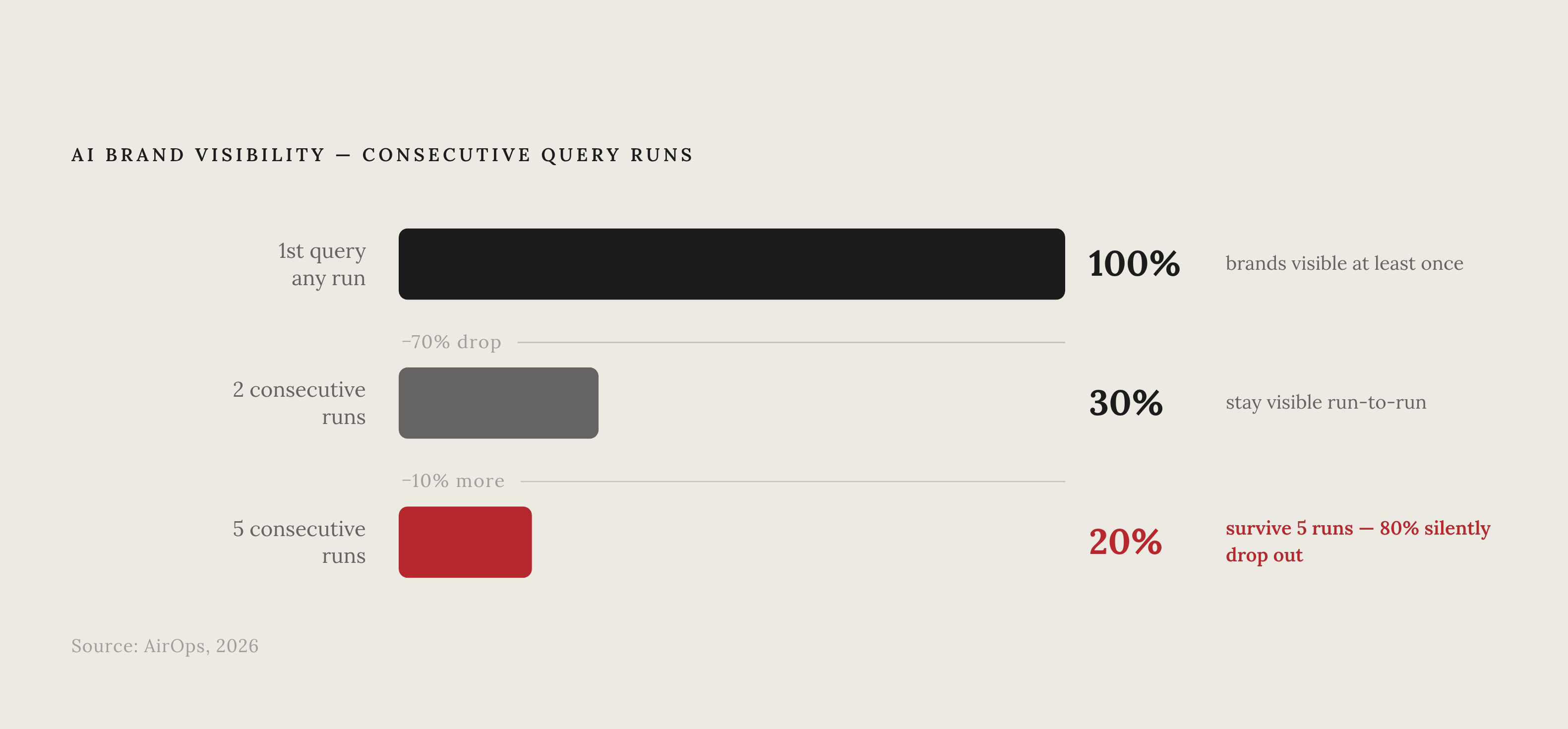
The numbers on instability are stark. AirOps' 2026 research found that only 30% of brands stay visible from one AI answer to the next, and just 20% remain present across five consecutive runs of the same question. Disappearing is the default outcome for brands that treat AI visibility as a project rather than a discipline they maintain.
Call it the single-channel trap. A brand pours resources into SEO and nothing else, or fixes its review management and calls it done, or leans entirely on PR. Each of those, alone, leaves an incomplete picture of the entity, and an AI system fills the gaps with whatever it already has in training memory, or it just skips the brand rather than guess.
The stakes reach further than search visibility. A Gartner survey from May 2026 found that 69% of B2B buyers want to check an AI-generated recommendation against a human sales rep before making a final call. That sounds like it protects brands from AI's mistakes, but read it the other way: the framing an AI applies, favorable, neutral, or wrong, shapes the buyer's expectations before a salesperson ever gets on the phone. A brand misdescribed or skipped at that stage may never make it to the validation conversation at all.
Brand drift deserves its own line here, because it's a consistency failure with a specific fix. If a company launches a new product line, pivots its market, or earns a certification, and that update doesn't land on the high-authority sources AI systems actually verify against, quickly, the model keeps repeating the old version indefinitely. There's no expiration date on stale training data. The fix has to be systematic and ongoing, not a press release fired once and forgotten.
And the risk compounds. EchoTrace's CIKM '26 findings on self-reinforcing exposure patterns cut both ways: brands that missed the early cycles of AI training data face a recovery curve that gets steeper the longer the absence persists, because the loop that rewards existing visibility punishes the brands that started without it.
How to measure where a brand actually stands in AI perception before optimizing anything
Reputation used to live in a star rating. The signals that matter now span entity consistency, sentiment, freshness, and authority, a set that doesn't reduce to a single number on a review page.
Practitioners tracking AI brand perception have pointed to several relevant measures: the sentiment surrounding a brand's citations, the authority of the sources doing the citing, the consistency of the narrative different AI models construct about a brand, and a map of which other brands and concepts an AI system associates with the brand in question, essentially the neighborhood the brand lives in algorithmically.
Share of Model is emerging as the metric that replaces Share of Voice, and Yotpo's framing of it is useful: it measures how often a brand actually shows up, gets mentioned, gets cited, or gets recommended inside AI-generated answers. It's the AI-era equivalent of asking how often a salesperson brings up your product unprompted.
As a standing audit, track how often the brand is mentioned inside the body of an answer, versus how often it is cited as an actual source. The gap between those two numbers tells its own story.
The tooling around this has matured fast. ZipTie.dev tracks Google AI Overviews, ChatGPT, and Perplexity, with query management, full response-text tracking, competitor and source attribution analysis, and something it calls an AI Success Score. Meltwater launched a product called GenAI Lens on July 29, 2025, folding AI monitoring into the same dashboard as existing social and news tracking, so brand teams aren't juggling separate tools for separate eras of the internet. Evident, at evident.so, takes a broader swing at the problem, scoring brands across more than 400 signals and three distinct evaluation dimensions, algorithmic, AI, and human, giving a brand a scored read on how each audience actually perceives it, along with guidance on which gap to close first.
None of these tools solve the whole problem. A brand can hold a strong share of model and still lose, if competitors own the specific attributes customers actually care about. A dashboard that only measures whether a brand shows up can't tell a marketing team whether it's showing up for the right reasons, or being remembered for the wrong ones.
The scale of what's at stake is hard to overstate. Gartner's March 2025 forecast puts roughly 30% of brand perception, by 2026, in the hands of generative AI content rather than traditional media. Once perception shifts to that degree, leaving it unmeasured turns a forgivable oversight into a real business risk.
The multi-dimensional framework brands need to manage AI, algorithmic, and human signals together
Three separate audiences size up a brand at the same time now, and they don't grade on the same curve. Traditional search algorithms reward structured content, link authority, technical hygiene, and recency. AI systems reward entity confidence, off-site consensus, citation density, and narrative consistency. Human audiences reward relevance, credibility, social proof, and whether the brand actually feels trustworthy to a person reading it.
Optimize for one of these while ignoring the others and a gap opens up that competitors will find eventually. A brand with glowing human reviews and messy, inconsistent entity data reads beautifully to a person and disappears to a model. A brand with immaculate technical SEO and no third-party coverage ranks fine in a search engine and gets skipped in every AI-generated answer. Neither brand is doing anything wrong, exactly. Both are just optimizing for an audience of one when three are watching.
Algorithmic trust, looked at closely, is a composite of three things that all have to be true at once: verifiability, or the entity can be confirmed across sources that AI systems already treat as authoritative; authority, or trusted third parties are actually citing the brand; and structural clarity, or AI crawlers can extract and index what's actually on the page. Miss any one of the three and the whole thing wobbles.
GEO carries a similar tri-layer requirement. Content has to be technically accessible to AI crawlers, structured for retrieval at the passage level, and authoritative enough that a model is willing to treat it as a credible source. Clearing two out of three isn't a partial win. It's still a fail, because the third gap is exactly where the model decides to hedge or move on.
None of this is optimizable without a baseline. Without a score across all three dimensions, algorithmic, AI, and human, a brand is guessing at which signal to fix first, and guessing wrong wastes the budget and the quarter. The real value of a framework like this isn't the diagnosis on its own. It's the sequencing: which broken signal is costing the most visibility right now, and what's the highest-leverage fix available today.
What building AI-era brand trust looks like in practice
Start with the retrieval layer, not the owned domain. Updated positioning needs to land on the high-authority sources RAG systems actually pull from, Wikipedia, Crunchbase, major trade and industry press, so a model retrieves the current story instead of defaulting to whatever it memorized during training. That means actively targeting the platforms AI systems cite heavily: community forums, independent review sites, editorial coverage that isn't paid placement.
Entity consistency takes real audit work, not a one-off cleanup. Every major third-party surface, review sites, directories, press coverage, needs to describe the brand's name, products, leadership, and positioning the same way. Contradictions found in that audit need to get resolved, because every mismatched description is a small tax on the model's confidence, and confidence is exactly what determines whether the brand gets named or skipped.
Content has to be built for machines to extract, not just for humans to read comfortably. Schema markup and sequential heading structures give AI crawlers something to parse at the passage level. Adopting llms.txt, where it applies, signals directly to AI retrieval systems what content exists and how it's structured, a small technical step that pays off disproportionately.
Volume and cadence determine how quickly content compounds its visibility gains, with brands publishing the most fresh, citable material pulling ahead of competitors still working at a slower pace. High-volume, consistently updated content compounds its own visibility gains over time, and the brands publishing the most fresh, citable material are the ones pulling ahead of competitors still working off a content calendar built for a different era.
Narrative deserves its own monitoring track, separate from raw mention counts. What matters isn't just whether the brand shows up in an answer, but which attributes get attached to it when it does, and whether that context helps or hurts. Alerts should scale with actual reach: a poorly framed AI answer reaching a large audience of buyers deserves more urgency than a low-reach comment on social media, even if the raw sentiment score looks similar on paper.
None of this is a campaign with an end date. It's perception intelligence: a continuous, scored, multi-dimensional practice of tracking and improving how algorithms, AI systems, and human buyers each evaluate a brand, all at once, on an ongoing basis. Treating it as a project with a finish line, rather than a function that runs every quarter indefinitely, is the mistake most brands are making right now, and it's the mistake that decides who gets named and who gets quietly skipped.