Entity-Based Brand Identity Versus Keyword Positioning
Entity strength in knowledge graphs now shapes how search engines and AI systems surface your brand.
What an entity is and why a brand needs to think of itself as one
An entity is a company, a person, a product, a place, or a concept: a thing with a fixed identity in the real world. It exists independently of language. Searching for the entity in one language or another pulls up the same correct result. Keyword matching can't do that. Entity recognition can, because the system identifies a specific node in a graph instead of scanning for a string of characters.
For a brand, the entities worth building out are the company itself (name, description, category), the executives who run it, the flagship products, and the market category it competes in. Each carries its own record, and the strength of that record decides how confidently a search engine or an AI model will name the brand.
Take "Apple" the fruit against Apple the company. Sorting those two apart is a disambiguation problem, and no amount of keyword density solves it. What solves it is a system that recognizes the company as a node with its own attributes: headquarters, products, executives, financial filings, and links to thousands of other confirmed entities. That's the same mechanism that keeps a regional bank from getting confused with a same-named business three states over.
Brand awareness and entity strength get treated as the same thing constantly, and that's the wrong assumption to build a strategy on. A company can be a household name to actual people and still read as a weak, unclear entity to a machine, if its name and category get described differently across ten different web properties, or if there isn't enough independent material out there to back up who it actually is. An entity is a node connected to attributes and other entities. It is not a name sitting on a homepage waiting to get crawled.
How Google's Knowledge Graph translates entity strength into search visibility
The Knowledge Graph is the database that powers modern search, including knowledge panels and AI Overviews. Google's version is reported to hold an estimated 1.6 trillion facts about 54 billion entities. That scale is the machine deciding, at query time, which businesses get named and which get skipped.
A Knowledge Panel, that box with the logo and key facts sitting next to a search result, is the clearest visible sign that Google has built real confidence in a brand's entity record. Its presence or absence has direct consequences: brands with strong entity records surface more often in AI-generated answers, get pulled into "best of" queries consistently, and survive algorithm updates better, because their authority sits in entity relationships rather than in keyword patterns a ranking update can scramble overnight.
Most SEO teams still get this backwards. They keep optimizing for keyword density on a page instead of building the entity signals that let a system surface the brand for an intent-based query where the exact keyword never appears. Google's language models, its E-E-A-T signals, and its Knowledge Graph all point the same direction: understand what the user actually wants, then surface the most qualified source. The keyword becomes a hint. The entity relationship does the actual work.
Semrush and Datos found AI-generated answers now appear in 13% of Google queries, double the share from just two months earlier. Entity recognition inside the Knowledge Graph is increasingly the gatekeeper for those slots. Most brands still treat traditional search ranking and AI recommendation as the same game, and that assumption is the mistake that costs them visibility.
How large language models learn about a brand and what determines whether they recommend it
Large language models learn about a brand two separate ways, and confusing them leads straight to bad strategy. Pre-training is the first: the model absorbs enormous volumes of web text and picks up statistical patterns about which words and concepts show up together. A brand's baseline "opinion" inside the model gets shaped by everything written about it up through the training cutoff, flattering or not. Retrieval at inference time is the second, available in models with web-search or retrieval-augmented generation built in, where the system pulls in current information the moment someone asks a question. Not every model has that capability, and that gap changes how a brand needs to think about its own exposure.
Confidence appears in word choice. High confidence sounds like "X is excellent for this." Low confidence sounds like "X might be suitable for this." Entity strength decides which sentence a brand gets.
Large language models work like choice architects without a shelf. There's no ranking page to climb, no inventory to inspect. The model produces a short list of recommendations at the exact moment someone asks, and the only way to know what it's saying is to go look at the actual output.
Mention momentum plays a real role: brands referenced often, and referenced positively, throughout the training data start with a recognition edge, which favors companies with long, consistent content histories over newer entrants. Source authority compounds that gap. The average domain age of sources cited by ChatGPT is reported to run around 17 years, meaning these systems lean hard on established, consistently described entities. A brand that exists only on its own website is close to invisible here, no matter how well that website is built.
A study covering 128 brands across multiple languages and markets found Wikipedia the most-cited domain across the languages examined. The same research found Perplexity drawing the large majority of its backbone citations from a relatively concentrated pool of distinct domains. The third-party web is where these systems actually read a brand.
An LLM's sentiment toward a brand can reflect data that's months or years old, so a strong PR quarter doesn't move the needle on how the model talks about the company right away. And because users tend to treat an AI's stated opinion as synthesized, authoritative fact rather than one voice among many, a bad answer at the AI level does more damage than an equivalent negative review, and a good one carries more weight too.
The off-site reality: why third-party corroboration is the decisive signal for both search and AI
Around 85% of brand mentions during early-stage commercial search come from domains the brand doesn't own. Calla Creative's analysis of 250,000 AI citations found third-party content cited roughly three times more often than brand websites. Research out of the University of Toronto put the number even higher: 91% of AI-generated answers cite third-party content over the brand's own pages.
Yext's study of 6.8 million citations found Wikipedia leading inside ChatGPT at 7.8%, with Forbes and G2 tied for second at 1.1% each. That settles an argument that shouldn't still be happening: a Wikipedia presence is close to a prerequisite for a brand chasing AI visibility, not a nice-to-have somewhere on the wish list. Forum threads and comment sections on platforms like Reddit and YouTube have become significant source material for AI answers. Forum threads and comment sections are source material for AI answers now, not background noise nobody reads.
Placement matters as much as presence. Close to 90% of third-party mentions come from listicles, comparison pages, and review roundups, and about 80% of the brands named in those pages sit within the first three positions. A mention buried at position nine on a comparison page does almost nothing, and brands chasing volume over placement are wasting effort.
Each credible third-party mention works as a corroborating signal, the same way a well-sourced Wikipedia article and a Forbes mention both function as independent confirmation to a language model. Corroboration explains where the signal comes from. Whether it stays active is a separate question, tied to freshness and structure.
Content freshness, structured data, and the operational signals that sustain AI citation
AI citation is not a badge a brand earns once and keeps forever. Only about 30% of brands stay visible from one AI-generated answer to the next, and just 20% hold their spot across five consecutive runs of the same query. That's a decay curve, not a landmark achievement, and treating a single strong citation as a finished job is how brands fall out of the pool without noticing.
Pages left untouched for extended periods face a meaningfully elevated risk of losing their citations. Testing from March 2026 found new content entering AI citation pools within three to five business days of publication, while pages left unrevised for 14 days saw a 23% drop in how often AI systems cited them. Structure matters here too: pages using sequential headings and schema markup saw citation rates well above pages without either. Format is a machine-readability signal a crawler can parse, not decoration.
Five layers of entity authority need constant upkeep, and skipping any one of them weakens the rest. Consistent entity description, the brand's name, description, and category staying aligned across every property, is the foundation. Structured data, specifically Organization, Person, and Product schema, tells search systems directly what attributes belong to the entity instead of making them guess. A claimed and verified Google Knowledge Panel remains the single most visible entity record inside traditional search. Third-party authority, accurate mentions across trade press and credible directories, corroborates the entity from outside the brand's control. A maintained Wikidata record and a solid Wikipedia entry function as the reference layer LLMs lean on hardest.
Backlinks split the AI landscape in a way traditional SEO practice hasn't caught up with yet. Google's AI Overview still weighs backlinks fairly heavily, with an average influence score around 3.9. ChatGPT's architecture treats them as a far weaker predictor, scoring around 1.9. The single most important ranking signal in classic SEO doesn't carry the same weight across AI platforms, so a backlink-heavy strategy built for Google won't transfer automatically, and teams that assume otherwise are misallocating budget.
Airops' State of AI Search report found brands earning both mentions and citations were 40% more likely to resurface across consecutive queries than brands with citations alone, which suggests the two signals compound rather than just add together. NP Digital's survey of 100 marketers found third-party citations earning the highest trust scores across AI platforms, between 4.5 and 4.8, with expert-authored content close behind at 4.0 to 4.6.
The zero-click environment's meaning for brands that rely on keyword-driven traffic
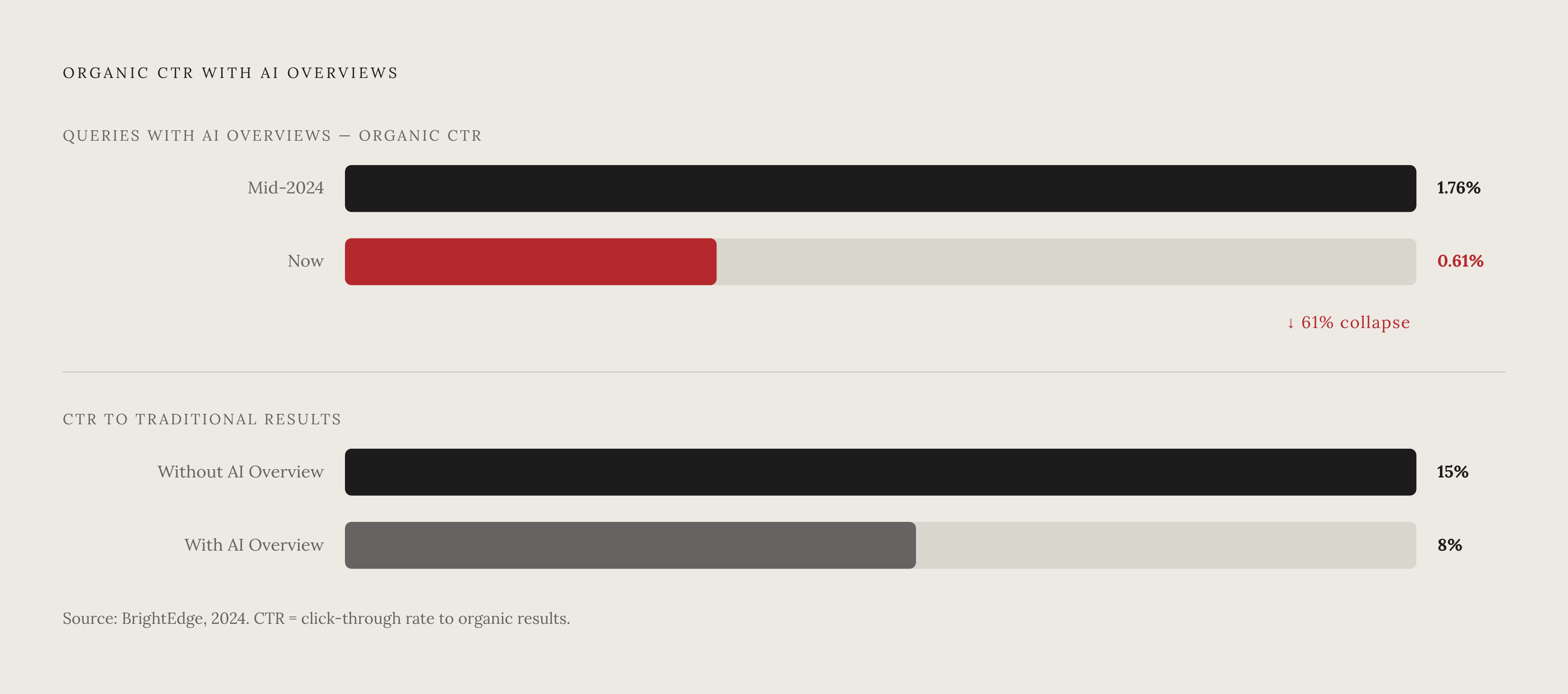
Organic click-through rates on queries featuring Google AI Overviews have fallen 61% since mid-2024, from 1.76% down to 0.61%. That's a collapse in a channel a lot of brands still budget around like it's stable, and the ones still doing so are planning against numbers that no longer exist.
Pew Research Center found that when users encounter an AI Overview, only 8% click through to a traditional result, against 15% when no AI summary shows up, a 47% reduction. Roughly 60% of all searches now end without a single click. Google's AI Overviews show up on 48% of search results pages and reach more than 2 billion monthly users.
The risk for brands still optimized purely around keywords is blunt. If an AI Overview cites a competitor's entity instead of yours, the brand doesn't rank lower somewhere below the fold. It disappears from the interaction completely, because there's no page two to scroll to anymore. A large share of enterprise brands remain invisible to generative AI models despite heavy SEO spending. They're failing because nobody built the entity signals that give an AI system enough confidence to say the name out loud, and the content underneath is not weak.
An AI citation now carries a kind of implicit authority a keyword ranking never had. That cuts both ways: getting named is worth more than it used to be, and getting left out costs more too.
How to measure entity strength and AI perception rather than just tracking rankings
Brand perception inside these systems shifts daily. Most brand-tracking tools still check in monthly or quarterly, and that mismatch is the first thing to fix, before arguing about which metric matters most. A quarterly snapshot of something that moves daily is close to useless on its own.
A working measurement set includes brand mention rate (measured against a category baseline), sentiment score (precision varying by vendor tooling), share of voice (benchmarked against category leaders), recommendation rate (averaging around 12%), and a trust score drawn from available platform and citation data. Citation Share, tracking how often a brand appears in AI-cited sources across major answer engines for category-defining prompts, is the clearest leading indicator of AI-era visibility going into 2026, and it belongs in any serious setup.
LLM perception tracking measures how these systems describe a brand when asked directly. That's a different discipline from traditional sentiment analysis, with its own methodology. Composite scores only earn their keep if they break back down into parts. Morning Consult's Reputation Score combines five components (favorability, trust, value, admired employer, community impact), and a single number that can't decompose into those five is a liability in front of an executive, not an asset.
The training lag mentioned earlier needs its own measurement layer: base model sentiment, what the model absorbed during training, against retrieval sentiment, what it pulls in live at query time. Telling those two apart takes deliberate analysis. A glance at one dashboard number won't do it.
A platform like Evident fits here. Evident scores brands across more than 400 signals along three evaluation dimensions, producing a decomposable entity-health score that a legacy SEO tool or a quarterly brand survey was never built to generate. Measurement has to come before optimization. A brand can't fix a signal it can't see.
The practical sequence for building machine-readable brand identity from the ground up
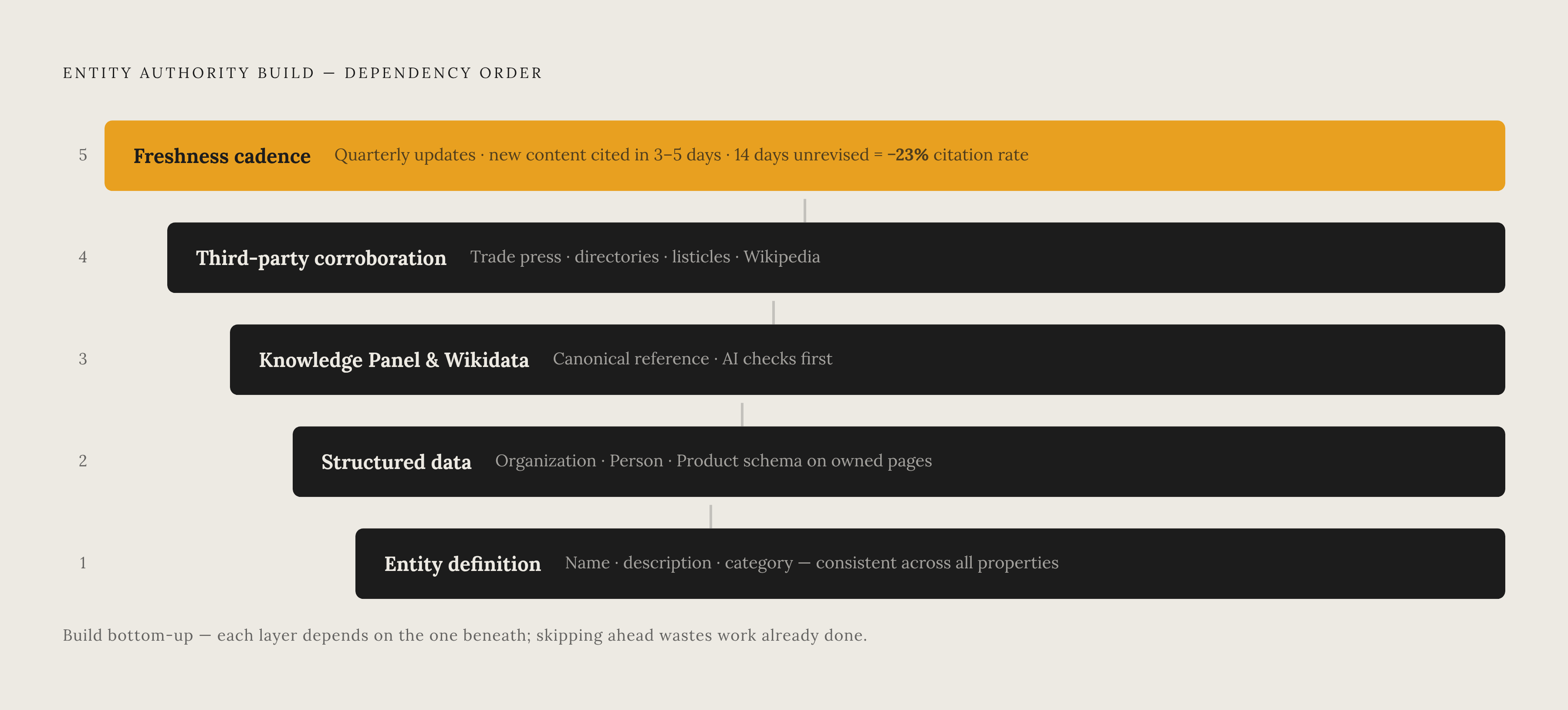
This runs as a sequence, not a checklist, and skipping ahead wastes the work already done. Each layer depends on the one under it holding steady.
Layer one is entity definition and consistency. Lock the brand's name, description, and category language across every property the company owns before touching anything else. Get this wrong and every signal stacked on top of it inherits the confusion.
Layer two is structured data on owned pages: Organization, Person, and Product schema, so search systems read entity attributes directly instead of guessing at them. This is the on-site groundwork that makes every off-site signal legible to a machine later.
Layer three is the Knowledge Panel and Wikidata. Claim and verify the Google Knowledge Panel, and build or improve the Wikidata record. These are the canonical reference points AI systems check against before trusting anything else.
Layer four is third-party corroboration: consistent, accurate mentions across trade press, analyst reports, directories, and community platforms. This is where AI citation probability actually gets built, and it means going after the exact formats these systems cite most: listicles, comparison pages, review roundups, and Wikipedia itself.
Layer five is a freshness cadence, a quarterly rhythm for updating owned pages. New content enters AI citation pools within three to five business days, but anything left untouched past 14 days sees that 23% drop in citation frequency mentioned earlier. Freshness works as an operating habit, not a project with a finish line: a company keeps its financial statements current whether or not anyone's asking to see them that week.
None of it replaces measurement, and none of it works without it either. A brand can build every layer here and still have no idea whether any of it is working, unless it can see, in concrete terms, how algorithms and AI systems are actually describing it back to the people asking.