Rebranding Strategy in an Era of Algorithmic Memory
Brands must reshape their AI footprint alongside their human one.
A rebrand used to end where human perception caught up: new logo, new messaging, a press cycle, then a wait for customers to absorb it. That playbook still matters, but it no longer covers the whole job, because large language models now sit between a company and the people trying to find it, and those models hold their own account of who a brand is, built from training data that can run years behind the truth. Most companies rebrand for humans without checking whether the machines got the memo. That's backwards, because algorithmic perception needs its own campaign rather than being left to catch up after the fact. The algorithmic layer needs its own campaign, running in parallel from day one, not cleanup after the fact.
Gartner projected traditional search volume would fall 25% by 2026 as generative answers took over more of the discovery process. First impressions increasingly form inside an AI-generated summary, not on the company's own site and not in a press clip someone happened to read. A company can execute a flawless rebrand by every traditional measure and still get described to a prospective buyer, in a confident AI voice, using its old name, its old positioning, and problems it fixed two years back. That gap can sit there for months, sometimes years, shaping decisions the brand never sees and can't correct after the fact.
How LLMs form and hold a brand's identity
Training a large language model means feeding it a huge pile of text: news archives, product reviews, Wikipedia pages, forum threads, trade publications, everything written about a company up to the point the data was cut off. None of that turns into a stored fact sheet the way a database entry would. It becomes a statistical map instead, a web of associations in which words that keep appearing near a brand's name become that model's working definition of the company.
Some brands get a head start simply by showing up often, and favorably, in high-quality sources during training, sometimes called mention momentum. Weak signal produces a tell of its own: when a model is unsure about a brand, its language hedges, qualifies, softens. "X is excellent for mid-size logistics firms" signals a brand encoded with confidence. Vague, qualified phrasing signals the opposite, and that difference in tone is itself information about how solid the brand's footprint is inside the model.
A September 2026 arXiv paper on brand retrieval and ranking calls LLMs "emergent choice architects," and the phrase earns its place. There's no shelf to audit here, no ranked list sitting behind the scenes that a company can pull up and check. The model builds a small set of alternatives on the fly, at the moment someone asks the question, and the only way to know what's in that set is to ask and watch what comes back.
Two layers complicate this further. Base training reflects whatever the world looked like months or years before the model shipped. Retrieval-augmented generation then layers current web content on top of that base, so a company mid-rebrand fights on both fronts at once: an old impression baked into training, and a live web presence that may or may not have caught up.
There's an authority problem too. When one article criticizes a company, a reader can weigh the source and discount it if it seems unreliable. Most users don't extend that same skepticism to an LLM's answer. They treat it as a synthesized, neutral verdict. An encoded negative association therefore carries more real-world weight than the same criticism would carry from a single outlet or reviewer.
What a rebrand looks like inside an LLM's training data
Renaming a company does not delete the old identity from the training corpus. It sits there, right alongside the early mentions of the new name, and in most cases it outweighs them by sheer volume. Years of press coverage, reviews, and citations under the old brand don't disappear because a new logo went up. Mention momentum, the same force that helps well-established brands, now works directly against the company trying to move past its former identity.
Ambiguity makes it worse. A new name that's generic, common, or shared with another company drags down the model's confidence, and a model under low confidence tends to default either to the old brand it already understands clearly, or to a completely unrelated one. Sentiment compounds the problem. A critical article from three years back doesn't just influence the one reader who saw it at the time; if it made it into a training set, it can shape how a model talks to everyone who asks about the brand going forward, long after actual humans have forgotten it. Social posts fade. Training data doesn't fade the same way.
None of this requires the old associations to be negative to do damage. A company that spent five years as an SMB tool and then repositioned toward enterprise customers can still get described, confidently, as a "small business tool," simply because that's the dominant context the model absorbed.
Because LLMs generate a brand set rather than pulling from a fixed catalog, the brands with the strongest encoded identity occupy that set by default, and a freshly rebranded company starts from a depleted position in that latent space, competing against incumbents with years of accumulated signal. There's no automatic fix on a timer, either. Training cutoffs mean a rebrand from last quarter may not register with a model at all until the next training run, and even then, years of old-brand content can still outweigh the new, thinner signal.
Which sources shape what LLMs say about a brand
Not every mention counts the same. Models weight by domain authority, not raw mention count, and the data on which domains matter most is more specific than most marketers assume, and less flattering to owned media than most rebrand budgets assume.
A study by Żatuchin, covering 128 brand names across 12 home markets and 13 languages, found Wikipedia the most-cited domain in 11 of those 12 languages. That consistency holds across markets that otherwise differ in language, media structure, and online habits. It's not universal, though: for 46 Polish national brands in the same study, YouTube topped the citation list, and four HR and careers portals combined supplied 637 citations, against 297 for Polish Wikipedia. Source dominance shifts by market, and a rebrand strategy built on one global playbook will miss that local nuance every time.
In the same study, Perplexity pulled from 15,995 distinct domains across 90,276 of its 131,514 backbone citations. The surface area is enormous, yet the weight still concentrates hard at the top of the list.
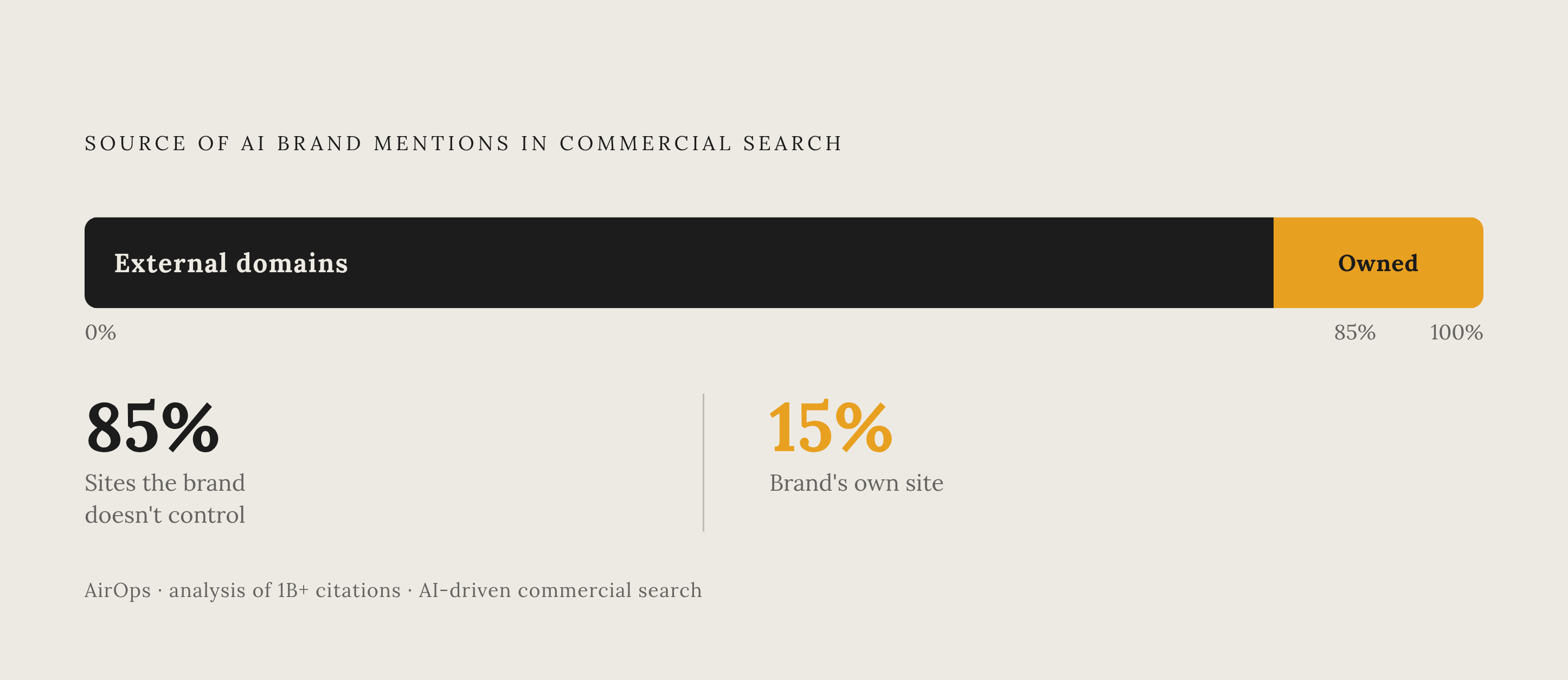
A separate AirOps report, based on more than a billion citations, found that roughly 85% of brand mentions inside AI-driven commercial search come from external domains, not the brand's own site, the number that should reorder a rebrand budget. That's the number that should reorder a rebrand budget. Updating the company website and putting out a press release covers maybe 15% of the relevant surface. The other 85% lives on domains the company doesn't control and can't simply edit. Brands with a strong off-site presence earned AI visibility far more often than brands leaning mainly on their own content, and no amount of homepage polish substitutes for that.
Models act less like neutral directories and more like advisors staking their own credibility on every answer they give. They surface a small number of brands, with confidence, drawn from sources they've learned to trust. Third-party authority, not owned content, is the real battleground for any rebrand trying to move an impression a model already formed.
Current methods for measuring algorithmic visibility, and why standard tools miss the rebrand gap
AI interactions leave almost no trace in traditional analytics. No click, no session, no referral link. A brand can get described unfavorably to thousands of people inside chat responses, and none of it appears on a standard dashboard.
Traditional sentiment tools and reputation management platforms track public posts, review sites, and social mentions. None of that captures what a model says inside a private chat, how it frames a company against a competitor, or which names it lists first when someone asks for a recommendation. The same brand can get strong treatment on one query, say "best enterprise CRM," and vanish entirely on a closely related one like "affordable CRM for growing teams." Standard tools have no framework for that kind of variation, because they were built to count mentions, not to test prompts.
Visibility is also unstable in a way that catches rebranding teams off guard. The AirOps report found only 30% of brands stay visible from one AI answer to the next, and just 20% stay present across five consecutive runs of a similar question. A rebrand that appears to have landed, because it showed up once in a chatbot's response, may be appearing inconsistently everywhere else. A single good result produces a trend it cannot reveal, so it tells a team almost nothing about the pattern that generates it.
Structural details affect whether pages keep earning citations, too. The same report found pages left unrefreshed for a full quarter are three times more likely to lose citations, while sequential headings and proper schema markup correlate with a markedly higher citation rate. Content quality alone doesn't hold a citation in place; the technical scaffolding around it does real work.
A Fuel Online AI SEO report, analyzing 1,000 enterprise brands, found that 62% were invisible to generative AI models despite 94% of those same companies investing heavily in traditional SEO. That gap is the whole argument in one data point: traditional SEO spend does not transfer automatically to AI visibility. Measuring the real picture takes prompt auditing run across multiple models, tracking of citation sources, sentiment analysis inside generated responses, and a running comparison of how a brand is positioned against its competitors. A dashboard built to count clicks won't do it.
The signals a rebranding company must actively reshape
Analysis of AI search trust signals breaks the relevant work into three categories. Entity identity comes first: a verifiable, consistent presence across authoritative platforms, so the new brand name reads as one clear, distinct entity rather than something ambiguous or easily confused with another company. Evidence and citations come second, meaning credible third parties actively vouching for the new positioning, not the company repeating its own claims on its own site. Technical and UX signals round it out: structured data, schema markup, security, and accessibility make a brand legible to machine-reading systems.
This cluster of work can be understood as a composite measure of verifiability, authority, and structural clarity as perceived by machine-learning systems, built through machine-readable signals that reduce ambiguity in how a model interprets the brand.
Given that 85% of AI brand mentions trace back to external domains, the priority for a rebrand's signal campaign sits outside the company's own channels: trade publications, structured directory listings, Wikipedia edits where policy allows them, analyst coverage that uses the new brand name accurately and consistently. Freshness matters on the owned side too, since content left untouched for a quarter is three times more likely to lose citations, so existing owned pages need active, ongoing maintenance under the new identity. Schema markup and clean, sequential heading structure correlate with a markedly higher citation rate in the AirOps data, and that's a cheap fix relative to what it buys.
Mentions and citations reinforce each other rather than working in isolation. The AirOps report found brands earning both together show a 40% higher likelihood of reappearing across separate AI answers, yet only 28% of AI answers include brands with both signals at once. A rebrand chasing press coverage alone, missing the structured citation layer that produces consistent reappearance, leaves a large chunk of the available lift on the table, exactly in the gap between what's possible and what most brands achieve.
An AEO scoring framework published by Nick Lafferty, validated against more than a billion AI citations with a reported 0.82 correlation to actual citation rates, weights criteria including citation frequency, position prominence, domain authority, content freshness, structured data, and security compliance. Read that weighting as a spending order. Citation frequency and position come first. Logo polish comes last, and often does not make the list.
Managing the transition period when old and new brand identities coexist in training data
For months, sometimes years, after a rebrand, a model might still call the company by its old name, tie it to discontinued products, or hedge its language because it genuinely can't tell which identity is current. This transition period holds most of the real risk, and it's also where most companies stop paying attention, because the human-facing rebrand already looks finished.
Disambiguation comes first. If the new name could plausibly refer to more than one entity, confidence drops and the model may default to a competitor with a cleaner, more singular footprint. Fixing that means structured data, an accurate Wikipedia presence, and consistent naming across every platform the company touches. It sounds administrative, and it is, but it's also the load-bearing technical task of this entire phase.
Citation hygiene matters just as much. Old brand mentions sitting in authoritative external sources should get updated wherever the publisher allows it, and new coverage should explicitly name the transition, tying the old identity to the new one so a model encountering both has a clear chain to follow rather than two disconnected names. Ongoing prompt testing needs to run against both the old and new name, checking whether negative sentiment tied to the legacy brand is bleeding into the new one or actually fading over time.
Human-facing signals still matter here, and they feed the AI layer as much as they feed human perception directly. The BrightLocal Local Consumer Review Survey found 81% of consumers check Google reviews before visiting a business, so review profiles and Knowledge Panels have to reflect the new brand accurately during this window, since human buyers and AI retrieval systems draw from the same review data.
One regulatory note belongs here. The FTC's final rule banning fake and AI-generated reviews took effect October 21, 2024, with civil penalties reaching $53,088 per violation. Juicing new-brand review volume artificially during a transition isn't a shortcut worth weighing; it's illegal, and manipulated signal tends to collapse under later scrutiny anyway.
Some old-brand encoding will persist no matter how much signal work gets done, since training cycles run on their own schedule and can't be forced. The realistic goal is building such a heavy, consistent volume of new-brand signal that each successive training run shifts the balance further toward the new identity. That's a sustained campaign with no end date.
Scoring the rebrand's progress across algorithmic, AI, and human dimensions
Most rebrand post-mortems measure human perception: brand tracker surveys, NPS movement, share of voice in paid media. Useful numbers, worth keeping. They also leave the AI and algorithmic dimensions almost entirely unmeasured. A company can declare victory on every metric it tracks while remaining invisible, or wrongly described, everywhere a model actually gets asked about it.
A fuller scorecard tracks AI inclusion rate: whether the new brand name shows up in responses to relevant category prompts, and how that frequency compares to named competitors. It tracks sentiment direction inside generated responses, definitive versus hedged, positive versus qualified, checked separately across ChatGPT, Gemini, Claude, and Perplexity, since citation behavior differs meaningfully by model. It tracks the authority of the sources actually citing the new brand, because ten citations from low-authority domains carry a fraction of the weight of two citations from a domain the model trusts. It tracks whether old-brand prompts are still competing head-to-head with new-brand prompts, or whether that legacy identity is genuinely fading from the model's responses over time. Review volume, review sentiment under the new name, and Knowledge Panel accuracy round out the human-facing side.
No single scoring methodology here is universal, and providers weight signals differently. What matters more than picking the "correct" framework is staying consistent within whichever one a company chooses, so the trend line means something over time instead of jumping around because the measurement itself keeps changing.
The underlying principle doesn't bend. There's no way to know whether a rebrand has actually succeeded inside AI perception without measuring AI perception directly. A clean press launch and an updated website are inputs into that process, not proof that it worked. Rebranding strategy needs measurement instrumentation built in from the first day of planning, not bolted on afterward as damage control. The parallel AI track is a core workstream that runs from the announcement all the way through to the point where the new identity sits stably and accurately encoded across the models now shaping how people find, evaluate, and choose the brand.