Audience Segmentation When Algorithms Redefine Who Sees Your Brand
Algorithms now decide which brands reach audiences before humans ever see them.
Audience segmentation used to run on a simple premise: the brand decides who its customer is, picks the channels that customer uses, and controls the message that reaches them. That premise no longer holds. Similarweb's Generative AI Brand Visibility Index found that 35% of US consumers now start product discovery inside an AI system, compared to 13.6% who still open a traditional search engine first. By the time a person types anything into a search bar, a shortlist has often already been built without them, and the brand had no vote in how it was assembled.
This is not a distribution problem. Distribution is about how an ad gets served once a brand qualifies for an audience. What's happening now sits a step earlier: whether a brand gets judged worthy of appearing. Segmentation strategy has to account for that judgment, layer by layer, or it ends up optimizing for an audience that never sees the brand.
Three distinct gatekeeper layers, each with its own evaluative logic
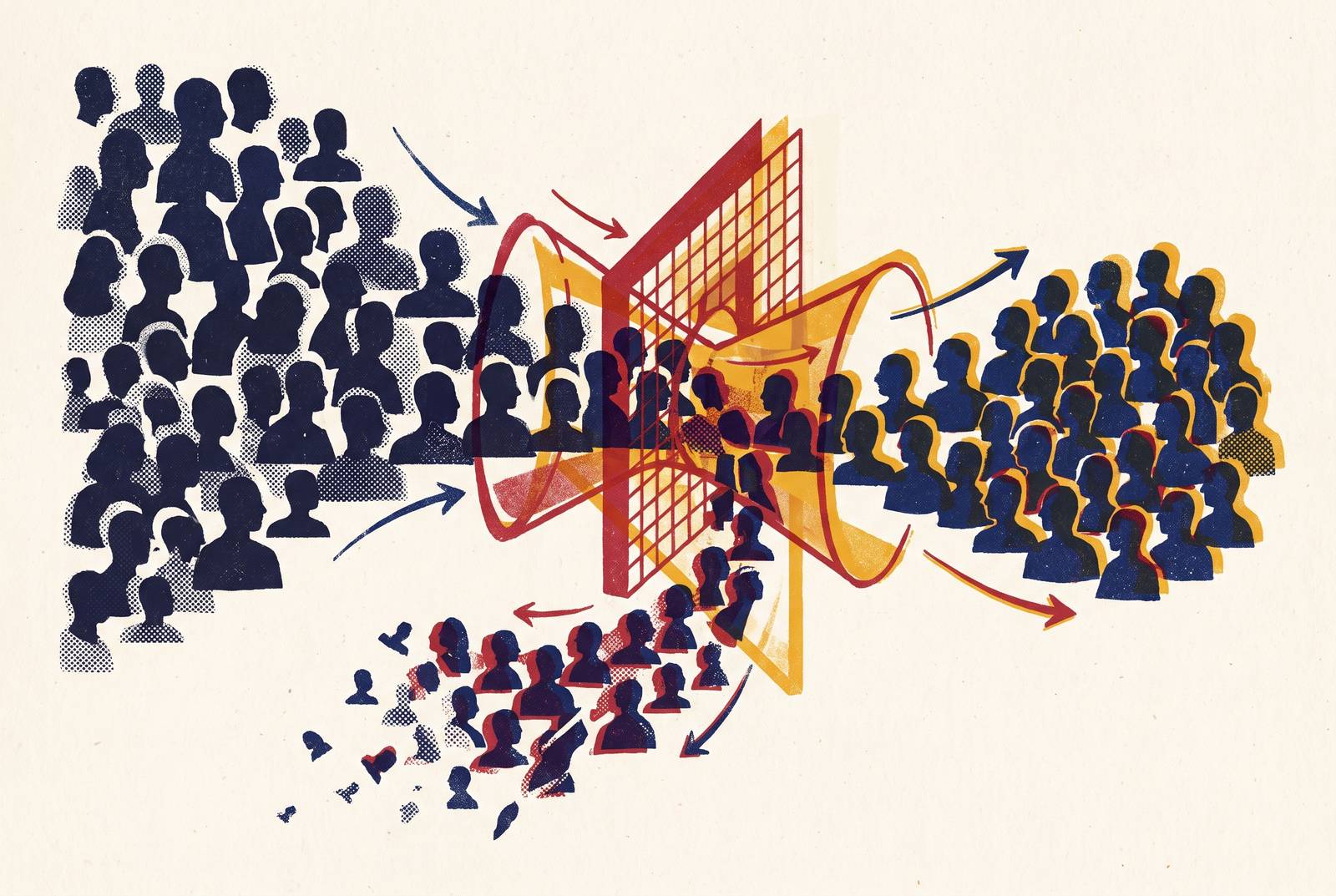
Three separate evaluators now stand between a brand and the people it wants to reach: algorithmic systems (search engines, platform ranking engines), AI systems (large language models, answer engines, AI Overviews), and human audiences. Each one decides differently whether a brand gets surfaced, how it gets described, and whether it gets trusted.
Most brands still pour their attention into the layer they can see and measure, the human one, while the first two quietly decide who ever reaches it. That allocation is backwards, and it's the central mistake this piece is built to correct.
The algorithmic layer runs on pattern-matching. It reads signals like authority, freshness, structured data, and the density of mentions across other sites, at scale, without judgment, the same way for every brand that crosses its path. The AI layer works differently: it doesn't just retrieve information, it synthesizes it, forming something closer to an opinion based on what it absorbed in training and whatever it pulls in at the moment of the query. Then it states that opinion in a confident, authoritative voice, whether or not the underlying facts hold up. The human layer still reads, still weighs credibility, still checks a claim against context, but increasingly it meets a brand only after the other two layers have already filtered and framed the story.
A person who reads a stranger's harsh opinion on social media tends to question the source, wonder about bias, look for a second opinion. Few people extend that same skepticism to a chatbot. Users tend to accept an LLM's sentiment about a brand as synthesized fact rather than treating it with the skepticism they'd apply to a stranger's review. That's a different kind of trust, and it puts far more weight on getting the AI layer right than most brands currently assume.
None of this sits in separate boxes, either. AI Overviews are themselves an algorithmic surface that hands AI-generated synthesis straight to a human reader, so the three layers blend together in the same moment a person searches. A brand that charms its human audience but goes missing or gets mangled inside the algorithmic and AI layers is reaching an audience different from the one it thinks it's reaching. It's reaching whoever survives two rounds of filtering it never saw happen.
What the algorithmic layer uses to decide whether your brand reaches anyone
Google's AI Overviews now show up on 48% of all search results pages and reach more than 2 billion people a month, according to available industry tracking. The algorithmic layer and the AI layer have merged into one discovery surface, and reaching that surface doesn't guarantee reaching a human being on the other end of it. SparkToro's analysis of Similarweb clickstream data found that about 68% of US Google searches in early 2026 ended without a single click. The answer got delivered on the results page itself, and the underlying site never got visited.
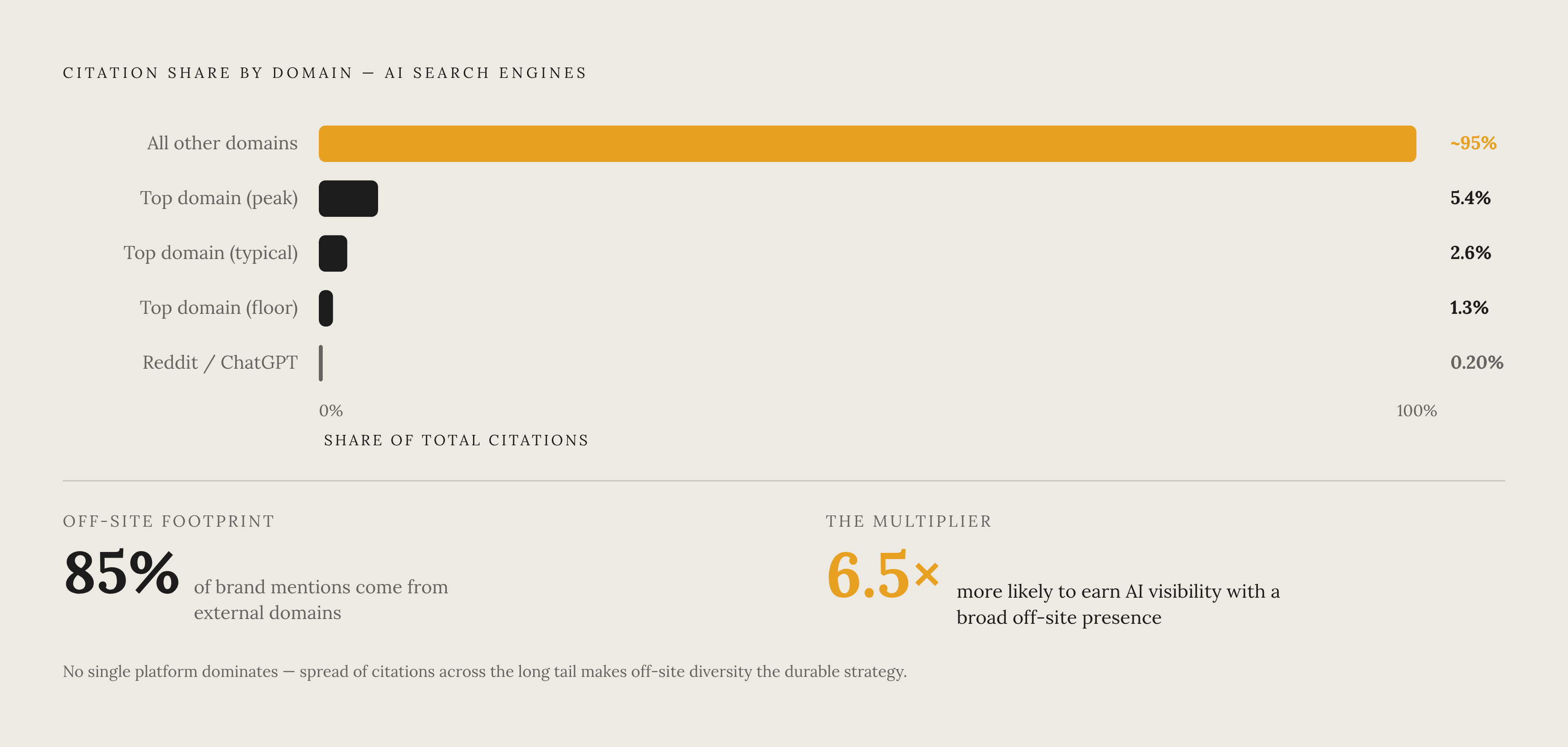
Google no longer just parses strings of text for keyword matches. It's built to recognize real-world entities, hunting for signals of tangible reputation and authority rather than counting how many times a phrase appears on a page. Off-site presence has become the dominant signal in that hunt, and this is where most brands still misallocate effort, pouring resources into their own website when the site is not where the algorithm is looking. AirOps' State of AI Search found that roughly 85% of brand mentions in early brand discovery in commercial search come from external domains, not the brand's own site, and brands with a strong off-site footprint are 6.5× more likely to earn AI search visibility than brands relying on owned content alone.
No single source dominates that off-site landscape, either. Continuous tracking data from Cloro shows the most-cited domain on any given AI engine accounts for somewhere between 1.3% and 5.4% of total citations. Reddit's share of citations inside ChatGPT, a platform many brands treated as the whole game not long ago, had fallen to 0.20% by August 2026, according to available citation tracking data. Building a strategy around dominating one platform means building it around a couple of percentage points of the total citation surface, at best. That's a mistake dressed up as focus, and brands still making that bet are optimizing for a battlefield that's already shrunk out from under them.
AirOps' 2026 data found pages that go unrefreshed for a quarter are three times more likely to lose citations, while pages with sequential headings and proper schema markup see citation rates substantially higher than pages without them. Structure and upkeep change whether a page gets cited; they are not cosmetic. There's also a quieter signal creeping in from the content side: platforms like TikTok and Instagram Reels, along with AI Overviews, increasingly weight markers of authenticity (unscripted pacing, natural audio, someone actually holding and using the product) the same way they weight more traditional authority signals. Algorithmic visibility is something a brand earns by building the signal profile the algorithm rewards, authority, freshness, structure, and off-site mentions. It is not something a brand buys through spend or claims through copy, and no amount of budget substitutes for that work.
How AI systems form a view of your brand that reaches audiences before you do
AI brand sentiment is a specific thing, distinct from star ratings or social buzz. It's how a language model characterizes a company based on the facts it has encountered online, weighted by trust, citation frequency, and perceived expertise. It's an opinion, formed by a machine, delivered with the confidence of a settled fact.
What makes this consequential is that LLMs don't hand back a list of links for a person to sort through the way a search engine does. They synthesize a narrative and deliver it whole. A single prompt now does the work that used to take several searches, a comparison site, and a scroll through a forum thread, and the evaluation that used to happen inside a person's head now happens inside the model before that person ever lands on a brand's site. Research from Yoast found that 54% of users ask AI tools to compare products directly, 47% have used AI to help make an actual purchase decision, and 42% use it for early, open-ended exploration. Brand framing locks in at each of those stages, often before a human notices it happened.
There's a lag baked into all of this that most brands don't account for. An LLM's underlying sentiment reflects training data that can be months or years old, layered against retrieved content that's current as of the query. A company running a strong PR quarter today may still carry a stale, unflattering base-model impression, and Trysight notes that separating the two takes deliberate, specialized analysis rather than a quick check.
The asymmetry in how people receive this information is the real risk. Criticize a brand on social media, and readers instinctively weigh the source. Have ChatGPT say something skeptical about that same brand, and readers tend to take it as settled. The burden of getting it right shifts almost entirely onto the AI layer, because the human on the other end has largely stopped checking its work.
That invisibility isn't hypothetical. It is a reputation layer operating entirely outside a brand's website, its ad campaigns, its review profiles, its social accounts, invisible to every dashboard a marketing team already watches. An analysis by Fuel Online, examining 1,000 enterprise brands, found 62% were effectively invisible to generative AI models, despite 94% of those same companies pouring resources into traditional SEO. The gap has almost nothing to do with how much a brand spent chasing search rankings, and everything to do with chasing the wrong rankings.
It's also not one gap. It's several. A landscape guide from kime.ai notes that ChatGPT, Gemini, Claude, and Perplexity each draw on different training data and produce different framing of the same brand, so strong visibility in one model says very little about visibility in another. A paper submitted to arXiv on September 14, 2026, by Malthouse, Lee, Yang, Pal, and Feng, titled "Evaluating Brand Retrieval and Ranking in Large Language Model Recommendations," is one of the first serious attempts to define what actually causes an LLM to recommend a brand. Tooling is catching up too. Peec AI launched a brand perception product in September 2026 that shows which attributes AI models associate with a company, how those attributes stack up against competitors, which objections keep recurring in AI-generated answers, and where an AI's claims contradict facts the company itself can supply.
Why brands cannot yet trust the AI layer's accuracy about themselves
Accuracy inside AI search is not a solved problem, and the gap is wider than most brands expect. Columbia's Tow Center tested eight major AI search tools on source-attribution queries and found they collectively returned incorrect answers more than 60% of the time. Grok-3 was wrong 94% of the time. Separately, an EBU and BBC investigation reviewed thousands of AI-generated answers and found 45% contained at least one significant factual or sourcing problem. Treating any single AI answer as ground truth, at this point, is a bad bet, full stop.
Consistency is its own separate failure, and arguably the more dangerous one, because it's invisible from the outside. AirOps' research found only 30% of brands stay visible from one AI answer to the next identical query, and just 20% remain present across five consecutive runs of the same prompt. The same research found brands earning both a mention and a citation together are 40% more likely to reappear across repeated answers, yet only 28% of AI answers include a brand with both signals present at once.
None of this means a brand should give up on AI visibility. It means the audience a brand believes it's reaching through AI search may be getting an incomplete picture, an outdated one, or one that's simply wrong. The gatekeeper here favors certain signals and sources over others. It's noisy, and noise left unmonitored compounds. A brand with no visibility into what AI systems say about it has no way of knowing when the story going out is stale, missing, or flatly incorrect, so the human-facing content a marketing team is busy refining may be running parallel to a completely different, higher-authority narrative it never sees.
How current reputation scoring methods fail to capture what the gatekeepers measure
Star ratings and review counts still look like hard data, but in 2026 they mean less than they appear to. AI-generated reviews are cheap to produce at volume, sentiment-analysis tools regularly misread tone and sarcasm, and platform-level scoring algorithms introduce their own biases that have nothing to do with actual customer experience.
Look at how individual platforms behave. Airbnb's rating system compresses almost every listing into a narrow band between 4.5 and 5.0, a range so tight it stops differentiating quality. LinkedIn's endorsement system rewards volume through quick, reciprocal, one-click endorsements that take seconds to give and mean almost nothing, though written recommendations remain far stronger evidence of actual capability. In both cases, gaming the system currently beats the slower work of building a real track record, and that should worry anyone still treating these scores as a proxy for trust.
None of that stops the human layer from responding to these same signals. Research consistently shows that the vast majority of consumers avoid a business with poor reviews, so the old scoring systems still shape behavior even as the algorithmic and AI layers quietly shift their weighting to different factors.
A more useful model of quality weights verified action heavily and treats raw volume with suspicion. One proposed structure runs: Quality Score weights Verified Actions most heavily, followed by Network Density, then Consistency, with Expertise Proofs given the smallest weight. Built this way, fake reviews contribute almost nothing, since they don't touch verified actions, don't build real network density, and don't produce expertise proofs. Existing reputation platforms do solid work for the human layer, combining sentiment, reputation, and listing visibility into composite scores. But they were never built to measure perception at the machine layer or algorithmic citation health, and that's the real gap: a brand's internal sense of its own reputation runs on metrics tuned for the human layer, while the algorithmic and AI layers are quietly grading on a different rubric.
What a multi-layer perception score must capture beyond single-channel metrics
Measurement has to come before optimization. A brand can't fix a distortion it hasn't measured, and it can't segment an audience with any precision if it doesn't know how each gatekeeper layer currently sees it. That means building three distinct scoring dimensions, one for each layer: algorithmic credibility (off-site authority, schema markup, content freshness, citation consistency), AI perception (mention rate, share of model, sentiment classification, entity associations, and the factual accuracy of whatever the AI is claiming), and human trust (review sentiment, response behavior, verified action signals).
Listen Labs' framework for AI brand perception centers on three core metrics for LLM visibility: mention rate, share of model, and sentiment scoring, with scores under 8 flagged as pre-visibility and scores between 75 and 100 marking category dominance. The raw scores matter less than the gaps between them, though. If an LLM describes a brand as "trusted" while direct consumer interviews show real hesitation around the word "reliable," that's a measurable divergence, not a matter of interpretation, and it needs tracking as its own signal rather than folding into either score alone.
That divergence appears across models too, not just between AI and human perception. ChatGPT, Gemini, Claude, Perplexity, and AI Overviews can each hold a genuinely different view of the same company, so tracking has to treat them as separate surfaces rather than one undifferentiated "AI channel." Evident's approach, scoring companies across more than 70 indicators sorted into four pillars (Talent, Innovation, Leadership, and Transparency), shows what a framework built for this actually looks like: multi-dimensional, covering more than one evaluator at once, checked against every layer that now controls discovery rather than just the one a brand is used to watching. The score itself matters less than the prioritized list that comes out of it: which gatekeeper layer has the widest gap, which signals are fastest to fix, and where the brand is simply invisible versus actively misrepresented.
Reconfiguring segmentation strategy under gatekeeper-controlled first cuts
Segmentation can no longer start with "who is our audience." It has to start earlier: what does each gatekeeper layer currently know about this brand, and is that knowledge good enough to route the brand to the right people.
For the algorithmic layer, that means building off-site presence on purpose rather than treating it as incidental, since 85% of brand mentions inside AI search come from external domains and owned content alone won't close that gap. It means treating freshness and structure as baseline requirements rather than nice-to-haves: quarterly content updates, sequential headings, real schema markup, all tied directly to citation rates. And it means spreading citation presence across many domains rather than betting on one, since no single platform controls more than a low single-digit share of total citations. Concentration here is just fragility wearing a different name.
For the AI layer, the work starts with an honest audit of what each major model currently says about the brand, beginning with ChatGPT given its size, then moving through Gemini, Claude, and Perplexity. Wherever an AI's claims diverge from the brand's own documented facts, that gap needs correcting directly, which is the exact workflow tools like Peec AI were built around when it launched in September 2026. Consensus across trusted third-party sources matters here too: LLMs weight cross-source agreement heavily, and a brand's own website is not sufficient evidence on its own. Consistency needs watching just as closely as accuracy, since a brand that appears in one AI answer and disappears from the next identical query has a signal profile that's fundamentally unstable, no matter how accurate any single answer happens to be.
For the human layer, review response behavior remains one of the most fixable gaps sitting in plain sight, and most businesses still leave it sitting there untouched. Authenticity in content (natural pacing, visible product use, the texture of something unscripted) now feeds both human trust and AI citation patterns at once, which makes it one of the rare signals that pays off across every layer simultaneously.
The sequencing matters as much as the work itself. Measurement comes first, then attention goes to whichever layer shows the widest gap, not whichever layer is easiest to talk about in a meeting. A brand invisible to AI is losing its audience before a single human ever gets the chance to form an opinion, which makes that the highest-leverage fix available, even if it's not the most comfortable one to act on. The businesses that manage all three layers as one connected system, rather than as separate departments running separate reports, are the ones that will still know who their audience is once the gatekeepers finish deciding for them.
Sources
- AI Brand Perception Analysis: Complete 2026 Guide
- Why does having insights across multiple LLMs matter for brand visibility?
- The Most Significant LLMs of 2026 for Brands
- Brand Sentiment Analysis In Llms: Complete Guide 2026
- AI Search Trust Signals: How to Make Your Brand Safe to Cite by ChatGPT, Google AI Overviews, and Perplexity (2026 Guide) | ALM Corp
- datareportal.com
- arxiv.org
- globenewswire.com