Multi-Touch Attribution Versus Brand Contribution in AI-Influenced Journeys
AI now shapes buying decisions before customers leave a trackable trace.
Multi-touch attribution was built to solve one problem: figuring out which touchpoints in a buying journey actually deserve credit for a sale.
What multi-touch attribution was built to measure
Single-touch models have a known flaw: they systematically overvalue whichever channel happens to close the deal, while starving the channels that built awareness. Even now, 41% of marketers keep using last-touch attribution despite knowing what it distorts dataslayer.ai. The market moved on regardless. The MTA market reached $2.43 billion in 2025 and is projected to hit $4.61 billion by 2030 azariangrowthagency.com.
The models themselves range from crude to sophisticated. Last-click hands 100% of the credit to the final interaction and remains the default setting for most teams, mostly because it's the easiest thing to measure Adobe. Time-decay weights recent touches more heavily, which suits long B2B sales cycles where the buying committee circles back over months. Data-driven attribution goes further, using machine learning to assign fractional credit across the whole path, though it needs upward of 3,000 monthly conversions to work and has become the default inside GA4 kleene.ai.
Every one of these models rests on the same quiet assumption, treating a touchpoint as only real if it leaves a trace, a click, a session, an impression logged somewhere in a system a marketer can query. That assumption held up fine for a decade of channel proliferation. 75% of companies now use multi-touch attribution, and companies that switched saw cost per acquisition improve by 14–36% azariangrowthagency.com dataslayer.ai. Position-based (U-shaped) attribution allocates 40% to the first touch, 40% to the last, and 20% to the middle touches, acknowledging both introduction and close attnagency.com. That assumption is what AI-influenced journeys destroy (but save this for the next section).
The modern buying journey before any tracked click occurs
The journey has gotten longer and less linear at the same time. More strikingly, modern B2B buyers now complete 70% of their purchase journey on their own, independently, before they ever pick up the phone to talk to sales azariangrowthagency.com.
That independent research phase isn't a straight line from awareness to purchase. It looks more like awareness, then a dark period of research nobody at the vendor can observe, then a re-emergence that occurs when the buyer already arrives close to a decision. Attribution tooling only ever catches that re-emergence. The dark period itself, the part where the actual deciding happens, increasingly plays out inside AI platforms: ChatGPT, Perplexity, Google AI Overviews, Google AI Mode, Gemini, Microsoft Copilot, Anthropic's Claude.
Consider how much search itself has already gone dark. 68% of searches end without a click at all, and because Google still controls roughly 91% of search volume, that zero-click share represents an enormous number of real research sessions that no analytics dashboard will ever register azariangrowthagency.com digitalapplied.com StatCounter. Half of marketers, 49% of them, have already watched their own search traffic shrink because AI-generated answers are satisfying the query before a human ever reaches their site HubSpot. The gap MTA was already failing to close was never going to stay a rounding error azariangrowthagency.com. It just got structurally wider. B2B buyers in 2026 average 8–12 touchpoints before converting, while B2C buyers in considered categories often see 5–8 brand interactions kleene.ai.
AI touchpoints versus channels MTA was designed to credit
Traditional SEO gave brands something to hold onto: impressions, clicks, rankings, all trackable through tooling built over two decades. AI-driven brand mentions offer none of that. A brand's AI-driven mentions happen without a trace in analytics. There's no native way to know how often a brand comes up in AI answers, in what context, whether the description is even accurate anymore, or how it stacks up against competitors in the same response.
The problem compounds because of how people treat what AI tells them. When ChatGPT or Claude describes a brand, users tend to take it as settled fact, not as one opinion floating among many. That's a different kind of influence than a banner ad or a search snippet ever had, and it's harder to detect and harder to argue with. AI search also tends to name just one, two, or maybe three brands in a ranked list or comparison. Getting mentioned or left out functions as a binary outcome, not a matter of ranking position the way page-three search results might. When a model puts a brand's name forward, it's closer to an endorsement than a retrieval result, staking a bit of its own credibility on the recommendation.
MTA's whole logic depends on having an event to assign credit to. AI influence, by design, produces no event. A buyer shows up at a website already sold, already down to a shortlist, or already ruled a brand out entirely, based on research conducted days earlier, and the attribution log records nothing but the final click that brought them in.
The available workarounds only patch part of the hole. Self-reported surveys asking "how did you hear about us?" can include ChatGPT or AI search as an option. UTM tagging catches AI referral clicks on the rare occasions platforms pass that data through. Systematic query testing lets a team monitor how often it gets cited. Useful, all three, but partial: they catch fragments of AI influence after the fact and miss the formation of the consideration set itself, which matters most. Traditional attribution counts clicks. AI influence forms beliefs. Those are not the same measurement wearing different clothes: traditional attribution is a click-counting system, while AI influence is a belief-formation system, and they are measuring different things.
The scale of AI as an active evaluator, why this gap is not marginal
This isn't a niche behavior confined to early adopters. Over 800 million people use ChatGPT weekly, and Perplexity's user base has grown 370% year over year snezzi.com azariangrowthagency.com. These are serious questions people are asking, seeking product recommendations, software comparisons, and direct purchasing advice. They're asking for product recommendations, software comparisons, and direct purchasing advice.
Yet most brands have no idea where they stand in that conversation. A 2026 report analyzing 1,000 enterprise brands found that 62% were invisible to generative AI models, even though 94% of those same companies had poured resources into traditional SEO almcorp.com omnibound.ai. Good search rankings and AI invisibility can coexist in the same company at the same time, which tells you these are separate evaluation systems running in parallel, not two views of the same thing.
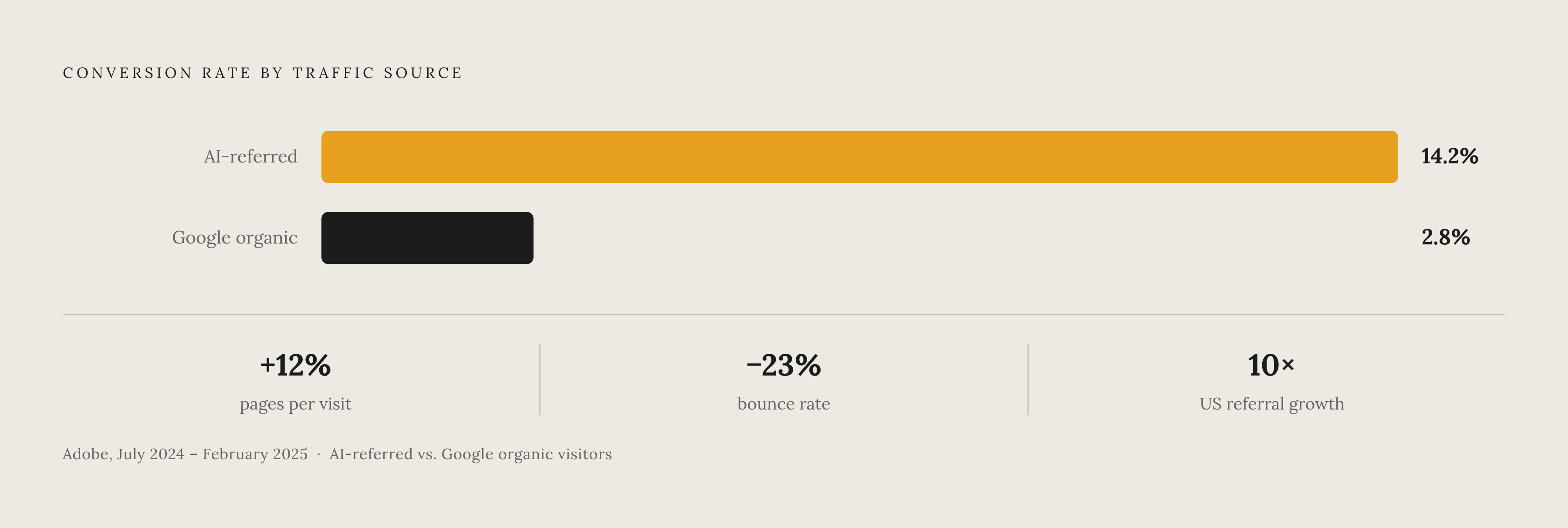
AI-influenced buyers are the highest-quality segment of the funnel, and they're also the segment attribution models are least equipped to see. It's no surprise that 58% of marketers already call AI referral traffic high intent, even without a clean way to measure why HubSpot. AI-referred visitors convert at 14.2% on average versus 2.8% for Google organic, because the buyer arrives pre-informed and recommendation-primed omnibound.ai mersel.ai dataslayer.ai. Adobe research covering July 2024 to February 2025 found that web traffic from generative-AI-driven referrals increased more than 10× in the United States, with AI-referred visitors browsing 12% more pages per visit and showing a 23% lower bounce rate omnibound.ai.
Inputs AI systems use to form their opinion of a brand
AI models don't form an opinion of a brand the way a human forms one, through ad exposure or years of brand campaigns. They form it out of training data patterns, structured data signals, and how consistently the brand shows up as a distinct entity across the web. Advertising reach barely factors in.
That opinion gets built along four dimensions: accuracy, depth, sentiment, and how often the brand gets recommended at all, each of which needs its own separate intervention to shift. Building on that, credibility gets assessed through three broad categories of signal: entity identity (can the organization be verified consistently across platforms), evidence and citations (do credible third parties vouch for the brand), and technical or UX signals like site security, load speed, and accessibility.
Earned media carries disproportionate weight here. Machine learning systems trust third-party citations more than they trust a brand's own owned content, no matter how well-produced that content is. PR targeting has badly missed this shift. A 2025 study found only 2% overlap between the journalists PR teams pitch and the journalists AI models actually cite omnibound.ai. Most PR programs are aiming at an audience that has almost nothing to do with AI visibility omnibound.ai.
And this is the detail that should unsettle anyone leaning entirely on SEO as a proxy for AI visibility: only 38% of AI citations trace back to top-10 organic results mersel.ai Adobe. Ranking well on Google does not guarantee a brand gets cited by the models increasingly standing between a brand and its next customer. Different models compound the uncertainty further, since ChatGPT, Perplexity, and Gemini pull from different data sources and different retrieval architectures, and routinely produce meaningfully different descriptions of the exact same company. Brands are being sized up and ranked by systems using criteria most attribution stacks were never built to observe, and that most marketing teams aren't actively managing at all. Sites present on 4+ platforms are 2.8× more likely to appear in ChatGPT recommendations, and schema markup improves LLM discoverability by 67%, though it is alone insufficient mersel.ai.
Brand contribution as a framework for AI exposure
MTA asks which click deserves the credit. Brand contribution asks a more upstream question: what shaped the buyer's belief system before they ever entered a funnel a marketing team can track? That's a meaningfully different question, and it demands a different kind of measurement.
B2B buyers are quietly building their shortlists inside AI research sessions that no one on the vendor side can see, cannot influence as it happens, and cannot correct if the AI gets something wrong. A brand left out of that consideration set has been ruled out before the sales team even knows a deal exists, in a conversation the brand was never invited to.
Answering that upstream question doesn't require event-level tracking the way MTA does azariangrowthagency.com. It requires checking the conditions that make conversion possible in the first place: the brand shows up accurately in AI responses for category queries, the sentiment attached to it in AI output leans positive, neutral, or actively harmful, and its entity signal stays consistent across the platforms AI draws from. Marketing Mix Modelling offers a useful comparison point here: MMM has always measured channel contribution in aggregate, without tracking individual users, and the AI perception layer works the same way, aggregate by nature, not click by click. A brand health survey tells a company what humans think of it. An AI perception audit tells a company what AI systems say about it, and what AI systems say is starting to shape what humans decide before they've even formed their own opinion. These are two separate disciplines, and brand contribution is the framework that finally gives AI's role in that process a legitimate seat in the measurement stack.
What measuring AI brand contribution requires in practice
Reputation scores that worked as rough proxies in the past won't hold up here. High star ratings and large review counts can look reassuring on the surface but mean almost nothing beneath it, because AI-generated reviews are cheap to produce at volume, sentiment tools misread tone constantly, and platform algorithms introduce their own biases that have nothing to do with actual customer experience, and this gap is what makes the underlying scores unreliable. Airbnb's rating system is the clearest illustration of inflation: it pushes scores toward a 4.8-plus average so consistently that the number stops differentiating quality at all, and LinkedIn endorsements have the same issue, they take almost no effort to rack up. Neither kind of signal is what AI systems actually weight when forming a judgment.
A sturdier model weights verified actions at 0.4, network density at 0.3, consistency at 0.2, and expertise proof at 0.1, a structure that naturally punishes fake review volume because fake reviews don't contribute to any of those four factors. Whatever scoring approach a team lands on, it needs to actually capture several things: citation frequency, meaning how often the brand appears in AI responses to relevant queries, sentiment and framing, meaning whether the AI's characterization is positive, neutral, negative, or outdated, cross-platform consistency of the brand's entity signals across the sources AI draws from, and the competitive gap between a brand's AI presence and its category peers in the same response.
Multi-signal scoring across algorithmic, AI, and human evaluation dimensions turns AI perception into something quantifiable and auditable, rather than a vague, soft impression a team argues about in a quarterly review. Measurement has to come before optimization, because without some kind of scored baseline, there's no way to know whether interventions, earned media pushes, entity consistency cleanup, citation-first content, are actually moving anything. Teams without full measurement infrastructure can still start somewhere concrete: run systematic query tests across ChatGPT, Perplexity, and Google AI Overviews for category and competitive terms, audit which outlets and journalists AI platforms actually cite in the brand's category and confirm the brand shows up there, and add an AI-source option to standard "how did you hear about us" intake forms to start building even a rough layer of self-reported data.
Running MTA and brand contribution together: what each layer answers
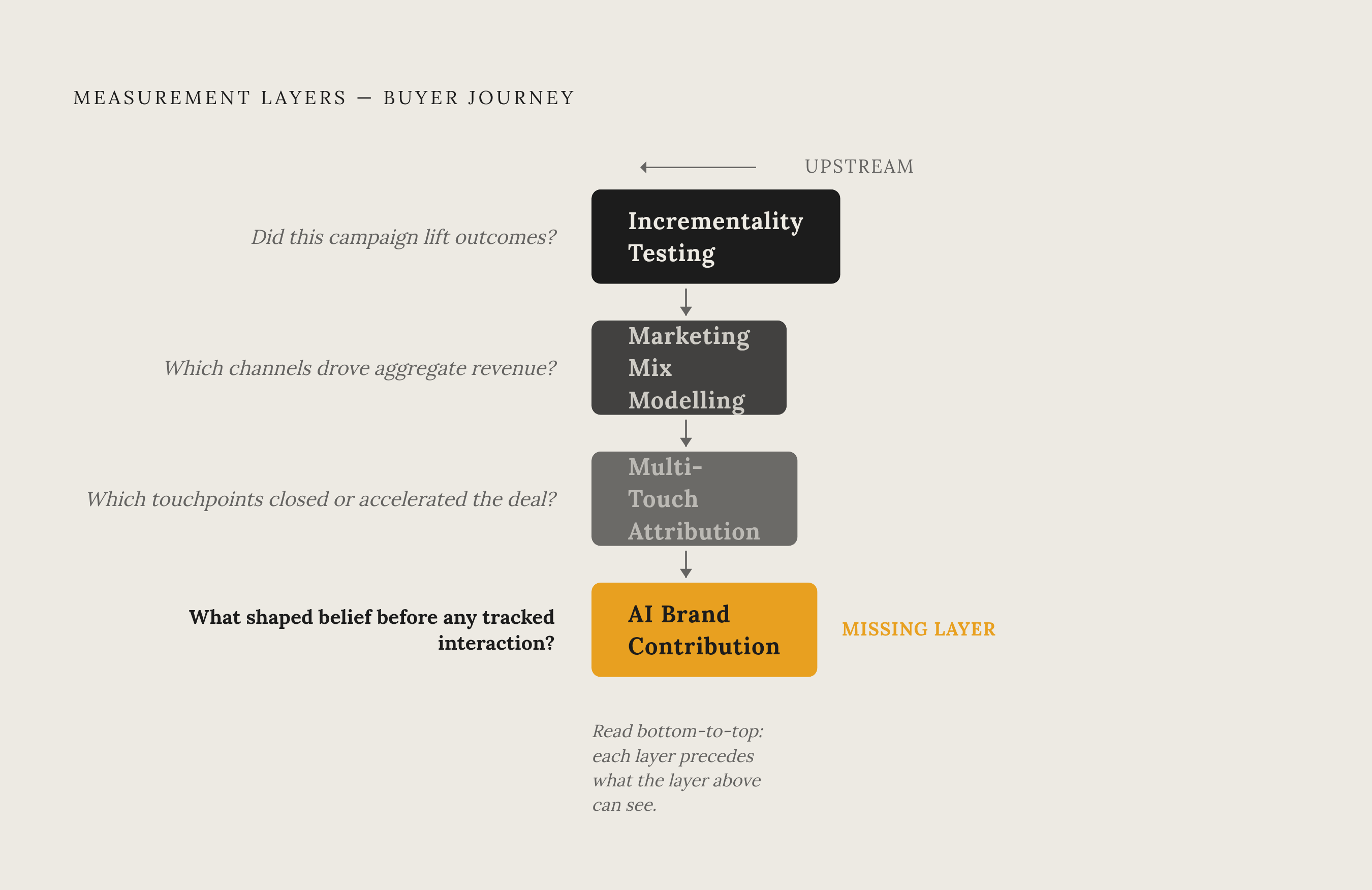
MTA and brand contribution aren't competing for the same job. They sit at different layers of the same journey and answer different questions. MTA answers: given a buyer who has already entered the trackable funnel, which touchpoints actually accelerated or closed the deal? Brand contribution answers something that comes before that: what shaped the buyer's entry into the funnel, carrying a favorable or unfavorable view of the brand before a single tracked interaction happened.
The comparison to Marketing Mix Modelling holds up well here. Most serious attribution stacks already run MMM, MTA, and incrementality testing side by side, precisely because each one answers a question the others can't. AI brand contribution is the fourth layer that stacks need to be building toward now, not eventually. Skipping it means MTA keeps making the same mistake last-click attribution has always made, over-crediting the bottom-funnel channels that happen to capture demand they didn't actually create, except now that demand was primed upstream by AI research the attribution system never saw coming.
The stakes are sharpest for B2B teams, where AI tools have become a standard part of initial category research, vendor shortlisting, feature comparison, and competitive evaluation, all of it happening well before a prospect ever fills out a contact form. Attribution built only for the visible half of that journey will keep missing the half that decides how the story ends.
Sources
- 75% Use Multi-Touch: Attribution Models Compared 2026
- AI marketing attribution in 2026: a guide to multi-touch attribution after cookies
- Multi-Touch Attribution 2026: AI Search Tracking Guide
- AI Customer Journey Mapping: First Touch to Conversion Guide
- multi channel attribution unified customer journey tracking cross platform optimization 2026