Building Brand Communities That Resist Algorithmic Displacement
Communities built on genuine member input shape how both humans and AI systems evaluate brands.
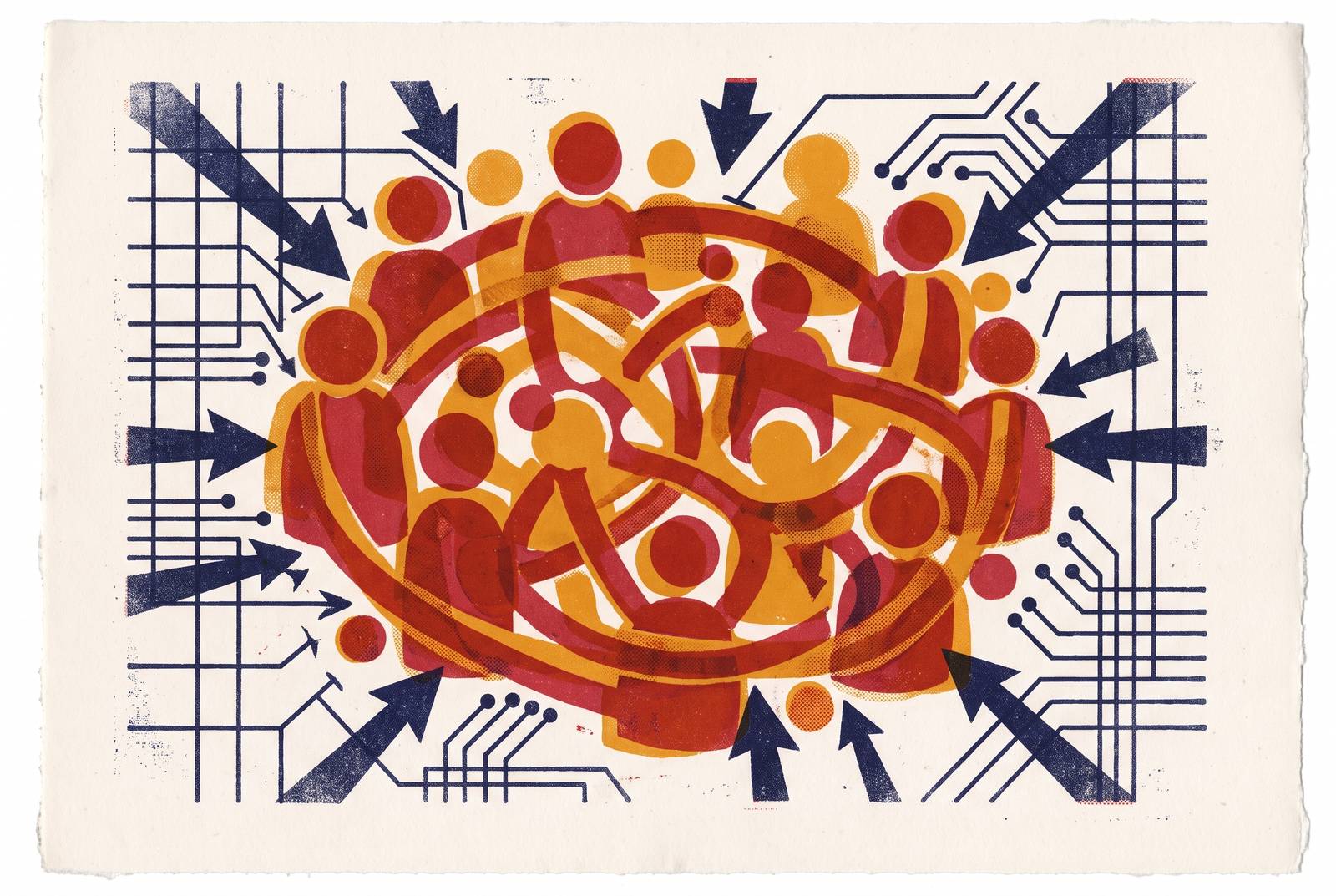
Brands now compete in two evaluation contests at once, and winning one no longer guarantees survival in the other. The first contest is for human trust. The second is for machine trust, and old search-era tactics only get you partway to either one. A search engine worked as a router: it took a query, matched it against an index, and sent the user somewhere else to find the answer. AI answer engines behave differently. It synthesizes an answer inside the interface itself, naming only a handful of brands in any given response, so the user has little reason to click past the summary. At the same moment, human audiences are pulling back from the public, algorithmic feed and moving into private communities, Discord servers, and the parts of the internet sometimes called dark social, looking for connection they can verify with real people. The risk this creates is double-sided: a brand can be left out of AI-generated recommendations entirely while also losing the human audience that has grown wary of content it suspects was never written by a person. Neither failure is visible on a traditional dashboard. Both are happening to brands that have not changed their strategy.
How AI systems form opinions about brands
Large language models don't research a brand in the moment a user asks about it. They draw on patterns learned across a huge body of training material: crawled web pages, articles, reviews, forum threads, documentation, and the sites that other sources treat as authoritative. A brand's own website is one input among many, and usually not the one carrying the most weight. What Reddit threads, G2 listings, Trustpilot reviews, trade publications, and community forums say about a company shapes how an AI model talks about it more than anything the company publishes about itself. That shift in whose words matter is the central fact of AI-era brand perception, and it is easy to underestimate because it is invisible in the output. A model doesn't list links the way a search results page does, so it just talks. It just talks, and the talk reflects whatever pattern was strongest in the material it learned from.
That pattern appears in small but consequential choices of phrasing. A model that lists two competitors before mentioning a brand, or that describes a brand as one that "also offers" a feature or "attempts to provide" a service, is repeating a hierarchy it picked up from how authoritative sources already rank that brand against its competitors. The same holds for confidence. When a model is well-supported by consistent, corroborating signal, it writes with more certainty: "X is excellent for this use case." When the signal is thin or conflicting, the language hedges: "X might be suitable for this." When discussion of a brand is genuine and comes from third parties, that is what pushes a model toward the confident version of that sentence.
The hardest part to manage is how a user receives that sentence. When an AI model states an opinion about a brand, people tend to treat it as a synthesized, neutral verdict, not the opinion of one commenter on one platform. That trust is not extended to a random post on social media, which a reader can dismiss as one person's take. An AI answer carries an air of aggregation, as though it weighed everything and arrived at a conclusion, and that perceived authority is why negative sentiment from a model does more damage than negative sentiment from an individual, and why positive sentiment, once established, tends to stay fixed in place across many future queries.
Why content saturation has made generic brand signals nearly worthless to every evaluator
A second force compounds the first: the glut of content built on the same handful of foundational AI models is producing a flattening effect across the web often called model collapse. When many brands lean on the same underlying systems to generate marketing copy, you get outputs that drift toward a statistical average. The result reads like it came from a committee rather than a company, and whatever made the brand distinct gets smoothed away in the process. If more content was always better, volume-based strategies would still work, but now they actively work against a brand. Flooding every channel with average material doesn't build presence; it trains the audience to filter the brand out as noise, the same way you learn to skip past ads after seeing enough of them.
The same homogenization problem hits AI evaluators from a different angle. When a brand's footprint beyond its own site is made up of generic content indistinguishable from what a hundred competitors are also publishing, there is no sharp pattern for the model to lock onto. Signal density stays low. Confidence stays low. And the language a model produces about that brand stays hedged because there is nothing distinct enough in the record to produce a confident answer, not because the brand did anything wrong. Sameness, not any particular tool or tactic, is what makes a signal disappear to both a human reader and a machine evaluator at once.
The Human Audience's Response to Algorithmic Saturation
AI systems filter brands through pattern strength, but human audiences are responding to the same saturation by relocating. The State of Brand reports that only a small share of users in 2026 say they feel excited about AI, a figure down sharply from two years earlier, with a majority of Americans now describing something close to AI fatigue. That fatigue has started to shape brand strategy directly. Aerie, Equinox, and Almond Breeze all ran campaigns in early 2026 that explicitly called out AI-generated content as something they were avoiding. iHeartMedia built an entire campaign around the phrase "guaranteed human." Apple TV's series Pluribus added a line to its end credits reading, "This show was made by humans." None of these are incidental marketing choices. They are responses to a market that has started treating human origin as a selling point in its own right.
MindStudio describes this as a "human-made premium," the extra value a consumer assigns to a piece of work once they know a person made it. That premium raises willingness to pay and strengthens trust, and it is a competitive position that AI-first companies cannot occupy by definition, no matter how good their output gets. Audiences chasing that premium are migrating toward private groups, Discord servers, and branded community spaces, where peer validation and conversation happen in ways an algorithmic feed cannot replicate or easily surveil. These spaces bypass the impersonal recommendation engine entirely, offering the kind of proof a person actually weighs: another member saying something worked, not a ranking algorithm suggesting it might.
Audiences are not passive about this shift. McDonald's Netherlands released an AI-generated Christmas ad and pulled it after public backlash, with comments branding it "AI slop." The episode is a clear signal that audiences now actively police the line between human and synthetic content, and that a brand misjudging that line can lose public standing quickly and publicly.
Why brand communities generate the specific signals that all three evaluators reward
The two threads, how AI models form opinions and where human audiences are relocating, meet at a single point: an active brand community. If you let a real community run on normal participation, it produces the exact multi-layered pattern of third-party signal that language models weight most heavily, and that the broader algorithmic ecosystem treats as credibility evidence. It's a structural overlap between what builds human trust and what builds machine trust.
Community activity generates third-party corroboration without a brand having to manufacture it: member reviews on Trustpilot and G2, forum threads on Reddit, user-written articles, and unprompted mentions scattered across platforms the brand doesn't own. When a model forms an opinion about a brand, it reads precisely that category of source most heavily. Brand search volume, one of the clearest correlates of how often AI systems cite a brand, rises on its own when a community is active, because members search for the brand by name, bring it up in unrelated conversations, and point other people toward it. Community activity also spreads naturally across platforms rather than piling up on one owned channel, and when a brand has presence across many platforms, it has a higher chance of being mentioned by an AI system. Community conversation keeps renewing, too: new questions answered in public, new member content published, new threads started, all of which keep a brand's footprint inside the freshness window that AI crawlers prioritize.
Call this the signal density principle: a language model looks for several aligned proofs that corroborate each other. An active community produces reviews, forum mentions, expert commentary, and recurring entity associations all at once, which is exactly that corroborating pattern. Creators and community managers matter here because they carry attributable expertise and lived experience, and generated content cannot fake that. In 2026, creators increasingly function as curators and mentors inside these spaces, and when they participate, they generate a signal that both human readers and AI evaluators trust more than anonymous volume.
None of this can be replicated by buying fake reviews. A paid review campaign can add review count, but it cannot produce verified behavioral patterns, real network density among genuine users, or the consistency of expertise that a real community builds over time. Authentic community activity is harder to fake by its structure, so both human audiences and algorithmic evaluators trust it more than anything manufactured.
Building a community structure that generates durable signals rather than surface engagement
Not every community produces this effect. If a community hardens a brand's perception or simply generates vanity metrics, that comes down to a handful of structural decisions made early.
The first is ownership. If a community is built entirely on a third-party social platform, it lives at the mercy of that platform's algorithm changes, which can suppress reach or quietly reshape how members treat each other and the brand. A community built on owned infrastructure, a branded forum, a chat server the brand controls, an email-connected hub, gives the brand a direct line to members that a platform policy change cannot sever overnight.
The second is who shows up inside it. Creators and community managers function as amplifiers of the signals a community produces, not just hosts of conversation. Authentic creators bring narratives and lived experience that generated content has no way to reproduce, and their engagement inside community spaces produces attributable expertise signals that AI evaluators weight heavily when forming an opinion about a brand.
The third is where the community's output ends up. A conversation that stays locked inside a private channel never reaches a language model's training data or a search crawler's index, no matter how valuable that conversation is to the people having it. The perception value of a community extends past its membership only when there's a structured way to move insight out into public view: member case studies published openly, questions answered where anyone can find them, expert commentary placed on open platforms.
The fourth is where AI belongs inside the structure, and where it doesn't. AI tools have a legitimate role in moderation support, in personalizing a member's experience, and in handling the logistics of running a large group. What should stay unmistakably human is everything member-facing and everything carrying the brand's voice. AI runs the decisions, humans create the content, and the consumer never sees the machinery behind either one.
Tracking whether community activity is moving the perception signals that matter
Investing in a community without measuring it produces activity, not accountability. The signals a community generates have to be tracked at the level where a brand can actually be displaced; vanity metrics look encouraging regardless of what's happening underneath.
Engagement rate, member count, and post volume are the numbers most community programs default to, and none of them answer the questions that matter now: is the brand's AI perception improving, is its Share of Model rising, is the third-party signal footprint the community produces actually changing how language models describe the brand to someone who has never heard of it. Tracking that requires watching three dimensions at the same time: how AI models describe and recommend the brand, including sentiment, confidence, and how it's positioned against competitors; how algorithmic systems read the brand's authority and entity signals; and how human audiences read the brand's credibility day to day.
Hope Frank's description of the stakes is direct: "If an AI agent doesn't trust your data or your privacy posture, you simply disappear from its recommendations." If you disappear inside an AI answer engine, you get none of the usual warning signs. There's no notification, no ranking drop on a familiar dashboard, no public complaint to respond to. The brand is simply absent from the answer, and nothing in the ordinary toolkit tells anyone that it happened.
Share of Model, the frequency and favorability with which a generative AI system mentions a brand across relevant category prompts, is emerging as the successor to share of voice for this environment. It is a probabilistic measure and has to be tracked across many different query contexts, not just on the queries where a brand already looks good. Attribute alignment matters inside that tracking: a model might describe a brand warmly on a general query about its category, then introduce hedges and qualifications when the same brand appears in a head-to-head comparison. Watching that gap shows exactly where community-generated signal is doing its job and where more work is needed.
You need to establish a perception baseline before you scale up community investment, so you can credit whatever improvement follows to the community work itself, not lose it among everything else that is changing at the same time. This is the step that turns community building from a branding instinct into a program with a measurable return, and it is the layer platforms built for perception intelligence now exist to track: how AI models, algorithmic systems, and human audiences are each, independently, forming an opinion of a brand, measured consistently enough to know whether that opinion is moving in the right direction.