Third-Party Review Platforms as AI Training Data for Brand Perception
AI systems trust what strangers say about brands far more than brands say about themselves.
A brand's own website, press releases, and marketing copy carry almost no weight in how an AI system comes to understand that brand. The belief gets built from training data and, in systems with live retrieval, from whatever the model pulls in at query time, and in both cases the sources doing the heaviest lifting are third parties: review platforms, analyst reports, editorial coverage. Analysis of AI research pipelines by Listen Labs identifies this as the core failure mode companies run into when they try to manage their AI presence the way they'd manage a website: the sheer volume of owned content a brand publishes contributes almost nothing to how visible or well-represented that brand becomes in AI outputs. Third-party behavioral endorsement moves the needle: the record of what independent people and publications have said about the brand, not what the brand has said about itself.
This produces a specific and avoidable kind of error. A company that has invested heavily in its own site, its blog, its product pages, but has thin coverage on review platforms and in independent press, ends up with an AI-generated picture of itself that reflects its own messaging. Those two pictures diverge, and they diverge in a way that is structural rather than incidental: the model simply does not have much else to draw on, so it either reflects back the brand's own language or fills the gaps with whatever thin third-party signal exists.
The knowledge-graph layer underneath these systems is what makes the problem persistent. AI systems build semantic relationships between a brand and its associated attributes by indexing third-party sources over time, and when those sources say something that conflicts with where the brand actually stands today, the model extrapolates from historical pattern. Listen Labs calls this stale graph topology: a model trained on 2024 data, asked about a brand that rebranded or got acquired in 2026, fills the gap by pattern-matching against similar companies it has seen before, not by reading the brand's current site. When review sites, old press releases, and the brand's own current positioning all say different things, the model doesn't pick the most authoritative or most recent one. It synthesizes a middle ground that can be factually wrong in ways none of the individual sources actually claimed.
The practical weight of this, before any question of strategy enters the picture, is that the one channel a brand cannot directly control, the external ecosystem of reviews and citations, is the channel AI systems lean on hardest. Yotpo's analysis of this dynamic found that third-party mentions correlate with AI visibility roughly three times more strongly than traditional backlinks do. The lever that used to matter most in search, inbound links to a brand's own domain, matters much less here. What matters is what independent sources, especially reviewers, say about the brand out in the open.
Review platforms at the top of AI's source hierarchy
Review platforms outrank most other third-party sources in AI citation because their structural properties line up almost exactly with what large language models look for when deciding what to cite: verified authorship, high query volume, structured comparative data, and domain authority built up over years. An analyst report or a news article might carry one or two of these qualities. A mature review platform tends to carry all four at once, and in volume.
LLMs often select which sources to draw from before they go looking for citations, working first from parametric memory, the patterns baked into the model's weights during training. A review platform that has already achieved high authority in the training data gets cited reflexively, not only when it happens to surface in a live search. That has a real consequence for brands: representation on a high-authority review platform becomes part of the model's underlying structure, not just something that shows up occasionally when retrieved. It is embedded in how the model already understands the category, which makes it harder to dislodge than a single piece of earned media that merely sits in a feed waiting to be surfaced.
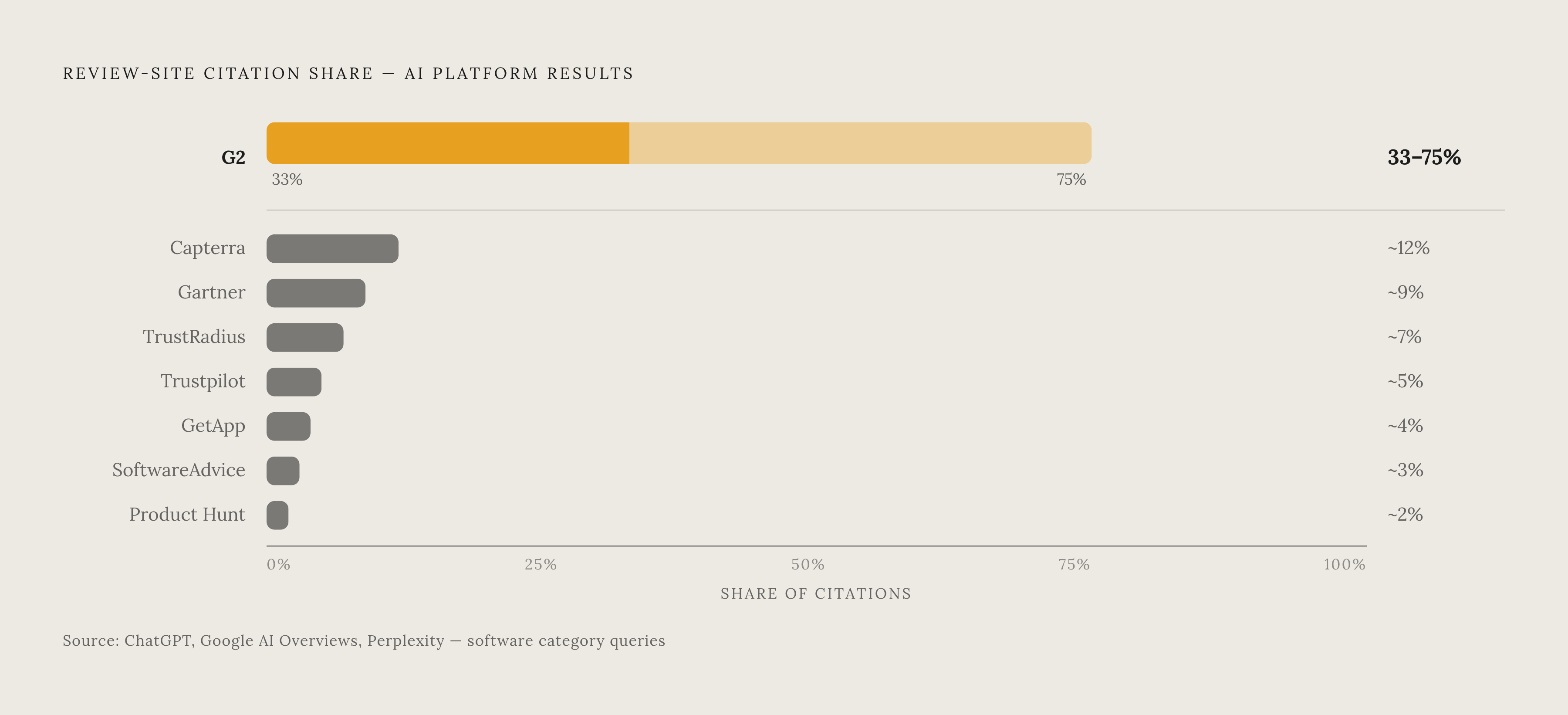
The dominance of G2 in B2B software citations shows this mechanism at work in concrete terms. Data from G2 itself, corroborated by Profound, shows that across ChatGPT, Google AI Overviews, and Perplexity, somewhere between one-third and three-quarters of all review-site citations in software categories come from G2, well ahead of Capterra, TrustRadius, Gartner, Trustpilot, SoftwareAdvice, GetApp, and Product Hunt. Trevor Pyle at Profound attributes this to the combination of a high-authority domain, a large volume of user-generated comparative data, and structured product comparisons, the exact format a model needs when a user asks something evaluative like "what is the best project-management software for a small team." G2's own Director of SEO Content has noted that the pages most often cited are category pages and best-of listicles, and that actual user reviews get quoted verbatim inside AI-generated answers. The user-generated content layer isn't being summarized from a distance; it's being pulled directly into the model's output, word for word.
The underlying reason platforms built on this kind of content earn their position is that models need some signal of trustworthiness and verification before they'll treat a source as citable, and review platforms supply both of those at scale: verified authorship, large volumes of reviews, and categories structured consistently enough for a model to compare across them. Yotpo's framework for this describes a "hierarchy of AI truth," in which AI systems place earned media and third-party platforms above owned content because they represent an independent market response. That hierarchy is not a preference the model was told to have. It falls directly out of what these sources structurally are.
What AI systems read in reviews, beyond star ratings
Once a review platform has been selected as a trusted source, what a model extracts from it goes well beyond the star average. AI systems read the language inside reviews and register recurring themes, emotional patterns, and specific claims about particular attributes as persistent associations with the brand, in a way that older ranking algorithms, built to average a numeric score, never did.
The natural-language processing inside modern pipelines works at the level of constructs like trust, skepticism, hesitation, and contempt, not simply a positive-or-negative tag. Listen Labs' analysis of these pipelines treats standard sentiment classification as structurally inadequate for this purpose. A brand with a 4.4-star average can still have dozens of reviews mentioning slow response times or unresolved billing issues, and those specific, repeated complaints get registered as negative signals independent of the aggregate score sitting on top of them. The four constructs Listen Labs points to, trust, contempt, surprise, and hesitation, predict brand-perception divergence because they capture the ambivalence that tends to precede an actual shift in loyalty. A pipeline that only reads polarity, positive versus negative, misses this ambivalence.
This lines up with what the broader research on LLM-based opinion summarization has found: models can extract and compress the recurring claims inside a large review corpus into something semantically coherent and efficient. Research on multidimensional review classification adds a further layer: models can decompose review content into separate, interpretable dimensions, so a brand's perceived quality on customer service, product reliability, and pricing fairness can each get tracked on its own from the same set of reviews, rather than collapsing into one overall sentiment number.
A hotel industry audit makes the gap between what AI actually measures and what it says it's doing concrete. The audit, a randomized algorithm study covering twelve AI models (arXiv:2606.16344), found that a top guest rating raises a property's probability of being selected by 31.6 percentage points, a large, structural effect driven by how the model reads rating signals, not by any explicit mention of reviews appearing in its output. The same paper found that these models act on review volume and list position without ever naming them as factors, while over-citing brand itself relative to its near-zero actual influence on the outcome. That gap, between the signals a model is demonstrably using and the reasons it gives for its answer, means a brand cannot manage its AI perception by watching what AI says about it. It has to understand what the underlying review corpus is actually feeding the model, independent of the model's own explanation of itself.
How review-platform signals propagate into AI-mediated discovery and recommendations
The brand beliefs built from review content don't stay contained inside a model. They travel downstream into the actual outputs a buyer sees, in the exact spot where search rankings used to sit, and they shape which brands get surfaced first in a process that increasingly looks less like browsing and more like being told an answer.
The shift from search engine to answer engine has gone far enough that ranking well in traditional search no longer predicts whether a brand gets cited by an AI system. Yotpo's analysis frames the core difference: an AI interface is built to hand a user a synthesized answer rather than a list of options to sort through, so a brand left out of that synthesis can be overlooked at the moment of discovery no matter how it ranks on Google. The overlap between Google's top-10 organic results and the sources AI systems actually cite has dropped sharply, to the point that ranking first in search and being cited by an AI model are now two separate problems requiring two separate strategies.
B2B software buying illustrates how directly this plays out. Because G2 accounts for somewhere between a third and three-quarters of all review-site citations across the major AI platforms, a software company's G2 profile functions, in practice, as its primary representation during AI-mediated buying research, ahead of its own website and ahead of its Google ranking.
Travel and hospitality make the commercial stakes even more direct, because the AI assistant in that category has become an infomediary standing between the traveler and the booking decision, not just a source of background information. A fast-growing share of U.S. travelers now use generative AI tools to plan trips, while the share who start their research at a conventional search engine has declined significantly. The assistant has moved into the position search results used to occupy, and it is the one deciding which properties a traveler actually sees recommended. The hotel audit referenced above adds a further wrinkle: list position, meaning simply where a property happens to sit in the order the model was given, carries a measurable 4.1% revealed importance in shifting which property gets chosen. That's a content-free artifact of input ordering, and it compounds whatever effect the review signals themselves are already having.
All of this is why "Share of Model" is replacing share of voice as the metric that actually matters, because the citation itself, not the click that follows it, is now the moment discovery happens. Yotpo defines Share of Model as the primary KPI for visibility in the AI era, built around a specific scenario: a user asks an AI assistant a question, gets a brand name back in the answer, and navigates straight to that brand's site. The referral link breaks, traffic shows up with no clear source, but the brand equity is already secured, because the AI's answer was the discovery event, not the click. The commercial value of a strong presence on review platforms increasingly flows through that citation moment rather than through direct referral traffic, which is a real structural change in how the investment in reviews pays off.
The specific ways review signals can distort or misrepresent a brand in AI outputs
Because AI systems lean this heavily on third-party review signals, every weakness in those signals, stale information, inconsistency across platforms, noise from fake or low-quality reviews, becomes a structural source of brand misrepresentation.
Temporal decay is the most underappreciated of these failure modes. Listen Labs identifies stale graph topology as the primary cause: a model trained on older data fills in gaps about a brand's more recent rebrand or acquisition by extrapolating from how similar companies have behaved historically, not by reading the brand's current positioning. When review sites, old press releases, and the brand's current site all say different things, the model doesn't resolve the conflict by picking the most recent, most authoritative version. It synthesizes a middle ground across the conflicted corpus, producing an output that can be wrong in a way no single source actually said, with the error coming from averaging across disagreement. A brand cannot fix this by updating its own website. The correction has to happen in the third-party sources the model is actually weighting, which are often outside the brand's direct control.
Inconsistency across platforms carries its own penalty, and it's a distinct one from any single bad review. A model reading conflicting signals, a strong profile on one platform next to a neglected or outdated one on another, tends to treat that inconsistency itself as evidence of manipulation rather than as ordinary variation in how a brand happens to show up in different places. A brand that has carefully managed its presence on one review platform while letting another go stale can end up penalized for the gap between the two, independent of whatever the underlying quality of its product or service actually is. Managing a single platform well is no longer sufficient protection against how a model interprets the whole picture.