AI-Generated Imagery and Brand Visual Consistency
AI image generators lack memory, causing visual drift that compounds across production.
AI image generators produce brand-agnostic output because of how the underlying models work: they generate the statistical average of their training data, not the specific visual signature of any one company. That single mechanical fact explains nearly everything brand teams find frustrating about AI-generated imagery, and it means the fix has to start at the level of the model's memory, not at the level of the prompt.
Why AI image generators default to average, not brand-specific, output
Picture a prompt as simple as "confident professional in a modern office." The model has to decide, on its own, what the lighting looks like, what the color temperature is, how the room is arranged, and what the person is wearing. It makes those decisions by pulling the most statistically common version of each variable from everything it was trained on. The output is correct in the way an average is correct: a number that describes a whole population while matching no single member of it exactly. The image comes out polished, well-lit, competently composed, and indistinguishable from thousands of other images produced by other brands typing similar words into the same tool.
This is not something a better-written prompt can solve on its own, because the issue sits below the level of language. Foundation models don't carry brand context from one generation to the next. Each session starts over, with no memory of what came before, so the model has nothing to draw on except its training distribution. Typography makes the problem especially visible. Leonardo.AI's technical guide notes that font replacement remains one of the hardest unsolved challenges in AI image generation: a model can render text that is legible, but it cannot reliably reproduce one specific named typeface from a text prompt. The model has no concept of "this brand's font." It only has a general sense of what letters tend to look like.
How visual drift compounds as production scales
A single off-brand image is a nuisance. When the same problem repeats across hundreds of generations a week, it becomes a structural failure, because each session is stateless and starts from the same blank condition as the last. A designer might generate five usable images in one sitting, build up a working sense of what crops, lighting choices, and framing worked, and get a batch that looks reasonably coherent. None of that carries forward. The next session needs the same reference images, the same feedback, and the same preferred crops, all rebuilt from nothing. It's like starting from scratch with every new prompt."
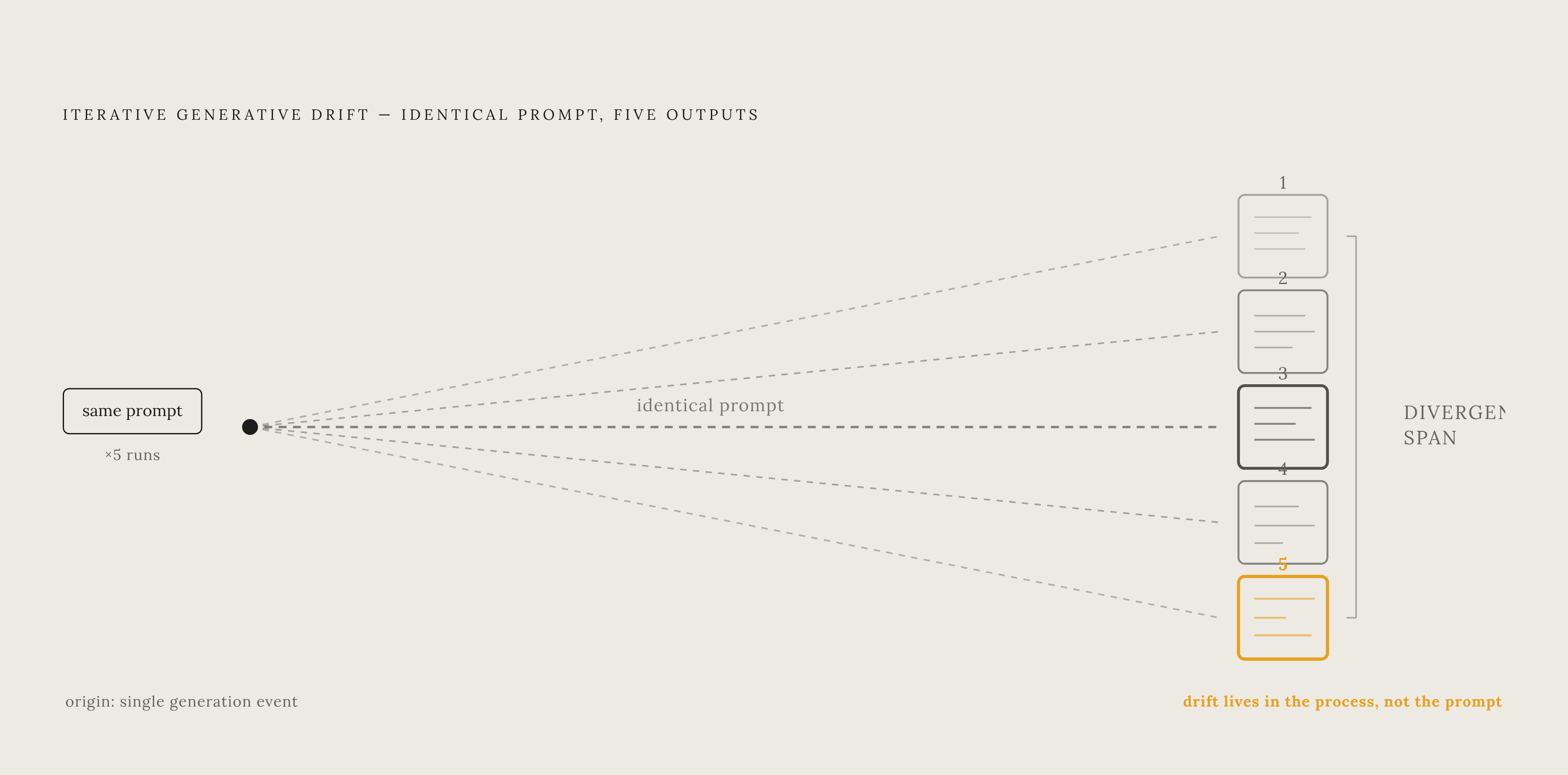
The SCHEMA methodology paper gives this pattern a name: "iterative generative drift." The paper works across a production corpus of its own and documents that successive generations using the identical prompt still diverge progressively in style, lighting, and composition. If you run the same words through the system five times, you get five increasingly different outcomes. That finding matters because it shows drift is not a risk introduced by sloppy prompting. It happens even when the input stays fixed, so the instability has to live in the generation process itself.
The consequence for teams scaling up their AI use is counterintuitive: the more images a team generates, the more the outputs spread apart, not the more consistent they become. Prompt engineering, no matter how carefully built, produces results that hold together within a single session and fall apart across sessions, teams, and time. A fix aimed only at individual prompts cannot keep pace with that. The fix has to operate at the level of the whole system.
What Off-Brand AI Imagery Costs a Brand
Inconsistent or visibly AI-generated imagery costs you more than an awkward-looking campaign. It wears down the trust a brand depends on, with erosion that builds in audiences across repeated exposures. Audiences now have a word for the feeling: Merriam-Webster named "slop" its word of the year for 2025, defining it as "digital content of low quality produced usually in quantity by means of artificial intelligence." A cultural term like that doesn't appear by accident. Enough people have run into the same flat, over-polished, context-free imagery, often enough that they needed a shared label for it, and once audiences suspect AI involvement, that label changes how they read a brand's visuals.
Smaller and newer brands carry more exposure to this risk than established ones. A large, long-trusted brand has decades of accumulated credibility, so it can absorb an occasional misstep. A smaller brand doesn't have that buffer. If a brand hasn't built up the reserve of trust larger competitors can draw on, a run of generic, obviously AI-made imagery can hurt its credibility and its search performance faster. The cost appears in how quickly an audience decides a brand is not worth its attention, and that decision, once made, is hard to reverse with better images alone.
How AI Systems Read Visual Brand Signals
Visual drift doesn't only affect what people see. It also affects what machines conclude. AI systems that categorize, recommend, and describe businesses build their understanding from the aggregate of signals they encounter across a brand's owned and earned channels, and visual consistency is one of those signals. When the imagery across those channels pulls in different directions, the resulting picture the machine builds comes out blurrier, and its confidence in how to categorize or recommend the brand drops along with it.
Consider a brand whose website presents one visual identity while its LinkedIn presence presents a noticeably different one. An AI system evaluating that brand runs into ambiguous input and, lacking a clear signal to anchor on, tends to default to a generic or lower-confidence read of what the brand actually is. AI systems reward consistent, structured, cross-channel presence, and a brand that holds its visual and semantic identity steady everywhere is easier for a machine to parse and therefore more likely to be recommended or described accurately.
That makes visual governance a function with stakes beyond design quality. It is an input that shapes how AI systems represent a business in the summaries, recommendations, and answers those systems generate for the people relying on them. And that raises a problem most brand teams haven't built tooling for: if visual inconsistency degrades machine perception, someone has to measure what that machine perception actually looks like, across different AI engines and different kinds of queries. That measurement is its own discipline. Tools like Evident score brands across algorithmic, AI, and human audience signals to find where a brand's intended identity and the identity AI systems actually report on diverge.
What Structured Prompt Engineering Can Control
Prompt engineering is a real and useful layer of control, and it would be a mistake to dismiss it just because it has limits. Leonardo.AI's guide documents a workable approach to color fidelity: build a color swatch sheet, upload it as an image reference alongside the prompt, and include the exact HEX codes for the brand's palette. That combination gives the model the clearest possible signal about what colors to reproduce, and it works considerably better than describing a color in words alone.
Typography gets a similar, if more fragile, treatment. The same guide recommends creating a visual sample of the brand's font and feeding it in as a reference image, then moving to a model built for high-fidelity text rendering. Leonardo.AI points to Nano Banana Pro, the commercial name for Google's Gemini 3 Pro Image, as the strongest current option for this task. Even with that approach, you still have to inspect the output letter by letter before publishing it, because text rendering remains an area where errors slip through.
The SCHEMA framework takes this kind of constraint-based approach and turns it into a structured method: a three-tier progressive system it calls BASE, MEDIO, and AVANZATO. Central to that system is what the paper terms the Constraint-Over-Elaboration Principle: explicit constraints, stated as prohibitions and required elements, control the model's output more reliably than long, descriptive, elaborate prompts do. The model handles a rule like "do not include text on signage" better than it handles a paragraph describing the desired mood.
Even SCHEMA's authors build in decision trees for what to do when structured prompts still fail, an acknowledgment that no amount of prompt refinement guarantees success every time. That's the real ceiling here. Prompt engineering lives inside a single session. It has to be reconstructed each time a new session starts, and it offers no way to enforce the same standard across different team members, different tools, or different weeks of production, which is precisely the environment enterprise creative teams operate in.
Brand Memory Infrastructure as the Fix for Consistency at Scale
Getting consistent AI-generated imagery at production scale requires giving the model something to remember between sessions, rather than describing the brand over and over inside each new prompt. That memory can come from a custom-trained model built on a brand's own visual material, or from a structured brand intelligence layer that feeds consistent context into every generation. Either way, the goal is the same: move the brand's visual specifics out of the prompt and into something persistent.
A custom model trained on a brand's approved photography, design examples, and documented style preferences encodes that visual identity directly into its weights. The model doesn't need to be told what the brand looks like each time, because it already knows. Practitioners building toward this outcome without a fully custom model rely on a few recurring components: a Brand Visual DNA Prompt, a fixed prefix capturing color palette, lighting preferences, and overall style that gets applied to every generation; a template library with brand elements already built in, so an image comes out close to final without extra design work; and human review before anything goes out the door.
The "Persona Flywheel" workflow documented in the 2026 marketing guide shows this logic applied to character-based content. A team locks in a base persona with defined appearance attributes, generates a set of reference shots covering different angles and contexts, and then uses that set of references to place the same persona into new scenes going forward. Those reference images function as a form of memory the model can draw from every time, instead of reconstructing the character from a text description each session. The structure, not the prompt, is what carries consistency forward.
The governance layer, workflows and review gates that prevent drift from re-entering
A brand memory system solves the technical half of the problem. It does not solve the organizational half, and drift finds its way back in through team variation, unreviewed outputs, and decisions that never get written down anywhere. The 2026 marketing guide documents the standard practice here: even with a well-built brand memory system feeding every prompt, assign a human reviewer to approve variations before they go live. That reviewer isn't there to fix prompt wording. Their job is to catch what the system has no way to judge, contextual fit, audience sensitivity, and quiet departures from the approved style that technically match every rule but still feel wrong.
Governance also means writing things down. A crop preference chosen in one session, a lighting adjustment that worked well, and a variation that got rejected for a specific reason all need to flow back into the brand memory system. Left undocumented, that knowledge disappears, and the next team has to rediscover it from scratch. SCHEMA's failure-routing principle, built for handling cases where structured prompts still produce bad output, applies just as directly to the organizational layer. When a brand-compliant input still produces an off-brand result, teams need a defined escalation path: who reviews it, what standard they're applying, and what comes out of that review, rather than leaving the call to whichever designer happens to be looking at the screen that day.
The most common objection to all of this is that governance slows down the exact speed advantage AI generation is supposed to deliver. Review gates built around a template library catch problems before deployment, considerably faster than redesigning an off-brand asset after it has already gone out into the world. The friction gets placed at the front of the process by design because it's cheaper there than at the back. The technical system and the governance process together form one combined mechanism. Neither one holds up consistency on its own.
Measuring AI and Algorithmic Perception of Visual Identity
Fixing internal brand governance is necessary, but it isn't the end of the work, because a team also needs to know how AI systems are actually representing the brand's visual identity out in the world, and that's the signal that reveals whether the internal fix is translating into anything external. A brand can run a disciplined, well-governed internal process and still find that AI systems describe it in generic terms, if those systems simply haven't encountered enough consistent, authoritative signals about the brand to build a sharper picture. The gap between internal discipline and external representation is measurable, and it does not close automatically just because the internal process improved.
AI systems that surface brands in recommendations and summaries weight cross-channel consistency, corroboration from outside sources, and how structurally legible a brand's presence is across the web. A brand that achieves visual and semantic coherence across its owned and earned channels gives those systems more consistent material to build from, and that consistency produces sharper, more accurate representation in AI-generated answers. The practical conclusion for brand teams is that internal production standards and external perception need to be tracked together, using a measurement approach that covers sentiment, attribute alignment, share of model, and consistency of representation across different AI engines, not just the quality of what gets produced in-house. Governance tells a team what it shipped. Measurement tells it what the machines decided that shipping actually meant.