Creative Brief Design for Human-AI Collaborative Campaigns
Treating the brief as a governance system prevents AI from defaulting to sameness.
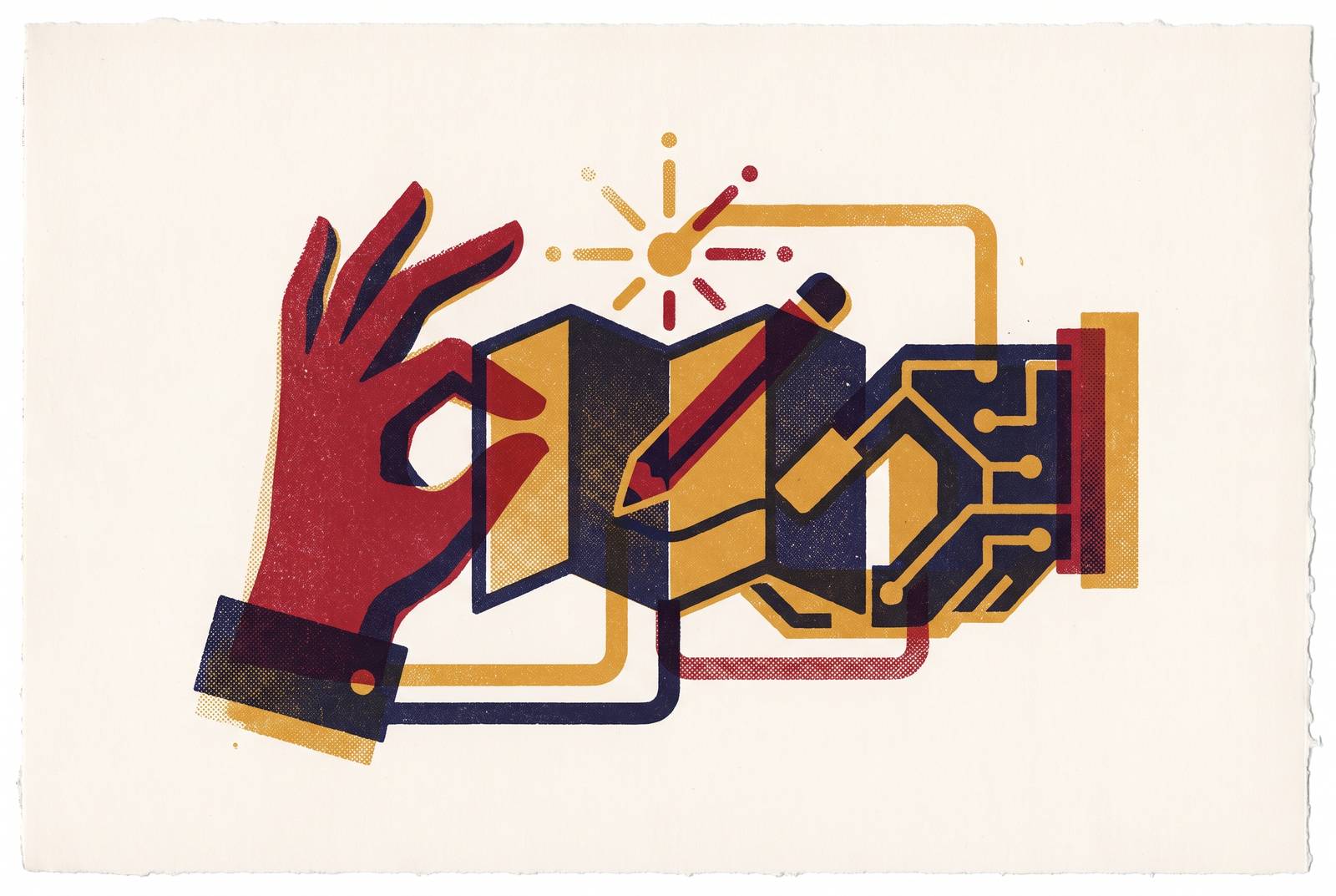
Feeds are full of AI-assisted work that looks and sounds the same because the reason is structural, a failure of imagination on any one team's part. Generative models, left without explicit limits, settle on the most statistically common output, and that tendency erases the differences between brands at scale.
Brand Sameness in the Unconstrained Brief
Open any set of AI-assisted campaigns from different companies and the resemblance is hard to miss: same palette choices, same sentence rhythms, same stock-photo instinct even in generated images. This is what happens when a system built mainly for automation gets asked to do creative work instead. Generative AI was not built first for originality; it was built to produce output quickly and consistently, and creative use is a newer application layered on top of that purpose. The ICML 2026 Human-AI Co-Creativity workshop named this directly: as generative tools get pulled into creative workflows, design fixation and idea homogeneity become real risks, not hypothetical ones. The fix is not a better tool and not a more talented prompt writer. What is missing is governance: a structure that tells the AI what not to default to, because left alone, it will fill that gap with the statistical average of everything it has seen before. Many teams assume a well-crafted prompt solves this, but a prompt is a single instruction fired once, while a system has to hold across a six-person team, a twelve-month campaign calendar, and a client relationship that outlasts whoever wrote the prompt. It breaks the moment someone new joins the project or the brief gets reused for a different product line, because nothing in it travels with the work.
What human-AI creative collaboration requires structurally
Collaboration between people and AI depends on how roles get divided, when each party steps in, and whether trust gets built over repeated interactions, not simply on how good the underlying model is. Research into this space is still early, and most of what has surfaced so far points at design choices as the deciding factor. The ICML 2026 workshop overview describes the field's central challenge as building a community that is "multilingual," meaning it needs people who understand the technical mechanics of generative AI, people who know how to design and deploy these systems for real users, and people with direct experience creating with the tools day to day. Those three kinds of knowledge rarely live in one person, and they never live inside a single prompt. A study by Komura and Yamada, published in PLoS ONE in January 2026, tested this directly with 148 participants in a brainstorming exercise about increasing café sales, comparing an AI that deepened human ideas against one that diversified into new territory. The deepening strategy won on both measures that mattered: participants trusted it more and adopted more of its suggestions, because its behavior was predictable enough for them to understand what it was doing and work with it. The lesson generalizes past café sales: collaboration breaks down because nobody defined in advance what each side is supposed to contribute, and that definition can't be left to the model to infer session by session. Canva Research Director Yuhui Yuan made the design version of this same point at ECCV 2026: a picture of a design is not a design. Real co-creation has to leave behind something humans can pick back up and keep working on at any point, a layered and editable file rather than a flattened image that locks the author out of their own project. That kind of output is evidence, after the fact, that the roles were actually assigned somewhere upstream.
The traditional creative brief cannot govern a human-AI workflow
The creative brief as it has existed for decades was built to get human creatives pointed in the same direction, never to control what a machine generates, limit its output space, or decide who gets final say between a person and a system. A standard brief carries tone, audience, and objective, and it trusts the person reading it to fill every gap with judgment, cultural awareness, and a feel for the brand that comes from working inside it. An AI model fills those same gaps differently: with whatever is statistically most common across everything it was trained on. Take an instruction as ordinary as "bold and irreverent tone." A human creative reads that and narrows it immediately, drawing on years of exposure to what the brand has done before. A large language model reads the same line and treats it as permission to produce anything that has ever been labeled bold and irreverent anywhere, which covers an enormous and largely undifferentiated range of material. Research on AI image generation demonstrates how sharp this gap can get: ask an AI system for "a suburban single-family home" and it may return a modern duplex. The brief did not fail because the intent was unclear. It failed because the brief and the model never shared a concrete enough picture of what "suburban single-family home" actually meant. There's a second failure stacked on top of the first: when a brief never states which calls belong to a person and which belong to the AI, authorship itself turns murky, and the IJCAI 2026 tutorial on Human-AI Co-Creativity lists this as one of the field's open problems, sitting next to copyright as an issue nobody has fully resolved. At the scale of a real campaign, this plays out in one of two ways. Either the ambiguous brief produces output that needs so much human rework that the speed AI was supposed to deliver disappears, or the work ships with the AI's defaults left in place, which is how brand sameness ends up in front of customers.
The architectural shift: brief as a role-assignment system
The brief has to turn into a structured system that spells out, in advance, which decisions belong to AI, which belong to people, and where the boundaries between the two sit. That system needs to carry three kinds of specification. The first is role assignment: AI takes volume generation, variation, and iteration inside a space the brief has already defined, while people hold brand voice arbitration, judgment calls about emotional resonance, cultural sensitivity, and anything ethical. The second is constraint encoding: the brief states hard structural limits, specific visual language rules, framings that are off the table, brand markers that must appear every time, written so a machine can act on them as rules. The third is decision rights: named points in the workflow where a human has to sign off before AI output moves forward, so defaults can't slip through simply because nobody was assigned to stop them.
The Komura and Yamada findings back the first category with evidence. Their result, that an AI acting as a supportive partner deepening human-initiated ideas built more trust and got more of its contributions adopted than an AI pushing into new territory, is a result a brief can encode as a standing rule rather than something each project team rediscovers on its own. Yuan's ECCV 2026 framework supplies the design equivalent: real co-creation produces layered, editable work that keeps human authorship intact at every stage, so the brief should state outright what form AI output has to take so a human can always step back in and take over.
Visual Electric handled world-building, ChatGPT refined scripts, ElevenLabs produced voiceover, and Runway, Kling, and Google Veo generated motion, with each tool assigned to one specific function while the human creative team kept control of narrative, pacing, and tone across the entire production. None of this amounts to the brief dictating individual prompts. It defines the space each party is allowed to operate in, and the prompts get written inside that space.
Where human judgment must remain non-delegable inside the brief
Assigning AI its roles is only half the job. A brief built well also names the territory AI is not allowed into, because that territory is where a brand's distinctiveness and a customer's trust actually get made. Brand tone and identity, emotional storytelling, campaign strategy, anything sensitive or high-stakes, and judgment calls about ethics or culture: these stay with people, because they call for cultural literacy and contextual read that an AI system can only approximate from patterns in its training data, not from having lived through anything.
How often people select the deepening strategy says nothing about whether that strategy produces work with real long-term creative value or genuine originality, something Komura and Yamada flag as worth building into the architecture. A brief needs a human review gate built specifically to check whether AI-deepened concepts are still ambitious, separate from the gate that checks whether people trust and will adopt them, because those are two different questions with two different answers. This is where the homogenization risk takes shape: the same AI tools that speed up production also flatten a brand's distinctiveness the moment people stop doing the work that produces distinctiveness. A properly built brief is what stops that retreat from happening automatically. Evident's framing applies directly here: a brand that has no way to measure how AI systems are perceiving and representing it, including whether AI-assisted creative work is reinforcing its signal or washing it out, is operating without a feedback loop. The brief should name measurement checkpoints alongside its creative checkpoints, not leave measurement for later.
The brief's creative decisions now double as AI perception signals
The choices a brief locks in around positioning, specificity, how expertise gets framed, and how content gets structured are the same choices that decide whether an AI system mentions a brand at all when it answers a user's question. AI systems build their answers from patterns across trusted sources rather than from a live crawl of the web at the moment of the question, so brand signals that stay consistent across guides, comparisons, expert articles, and outside references build up into a real probability of being included. Signals that are inconsistent or generic get read by the system as noise and get left out.
The brief sits at the earliest point in the entire content pipeline where this consistency gets locked in or lost. A brief that defines a brand's positioning vaguely produces content that signals vaguely, and a language model treats that as background noise. Certain brief elements do double duty as both creative direction and credibility markers an AI system can pick up on: expertise framing that names an actual domain and an actual author rather than gesturing at "thought leadership," structured content requirements like schema markup and clear headers, requirements for credible references, and mandates that keep a brand's own channels and third-party mentions saying the same thing about it. The signals that get a brand cited by an AI system, specific expertise, clear positioning, a named author, structured content, credible references, are the same E-E-A-T signals that earn trust from a human reader. A brief can require both at once, because they are one requirement described two ways, not two separate jobs competing for space.
The Brief That Governs Human-AI Roles in Practice
The evolved brief does not need to run longer than the kind teams have always used. It needs a different internal structure, built around layers a traditional brief never included: roles, constraints, decision rights, and measurement, laid out so each one can be acted on directly. Brand invariants come first, the non-negotiable elements AI is not permitted to reinterpret no matter how it's prompted, specific visual language rules, tone markers backed by real examples, framings that are ruled out, and brand identifiers that must show up every time, written as limits a machine can follow. Next comes the AI operating space, the explicit range within which AI is free to generate: volume targets, how much variation is allowed, which creative dimensions, color, copy register, format, are open to exploration and which are closed off, with the deepening-versus-diversification choice from the Komura and Yamada research written in as a standing rule. Then come human decision gates, named checkpoints, concept selection, emotional resonance review, cultural sensitivity review, final brand alignment check, where output cannot move forward without a person signing off. A fourth layer establishes shared conceptual grounding, following the approach Stanford HAI has been building: reference images, guides for spatial composition, scene-priority logic, a working vocabulary specific to the campaign that keeps a request for "a suburban single-family home" from coming back as a modern duplex. The final layer sets perception signal requirements: mandates for how content gets structured, author attribution, schema, header logic, requirements that positioning stays consistent across every channel it appears in, and measurement checkpoints tied to how an AI system is likely to read and categorize the campaign's output once it's live.
A team that writes this division of labor into the brief once builds a structure that holds the next time and the time after that, turning a brief into a system, while a team that reconstructs it from scratch on every new project never gets there.