Video Content Strategy for AI Search Visibility
Video must be structured for extraction and hosted where AI crawlers can find it to move the needle.
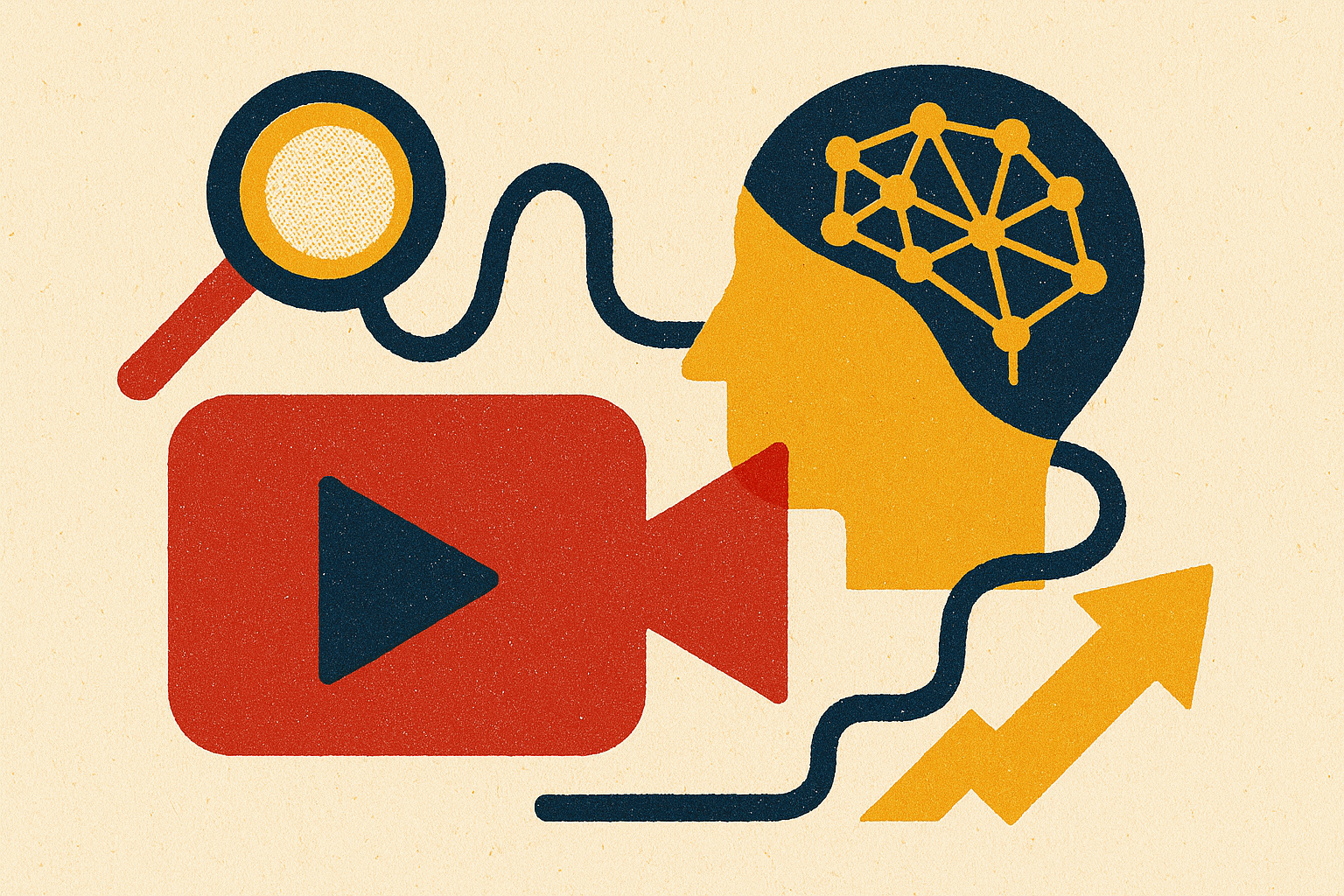
AI search visibility runs on a logic that is not how search engine ranking works, and if video content strategy doesn't follow that logic, it produces nothing measurable. This piece walks through the mechanism: how AI systems decide what to cite, where video fits in that decision, and what a brand actually has to build, structurally and technically, for video to move the needle.
Why AI systems evaluate brands differently than search engines
A search engine ranks pages. An AI system picks an answer, and a brand either gets named inside it, or it doesn't. That distinction is the whole starting point for this piece, because it changes what "visibility" means. Users are now asking ChatGPT, Gemini, Perplexity, and similar tools for recommendations, comparisons, and explanations, which changes what a brand needs: not a high page rank, but a mention when an AI system names an answer.
The mechanism behind that naming is a probability estimate: an LLM calculates how likely it is that a given brand is the correct answer to a given user's intent, drawing on how often the brand shows up in sources the model already trusts, how authoritative those sources are, what the sentiment in reviews looks like, how well the brand fits the specific context of the query, and whether structured data makes the brand's identity something a machine can parse cleanly.
Some of these systems also use retrieval-augmented generation, pulling content from indexed external sources at the moment a query comes in, rather than relying only on what the model learned during training. A page that ranked well long ago and hasn't been touched since may contribute nothing to an AI-generated answer today, no matter how authoritative it once was.
Once citation probability is the operating model, you have to ask which signals raise that probability most reliably, and how much leverage each one gives you per unit of effort. Video is one of those signals, and understanding its specific role in the calculation is where the tactical half of this piece begins.
Where video fits in the citation probability calculation
Video does not move the needle because AI systems cite video files directly in large numbers. It moves the needle because video presence correlates with the broader authority signals that drive citation across every format, and because platforms that host video, YouTube chief among them, rank among the most heavily weighted sources for specific AI systems. YouTube is one of the most cited sources in AI answers, especially by Gemini, which makes YouTube content one of the higher-return investments a brand can make for AI visibility specifically.
Part of video's advantage is what it demonstrates. Pages that include relevant video content tend to be treated as more trustworthy data sources by AI retrieval systems as a result.
Video's function isn't to compete with listicles for direct citation share. Video builds the distributed brand authority that raises the odds of every other citation type getting pulled, making it a multiplier on the rest of the strategy, a category competing for the same slot.
Authentic, customer-made video supplies exactly the raw signal that raises a brand's odds of being named as the answer. Videowise built its AI Visibility product around a specific observation: direct-to-consumer brands often sit on hundreds, sometimes thousands, of authentic user-generated videos that are completely invisible to large language models. The next section explains why that failure happens and what fixes it.
How transcript structure determines video extraction and citation
A video's value to AI citation depends on whether its spoken and written content can be pulled apart into a piece an AI system can isolate and quote with confidence. Most video content, as currently produced, fails that test because the information in it isn't organized for extraction, even when the information itself is correct.
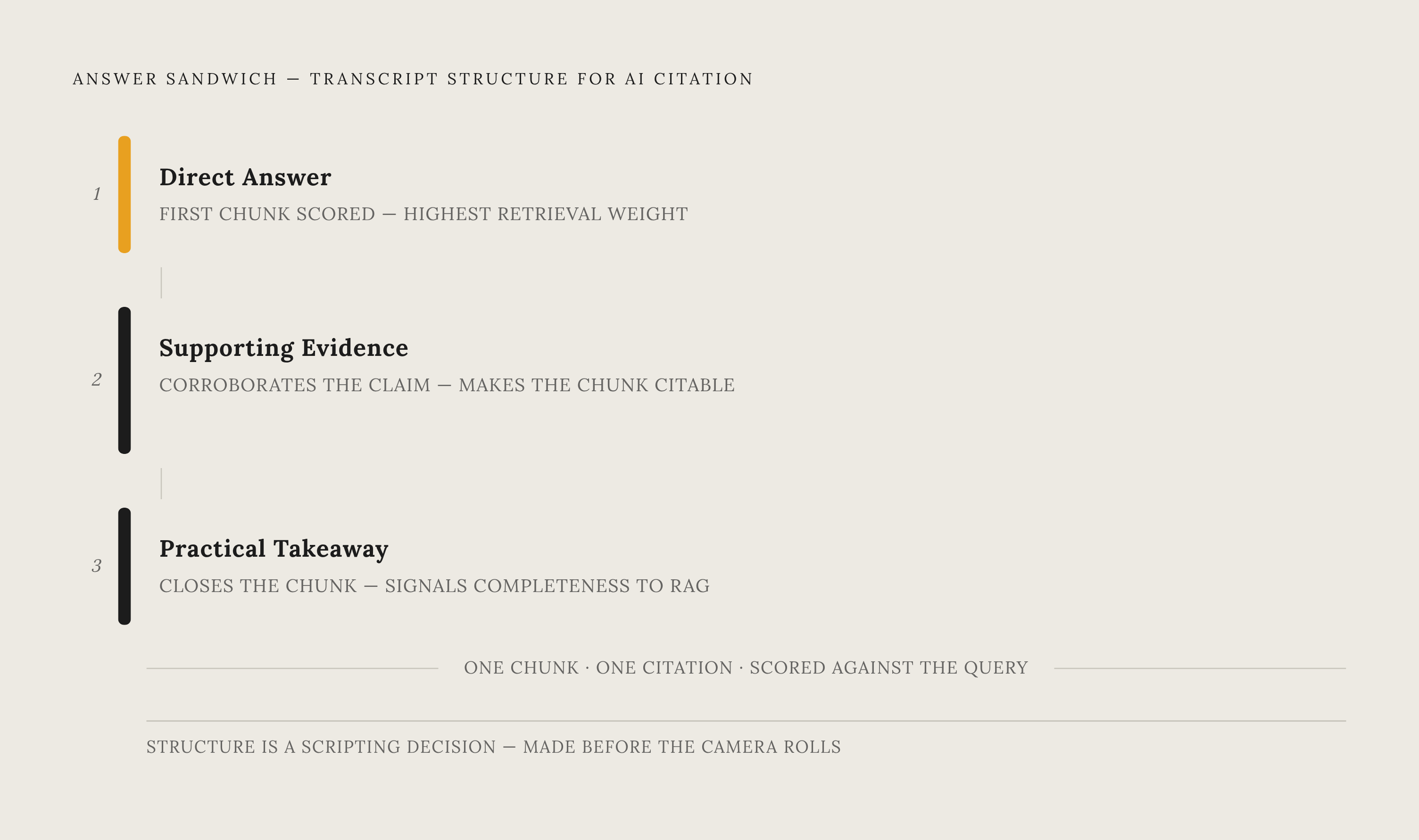
Systems using retrieval-augmented generation don't retrieve whole videos. They break content into chunks, score each chunk against the query at hand, and pull the passage that scores highest. The chunk is the unit that gets cited, not the source video as a whole, and that single fact changes what good video content looks like at the scripting stage.
The structure that performs best in this context mirrors what works in written content optimized for AI retrieval: lead with the direct answer, follow with the supporting evidence, then close with a practical takeaway. Call it the answer sandwich. A transcript organized this way gives an AI system a self-contained passage to extract, so it doesn't have to infer the answer from context spread across several minutes of footage.
Videowise's technical approach makes the underlying mechanics visible. The company's system analyzes both audio and image, frame by frame, using vector video search, and turns that analysis into content AI engines can read, cite, and rank. What an AI engine reads is that structured output, not the raw video file. That means the file itself is not the asset in any direct sense. The asset is whatever structured representation of it an AI system can access.
Unstructured footage is harder to extract and cite at this layer than the structured output the pipeline above depends on. Authentic customer and creator videos are unstructured by nature. Nobody records a testimonial in the "answer sandwich" format. Videowise's AEO product addresses this by extracting question-and-answer pairs out of raw UGC footage and assembling them into a structured wiki, converting unstructured authenticity into something an AI system can actually cite.
AI-powered search increasingly indexes audio directly. If a script never says the thing a user is likely to ask about, even when the on-screen demonstration shows it clearly, that gap remains, and metadata alone can't close it. So transcript structure is a scripting decision you make before a camera rolls, not something you fix in the edit bay afterward.
Metadata, Schema, and AI Trust in Video
Good transcript structure solves half the problem. A well-structured video can still be invisible to an AI system if the metadata around it is thin or if the page hosting it blocks the bots AI systems rely on to retrieve content.
The crawlers that feed AI systems, GPTBot and ClaudeBot among them, don't index the web the same way Googlebot does. Content that a traditional SEO audit would call perfectly crawlable can be functionally invisible to the bots an AI system actually uses. If a brand hosts its video library behind a JavaScript-heavy page layout, it is running that exact risk, no matter how strong the transcript or the production value is.
Schema markup is the fix at the entity level. VideoObject schema tells an AI system what a video covers, who made it, when it went live, and what it demonstrates, in a format the system can parse without guessing. Without that markup, a video is a file an AI system knows exists but can't describe with any confidence, which means it won't get cited even when it's the best available answer. The same logic that applies to adding Organization schema to a homepage, so a brand's basic identity is machine-readable, applies to VideoObject schema for each individual video a brand publishes.
You need to treat metadata as its own layer of optimization, separate from the video content itself. The clip and the metadata wrapped around it are treated as two distinct things to get right, not one.
Metadata also has a shelf life. You need to maintain video descriptions, surrounding page copy, and schema details as living assets that get revisited, not published once and left alone.
Google expanded SynthID in May 2026, marking a large volume of images, videos, and audio files and extending verification into Search and Chrome, alongside support for C2PA Content Credentials. Provenance metadata that confirms a video is genuine and brand-owned could become a factor in how AI systems weight citations, but this is an emerging direction, not something a brand needs to meet today.
How entity consistency across platforms amplifies video's citation signal
A single well-optimized video doesn't operate in isolation. How much it adds to citation probability depends on whether the brand behind it presents a consistent identity everywhere else an AI system might look. The same video, attached to a brand with a stable, consistent entity, raises citation odds in a way that compounds with every other consistent signal. But if the brand's identity is described differently from platform to platform, that same video only delivers a fraction of the benefit.
Entity consistency means a brand's name, category, description, and market position have to match wherever the brand shows up. Botric's guide frames this as a cross-referencing behavior built into how AI systems verify legitimacy: the system compares descriptions of a brand across sources, and any discrepancy it finds lowers the confidence with which it will recommend that brand.
Video carries several of these entity signals at once: the description under a video, the bio on a YouTube channel, the metadata embedded in a transcript, and even the way a brand describes itself out loud inside the video's audio. If those four things say four slightly different versions of who the brand is, the AI's attempt to resolve the brand as a single coherent entity fails, no matter how well-structured the individual video might be on its own.
Third-party video adds another layer to this picture, and it can help or it can hurt. Creator reviews, customer UGC, and partner content all strengthen a brand's entity profile when the language they use lines up with how the brand describes itself elsewhere. Videowise's social listening feature lets a brand identify positive third-party videos that mention it and cite them with attribution and a link back to the original creator, treating that third-party video as a signal to actively curate rather than something to leave alone and hope for the best.
None of this holds up without measurement. A brand can't maintain consistency across a dozen platforms by instinct, and the data backs up why that matters: the SSRN "AI Perception Index 2026" found that cross-model perception drift reaches 21.86 points for the same brand across different AI systems. That's a measurable gap in how differently ChatGPT, Gemini, and other systems can describe the identical brand. You have to systematically track how a brand is actually being described across AI systems and platforms, rather than assuming it's consistent just because the brand's own website is accurate. So entity consistency, at the scale a modern brand operates, is a measurement problem before it's a messaging problem.
Platform distribution strategy for citation probability
None of the preceding sections matter if the video never reaches the platforms AI systems actually draw from. Distribution for AI citation means concentrating effort on the platforms AI systems weight most heavily as sources, and adapting content on each one to match how that platform gets read by retrieval systems.
YouTube is at the top of that list because Gemini reads full transcripts, and YouTube is one of the most cited sources in AI answers overall, especially for Gemini-mediated results. For any brand trying to influence what Gemini recommends, YouTube is the highest-priority platform to invest in, ahead of other video platforms by a meaningful margin.
That priority has produced a distinct practice: YouTube GEO, generative engine optimization built specifically for YouTube's retrieval behavior. Videowise's version of this takes clips from a brand's existing video library and rebuilds them into new YouTube uploads carrying LLM-optimized metadata. The underlying logic is that the same footage, packaged one way for a human audience scrolling YouTube and packaged another way for an AI system parsing metadata and transcripts, will perform differently depending on which audience it's built for. A brand that uploads the same cut everywhere, metadata unchanged, is leaving performance on the table for one audience or the other.
Shorter-form platforms, TikTok, Instagram Reels, and YouTube Shorts, play a different role in this strategy. They build the kind of distributed brand presence that AI systems read as a signal of market relevance, so they feed the entity consistency argument from the prior section even when a given short clip never gets cited directly. The format itself has grown more capable of carrying substantive content: YouTube Shorts now supports videos up to three minutes long, which gives brands room to fit a real demonstration or explanation into a short-form slot, not just an attention-grabbing teaser.
Captions and on-screen text matter across every one of these platforms, not as an accessibility afterthought but as another layer of text a platform's indexing system can read and match to a search intent. Combined with the spoken audio indexing covered earlier, that means a video's words, whether typed on screen, spoken aloud, or embedded in metadata, all function as retrievable text now. So a distribution strategy built around citation probability gets every one of those layers right on the platforms that carry the most weight, rather than spreading the same unoptimized video thin across every channel at once.