How Generative AI Search Citations Reward Certain Content Formats
AI systems reward clear structure and outside validation over traditional ranking signals.

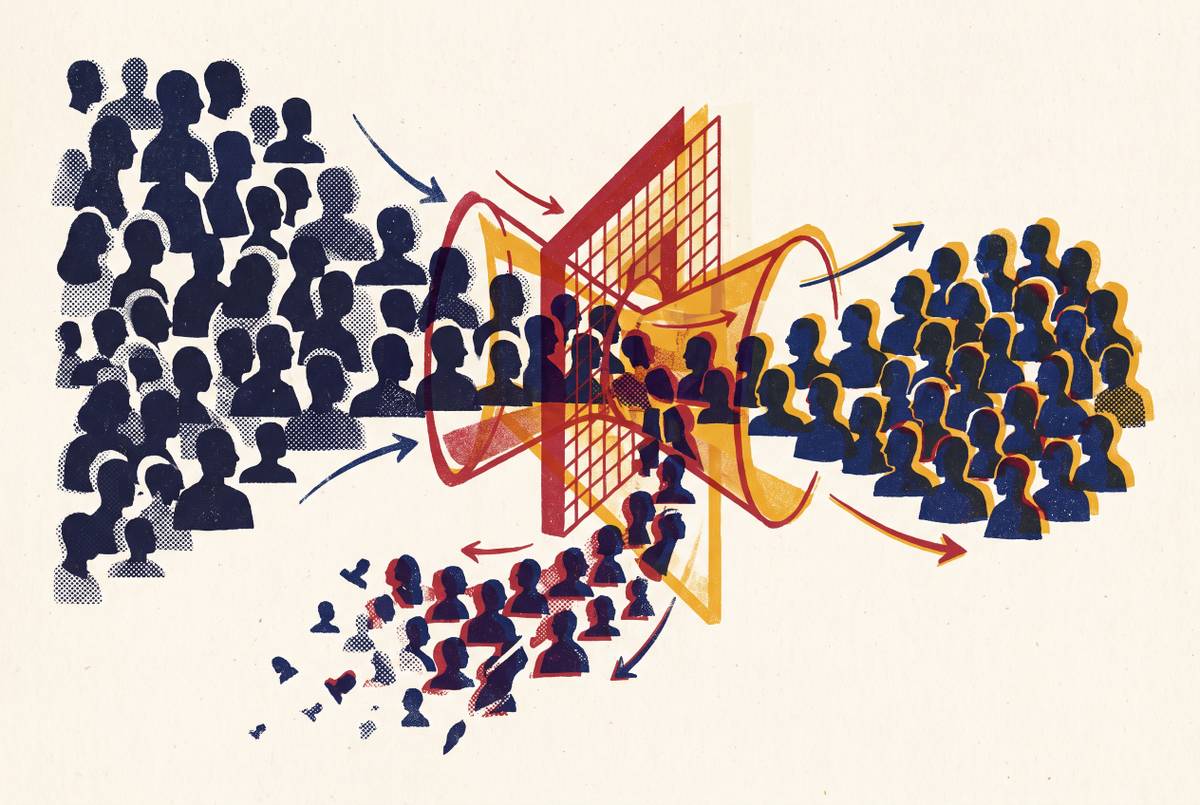
Someone types a question into ChatGPT and gets back a paragraph, not a list of blue links. That paragraph carries footnotes, small numbers next to certain sentences, pointing to sources the model decided to name. That's citation in a generative system, and it works nothing like a search ranking, because a ranking algorithm sorts pages while an AI system builds an answer from scratch and only afterward decides what to credit. The distinction determines the sequence of operations: a large language model breaks a query into smaller sub-questions, pulls candidate passages through retrieval methods (the RAG process, retrieval-augmented generation), writes an answer, and only then attaches sources to the specific sentences it just generated. Citation isn't assigned to a page. It's assigned to a sentence, scored against the passages the model retrieved, and only passages that clear a threshold score make it into the final output.
That's a structurally different filter than what Google's ranking algorithm runs. The numbers make the gap concrete. Research from the GEO firm Brandlight found that overlap between top Google links and AI-cited sources has fallen from roughly seven in ten down to fewer than two in ten. A page can rank well in Google and still never appear in an AI-generated answer, because the retrieval and scoring pipeline evaluates different properties than a ranking algorithm does.
The AgentGEO research (arXiv:2603.09296, March 2026) adds a sharper wrinkle: among pages that are topically relevant to a given query, a large minority get zero citations under baseline conditions. For those pages, the useful question isn't how to earn more visibility. It's why they got none at all, and that question is what the rest of this piece tries to answer.
How the citation pipeline selects which passages to attribute
Citation happens in stages, and a page can get knocked out before a model ever reads a word of its actual content. The pipeline runs through query decomposition, passage retrieval, citation scoring, and presentation. First, the system breaks the user's question into sub-queries, and a page has to show up as relevant for those narrower sub-questions, not just the broad topic the user typed. Then candidate passages get pulled together, deduplicated, and re-ranked using a mix of older methods like TF-IDF and newer neural scoring. Only after that does a citation model, often a fine-tuned LLM or a lightweight classifier, score each candidate passage against each sentence the system is about to generate, attaching a citation only when the score clears a set threshold.
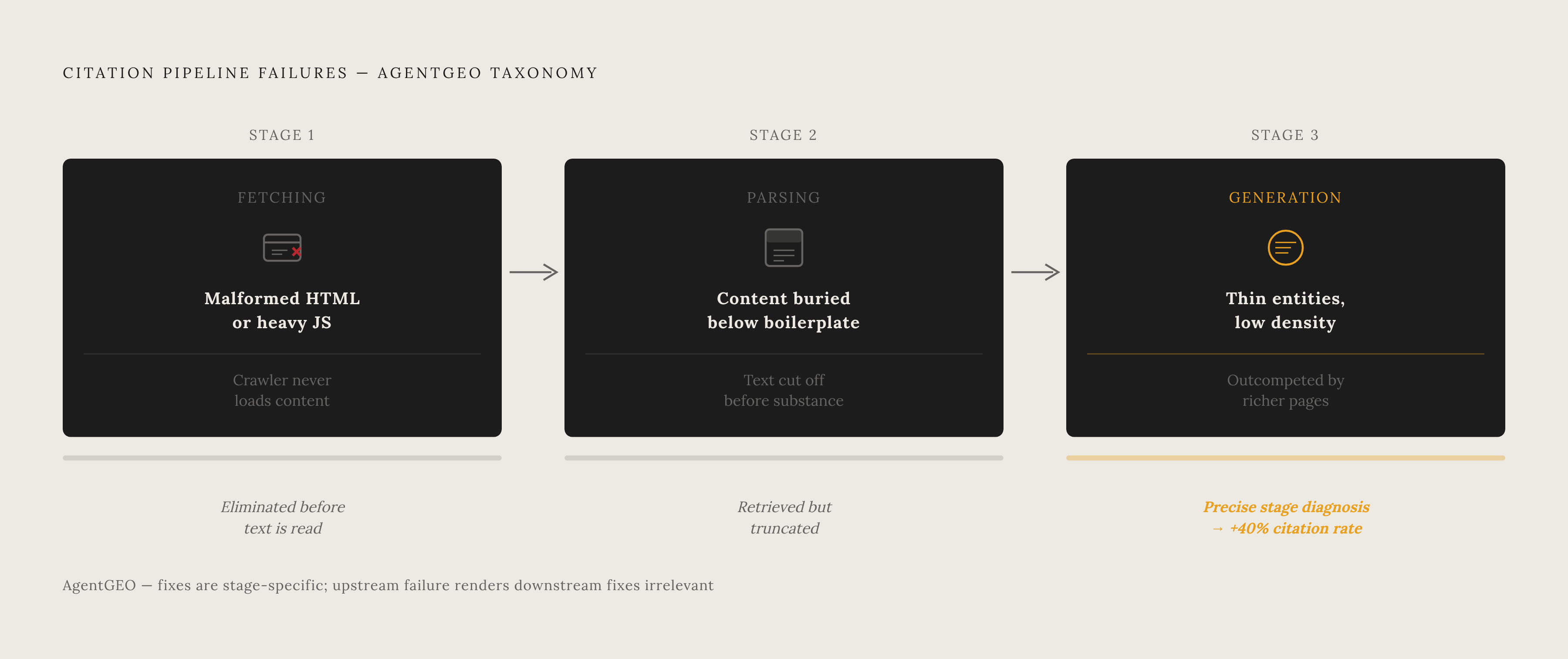
That structure implies failure isn't one thing. AgentGEO's taxonomy splits it into three separate failure modes, each requiring a different fix. Pages fail at fetching, when malformed HTML or heavy JavaScript dependencies keep a crawler from even loading the content properly. They fail at parsing, when the actual answer is buried below navigation menus, ad boilerplate, or gets cut off entirely. Or they fail at generation, when the content is technically retrievable and readable but thin on named entities or simply weaker on information density than a competing page.
That taxonomy matters because it rules out lazy fixes. Adding a few statistics or polishing sentence flow does nothing for a page that's failing at fetching or parsing, since those failures happen before the system ever gets around to reading the text. The AgentGEO researchers built an agentic system that diagnoses which failure mode applies and applies a targeted repair rather than a blanket rewrite, and the results were stark: over 40% relative improvement in citation rates while touching only a small slice of the content, against markedly weaker gains from generic optimization baselines. Diagnosis before treatment, in other words. Rewriting a page's prose is wasted effort if the real problem is that a crawler can't render it in the first place.
The structural and stylistic properties that push a page past the citation threshold
Assuming a page clears fetching and parsing, what actually pushes it over the citation-scoring threshold? Cited sources look different from uncited ones in ways that can be measured directly: lower perplexity (meaning more predictable, less surprising phrasing), higher readability scores, tighter formal structure, and key information placed early rather than buried. None of this is accidental. It reflects what a language model finds cheapest to extract and attribute cleanly, and research from the EmergentMind topic page on generative search citation backs this up: cited sources run semantically closer to what the model expects and stylistically more predictable than a typical page ranking well in conventional search.
Break it down by pipeline stage, since each format signal is really solving a different stage's problem. At the parsing stage, explicit HTML structure, real headings, actual lists, clearly defined terms, gives the system clean boundaries to identify where one passage ends and another begins; content that's truncated or hidden below a wall of boilerplate fails at parsing before citation scoring even starts. Schema markup does similar work: tags like FAQPage or Article tell an AI system what kind of content it's looking at, who wrote it, and what it's for. Schema-tagged pages pull in noticeably more AI citations than pages without it, and one health-sector study found schema markup present on 86.8 percent of the sources that were commercially cited (arXiv:2601.17109), though that figure describes one sector, not content generally.
At the generation stage, the signals shift toward information density. Statistics raise a page's AI visibility, and direct quotations push that further, because both raise the density of usable, attributable information the generation stage is scoring against competing passages. Recency matters here too: pages that go stale, that aren't updated on a regular cadence, are considerably more likely to lose citations, especially on topics that move fast, because language models are trained to favor sources that seem temporally reliable. The health-sector study also found that a large majority of commercially cited sources ran past a common long-form content threshold, suggesting depth signals to a model that a page can answer follow-on questions, not just the one asked. None of this is guesswork. GEO was formalized by researchers at Princeton, Georgia Tech, AI2, and IIT Delhi, whose GEO-bench benchmark demonstrated that content optimizations including citations, quotations, and statistics produce measurable improvements in citation visibility, per the research brief.
Third-party editorial presence versus brand-owned content in AI citation
Format alone doesn't close the gap. A page can nail every structural signal above and still go uncited, because generative engines are checking something upstream of formatting: who else is saying this. AI systems weigh corroboration, meaning how many independent, credible sources confirm a given claim, over raw link volume. A brand with a handful of solid editorial citations in outlets people already trust can out-cite a brand sitting on hundreds of low-value directory links. Even a mention that carries no link back to the site still functions as a trust signal to the model; the mention itself does the work.
This creates a real asymmetry against brand-owned content. Generative engines frequently exclude vendor blogs and brand-owned social accounts from their citation pools outright, so a genuinely well-written page can sit uncited simply because of where it lives. An audit of four major generative search engines, ChatGPT, Copilot, Gemini, and Perplexity, run by researchers Allaham and Diakopoulos at Northwestern University (arXiv:2605.23684, May 2026), found that these engines lean on a fairly narrow set of domains they cite repeatedly, while a much larger pool of domains gets cited only rarely. The same audit turned up something else: AI-generated content itself was showing up inside the citation pools of all four engines, which is one more reason earning a mention in a trusted, human-edited outlet matters. It separates a brand from an increasingly crowded field of synthetic text competing for the same citation slots. Look at the domains ChatGPT cites most often in the US: Reddit, Wikipedia, Amazon, Forbes, Business Insider. Every one of those is third-party, and either editorially governed or run by a community, not a single company's marketing team.
None of this makes SEO irrelevant. Strong SEO performance feeds directly into GEO visibility, since the two systems share overlapping signals even where they diverge. But SEO on its own isn't enough, and the practical consequence for smaller or newer brands is uncomfortable: this setup rewards whoever already has visibility. The citation pattern shows head-and-tail amplification, meaning prominent, already-cited creators keep getting more exposure while less established ones stay stuck in the long tail. Earning coverage in a publication the model already trusts functions as a force multiplier. No amount of on-page polish substitutes for it.
How AI perception diverges across platforms
Assume a brand starts showing up in trusted third-party coverage that corroborates its claims. That still isn't the finish line, because citation behavior isn't consistent across platforms, or even across products from the same company. Only 13.7% of citations overlap between Google's AI Mode and AI Overviews, meaning content tuned to perform well on one of those surfaces will largely miss the other. Sentiment splits by platform too. A March 2026 analysis found Google AI Overviews considerably more likely than ChatGPT to surface negative brand sentiment, while ChatGPT tends to cluster its negative sentiment much more tightly around the moment someone is actually deciding whether to buy.
Cross-model drift appears even in controlled research settings. Researcher Faruk Tugtekin ran an empirical measurement using something called the Perception Control Framework v2, testing six brands across GPT-4o and Claude Sonnet with eight standardized prompts, and found a real gap in perception scores between dominant, well-established brands and emerging ones, plus meaningful drift in how the same brand gets perceived from one model to the next. Add to that a timing problem: LLM perception typically lags behind when content actually gets published by three to nine months, so what a model says about a brand today often reflects conversations that happened well before that. Optimization work, in other words, doesn't pay off immediately. It appears later, on a delay nobody fully controls.
The practical upshot is uncomfortable for any brand that assumed a clean Google presence was the whole story. A brand can sit on page one of Google, look spotless there, and still get summarized unfavorably by an AI system pulling from an entirely different signal set. A 2026 AI SEO report from Fuel Online, looking at enterprise brands, found a large majority effectively invisible to generative AI models, despite most of those same companies pouring resources into traditional SEO. Investment in the old system doesn't transfer automatically to the new one.
What measuring AI citation and perception requires
Given all that variance, tracking AI presence with a rank tracker or a standard analytics dashboard doesn't work. Citation and perception move by platform, lag by months, and respond to signals traditional SEO tools were never built to see, which means measuring this space calls for something purpose-built, not a bolt-on to existing tools. Each piece exists to answer a different practical question, and together they tell a brand not just where it stands, but what would have to change for that standing to improve.
Sentiment scores are directional. They can show perception shifting over time, but they can't prove that one specific article or one campaign caused a particular AI response. That's not a small caveat. It means measurement tells a brand where the wind is blowing.
The market is filling in around this need. PeakMetrics launched a product called AI Perceptions on September 17, 2026, positioned as the first narrative intelligence platform to track AI-generated brand perception alongside news and social media in one place. Cision, meanwhile, acquired Trajaan in December 2025 and added a Search Intelligence module that runs prompts across multiple LLMs and logs which brands get cited in the responses. Evident takes a broader approach, scoring brands across more than 400 signals and three separate evaluative dimensions, algorithmic ranking, AI system citation, and human audience perception, giving a company one scored, actionable read on how each of those three forces actually sees it. That range, from narrative tracking tools to multi-dimensional scoring platforms, points to where this discipline is heading: measurement has to come before optimization, because a brand can't fix a failure it hasn't yet diagnosed, whether that failure sits in fetching, in parsing, in corroboration, or somewhere in the gap between platforms nobody's checked yet. Emerging LLM Perception Scores, described in the research brief citing handraise.com, are organized around citation intelligence results, earned-media evidence scores, supporting evidence explaining answer patterns, and a confidence rating showing how stable and well-supported the score is, with the component dimensions explaining why the score exists and what would need to change for the brand's perception to improve.