Community-Generated Content and AI Citation Potential
Brands now compete to be cited accurately by AI systems, not just ranked on search results.
Community-generated content, the forum thread, the product review, the Q&A answer buried in a subreddit, has become one of the most heavily cited source types feeding AI-generated answers, and that fact now determines how a business is understood by the systems increasingly standing between it and its customers. The old question asked whether a brand ranked on a results page. Now you need to know whether a brand gets named, cited, and described accurately when an AI system answers the exact question a buyer is asking. A 2026 State of AI Citations report, built from more than 680 million tracked citations across ChatGPT, Claude, Perplexity, Gemini, Google AI Overviews, and Google AI Mode, frames this shift directly: these systems do not simply rank a brand's own pages, they interpret, summarize, and cite that brand through a blend of owned content, third-party sources, community discussions, publishers, and reference platforms. Zero-click behavior sharpens the stakes further, because a user who gets a complete answer inside the AI interface never visits a website at all, so a brand left out of the citation mix is left out of the decision itself. Competing to be found has given way to competing to be understood correctly, and that distinction sets the terms for everything that follows.
Why community platforms carry weight in AI citation pools
The reason community platforms dominate AI citation pools is structural. AI systems are built to answer questions the way a knowledgeable friend would, drawing on what people actually say about a product rather than what a brand says about itself, and forums, review sites, and reference platforms are where that lived experience accumulates at scale. Reddit accounts for an estimated 46.7% of Perplexity's top-10 source share, and Wikipedia makes up nearly half of ChatGPT's top-10 source share. These models source information this way by design. A brand's marketing copy describes what a brand wants to be true. A community thread describes what a thousand individual users independently found to be true, and an AI system trained to synthesize trustworthy answers treats that independent agreement as a stronger signal than any single company's self-description. This is why a business cannot treat community platforms as a secondary audience to be managed after the primary marketing channels are built. The forums, the Q&A threads, the review aggregators function as a layer of evidence that AI systems consult before they consult the brand directly, and a business absent from that layer is working from a structural disadvantage no amount of owned content can fully offset.
The difference between being mentioned by AI and being cited by it
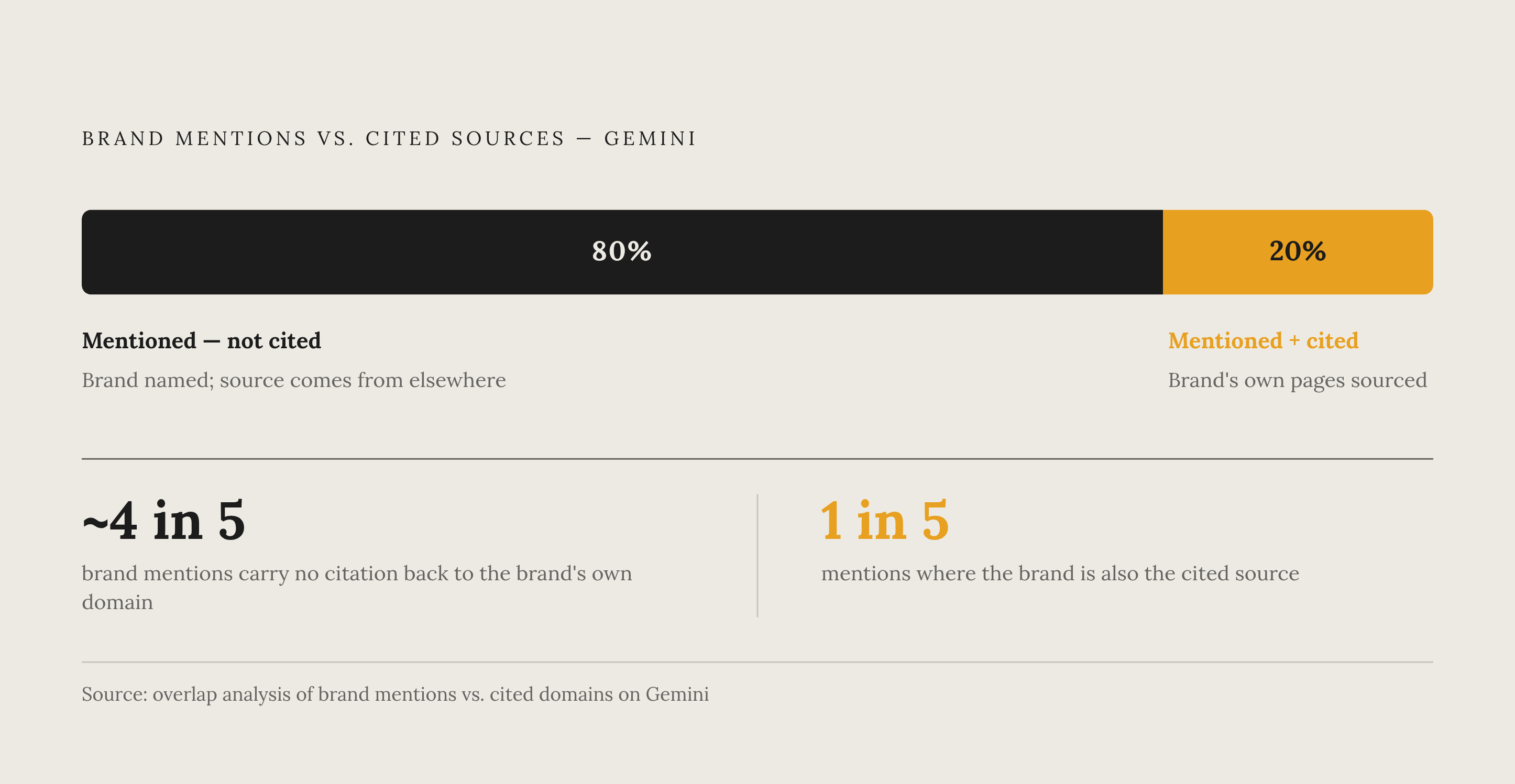
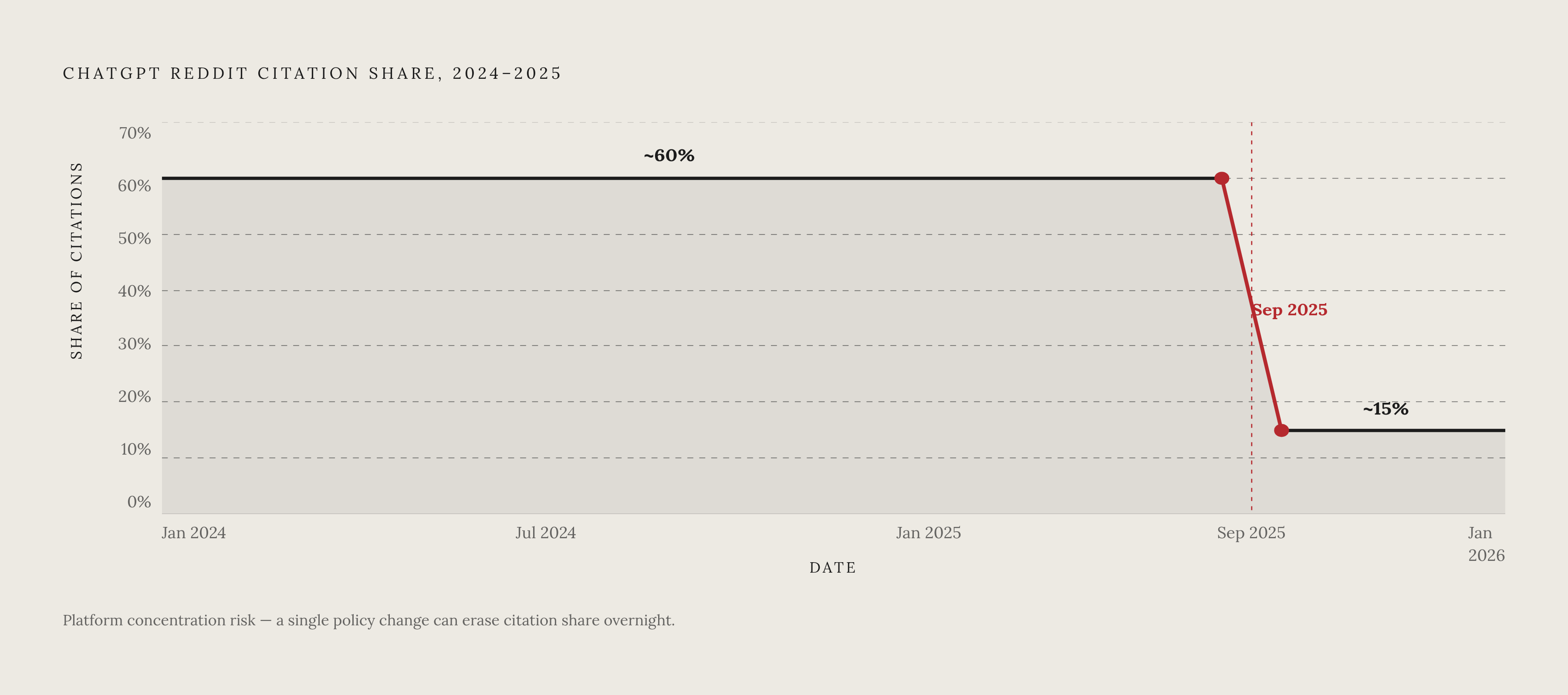
Most businesses evaluating their standing with AI systems treat "AI visibility" as a single measurable thing, and that assumption produces the wrong strategy. Being mentioned by an AI system and being cited by it are two distinct events, and a brand can achieve one without the other. A brand can appear as a named entity inside an AI-generated answer without any of its own pages ever being pulled as the evidence behind that answer. On Gemini, the overlap between brands that get mentioned and domains that get cited runs as low as roughly a fifth: the vast majority of the time a brand is named, the actual sourcing behind that answer is coming from somewhere else. That gap puts a business in a two-front competition: it has to get named in the answer, and separately, it has to make sure the sources an AI system is actually pulling from describe it accurately and favorably. Citation patterns are not stable over time, either. The same 5W data shows ChatGPT's Reddit citation share collapsing from roughly 60% to a fraction of that figure in mid-September 2025, then settling into a new equilibrium. A strategy anchored to a single platform or a single source type is a strategy built to break. What a business needs instead is a portfolio of signals spread across multiple platforms and source types, so that volatility in any one of them doesn't take the whole citation position down with it.
What makes community content citation-worthy rather than just present
Not every forum post or review earns a place in an AI system's citation pool, and the signals separating the two are identifiable. The first is pure accessibility: information locked behind logins, paywalls, or content that only loads after a JavaScript interaction sits outside the reach of AI crawlers. Accordion-style dropdowns deserve a specific distinction here, because content already present in the raw HTML and merely hidden behind CSS remains readable to a crawler, while content that only renders after a user clicks stays invisible to systems like GPTBot and PerplexityBot. A business that wants its community content cited has to confirm the substance of that content actually lives in the HTML, not behind an interaction a crawler will never perform.
Recency functions as a second, independent signal. Pages that haven't been updated within roughly a quarter become substantially more likely to lose their citation standing, and for commercial or comparison queries, that freshness window closes even tighter, because AI systems treat recency as a proxy for trustworthiness when a user is actively weighing options. A three-year-old forum thread with outdated pricing or a discontinued feature set carries less weight than one still being actively discussed and updated, regardless of how authoritative it once was.
The third signal is credibility and depth, and it runs through three genuine categories: behavioral authenticity markers, depth of community engagement, and verified credential systems. A static trust score or badge matters far less than verifiable behavioral evidence, so a thread where users debate specifics, push back on claims, and cite their own experience carries more weight than a generic testimonial page. Original research, benchmark data, and "State of X" reports earn disproportionate citation presence over generic marketing content because they constitute exactly the kind of primary source material AI systems prefer to anchor an answer on. Patagonia's long-running public reporting on its supply chain illustrates the pattern: specific, verifiable, regularly updated disclosure gets treated as a citable primary source in a way that general brand messaging does not.
Earned third-party validation versus owned content volume in driving citation
A business that spends most of its content budget describing itself is working against the grain of how AI citation actually functions. The sources these systems prefer are third-party validations, not self-declarations, and a brand optimizing only its own properties is optimizing the channel that matters least. The 5W report identifies earned media, third-party validation, Wikipedia governance, and community engagement as the levers that actually move AI citation outcomes, which places Generative Engine Optimization much closer to public relations in practice than to technical SEO.
Some practitioners argue that enough structured, schema-rich owned content can substitute for this gap. Structural optimization does help owned content become more citable once it gets pulled into consideration, but it does nothing for the deeper problem: if the AI system is citing a ranking list, a directory, or a community thread a brand simply isn't part of, no amount of on-site polish closes that absence. Quality and authenticity of third-party engagement register with these systems in a way that sheer output never will.
A framework for diagnosing and closing the gaps that keep a brand out of AI citations
Improving a brand's standing in AI citations starts with diagnosis, because the gaps that keep a given brand out of citations are usually concentrated in one or two specific categories. The first category to check is the third-party authority gap, which occurs when an AI system cites a ranking list, directory, or comparison article a brand simply isn't included on, and closing it requires identifying the specific gatekeeper sources in that category and earning a place on them, the way TechRadar functions as a gatekeeper in B2B SaaS CRM, accounting for 8.86% of category citations, or the way NIH, Healthline, Mayo Clinic, Cleveland Clinic, and ScienceDirect dominate healthcare citations in Google's AI Overviews. The second is a sentiment gap, where a brand gets mentioned but without a clear recommendation or favorable framing attached to it, and you close this one by auditing what the third-party sources an AI system is actually pulling say about the brand, not simply by confirming those sources exist. The third is a UGC gap, where an AI system is actively drawing on community discussion in a given category but the brand itself has no presence in those conversations, and closing it requires building a genuine, ongoing presence in the forums, threads, and Q&A spaces where buyers and users are already talking, not a one-time campaign to seed mentions. The fourth is an entity consistency gap, where an AI system's understanding of a brand is fragmented or contradictory across the sources feeding it, and closing it means making sure Google Business Profile, Wikipedia, Crunchbase, and other structured data sources all carry the same accurate description, since AI models rely on this structured data to build their underlying entity model of who a business is and what it offers. Citation share of voice, source URL inclusion, and sentiment when mentioned are the indicators that turn closing these gaps from a one-time audit into a repeatable diagnostic a business can run continuously. Measurement has to come before optimization, because a business that cannot see which sources an AI system is pulling for its category, or whether its own name is surfacing in synthesized answers at all, has no basis for deciding which of these four gaps to close first.
Building brand search volume and off-site presence together
Brand search volume and community-validated off-site presence reinforce each other, so if a business treats them as sequential priorities, building brand awareness first and worrying about AI citation later, it accumulates a disadvantage that compounds the longer it persists. The 5W data identifies brand search volume as the strongest known predictor of AI citation likelihood, with a correlation stronger than backlinks. Brand-building work now carries a direct, measurable effect on AI visibility, not merely on general human awareness. Semrush's 2026 research reinforces the case for building these two efforts together: 81% of organizations that manage SEO and AI visibility as a single, unified workflow reported increased traffic or leads from AI platforms, compared with substantially lower rates among organizations running the two as separate programs.
Volatility makes the case for building a broad portfolio across many sources. The mid-September 2025 collapse in ChatGPT's Reddit citation share is the clearest demonstration available of what happens when a brand's citation exposure leans too heavily on a single community platform, and the lesson generalizes: the portfolio of sources a brand depends on has to span multiple platforms and source types, because any single one of them can shift without warning. A measurement layer underneath it is what makes this manageable. Without a system scoring citation share of voice, source inclusion, and sentiment across platforms, a business has no way to tell whether its brand-building spend is actually converting into AI citation gains, or whether the off-site placements it already has are even accurate and favorable. Evident's approach addresses that exact gap, scoring hundreds of signals across three evaluation dimensions covering algorithmic, AI, and human audiences, which gives a business the structured read on its citation exposure needed to manage brand-building and off-site presence as the parallel, mutually reinforcing investments the data shows they have to be.