The Brand Signals B2B Companies Must Own for LLMs to Treat Them as Credible Sources
LLMs cite vendors who appear consistently across independent sources, not polished websites.

LLMs judge B2B vendor credibility by looking for signals that recur across sources, such as the same brand descriptions, references from independent experts, and a place on trusted review platforms. A polished website alone is not enough to make a company an authority. B2B companies become credible, citable sources when those signals let an AI system connect the same brand to the same expertise across independent sources.
Why the B2B buying journey now begins inside an AI chatbot
Enterprise buyers now use AI chatbots before they run a search or contact a salesperson, so AI-generated answers reach them before the usual sales conversation. By the time a buyer arrives, AI guidance may already have narrowed a broad category to one or two finalists. The website is then supporting a choice.
That changes what absence from an answer costs. A brand can miss not only the shortlist but also the moment when the buyer learns how to describe the problem. AI guidance helps shape the words buyers use and the categories they look at. The chatbot therefore acts as an active gatekeeper, leaving a company excluded from that framing with less opportunity to connect its expertise to the need.
How do LLMs evaluate B2B vendor credibility? Through patterns
LLMs recognize recurring patterns of language, reference, and association across sources. Factuality, consistency, and corroboration provide signals from which a system can reconstruct an account of a company’s expertise. The model is not admiring the brand refresh. Tone and design cannot substitute for evidence that connects a vendor to a particular field.
Entity recognition makes that connection possible. When independent sources repeatedly associate a brand name with the same industry, product category, and expertise, the association becomes clearer. Co-occurrence adds another layer when a brand appears with recognized authorities in research, expert roundups, or practitioner guides. Those references place it in an established context rather than leaving it to announce its own importance.
Consistency helps the system join those references together. If every platform describes a different company under the same name, the variation introduces uncertainty. This is why traditional SEO measures do not map cleanly onto LLM visibility. Keyword density, link counts, and page rankings concern a different task from reconstructing who knows what. The practical opportunity is to build recognizable evidence.
The three signal families LLMs actually weight for B2B brands
Three signal families help the system piece this together, and they are cross-source entity recognition, source-family transfer, and narrative consistency. Entity recognition establishes which company is being discussed and what it knows, source-family transfer supplies context from trusted platforms, and consistency helps those references resolve into one coherent identity. A weakness in one family can make the others harder to interpret.
Entity recognition grows through mentions in sources the company does not control, including news coverage, analyst references, and practitioner discussions. A mention need not contain a hyperlink to contribute a signal. The important connection is between the brand and its area of expertise. Co-occurrence with an established authority strengthens that context, especially when the reference concerns a defined subject.
Source-family transfer helps explain what a company gains from being on platforms beyond its own website. Analyze’s B2B AI search analysis found a +23.9 percentage-point increase in the mention rate of the brand it studied when answers cited trusted directories or marketplaces. Platforms such as G2, Capterra, and TrustRadius can therefore supply a distinct source of recognition, although that finding is limited to mention rate.
Narrative consistency binds these signals to the same company. Its name, expertise, and founding story should not change between its website, LinkedIn, review profiles, and press coverage. The company can explain things differently to different audiences while keeping the facts the same. The distinction is between adapting the language and changing the identity.
What IBM Security X-Force and Salesforce built that most B2B brands have not
IBM Security X-Force makes expertise attributable to people. Its named experts publish in specific security domains rather than speaking only through a generic corporate byline. Its annual Threat Intelligence Index also gives external security publications and practitioners something substantial to reference. Those independent references create corroboration beyond IBM’s own publishing. X-Force is among the most commonly cited cybersecurity sources in AI answers, with a visible connection between specialist expertise, outside amplification, and citation.
Salesforce builds precision through content scoped to particular roles and industries. Its subjects include lead routing for financial services sales teams, patient engagement for healthcare administrators, and implementation playbooks for retail marketers. These are narrower associations than generic CRM guidance. When a financial services buyer asks about CRM, that specificity connects Salesforce to the context of the question.
The shared behavior is more useful than either company’s size. Both produce material that independent sources can repeat and corroborate, with expertise defined closely enough to fit a buyer’s actual question. Named authors give the knowledge an identifiable source, while vertical detail gives it a clear application. “Thought leadership” becomes more useful when it contains an identifiable thought.
Earned media as the dominant signal type, and why owned content alone does not close the gap
When AI systems research vendors, most of the sources they cite are earned media. Independent references show that another source has found a company’s claims or expertise worth discussing. Earned brand mentions are consequently more influential than backlinks alone in driving LLM citations. Counting links misses part of the evidence.
Specific claims, expert quotes, verifiable statistics, and named authorship give outside sources material they can use and attribute. These markers appear more often in AI-cited B2B SaaS articles than in non-cited articles. Named authorship helps establish whether a piece has an accountable source.
Review platforms add a different kind of corroboration. Profiles with more reviews on recognized platforms are cited more often than profiles with few reviews, and recent reviews carry more weight. A directory listing establishes presence, but a deeper review history supplies more independent evidence. That distinction is easy to lose when platform management stops at filling out the company description.
The sequence is therefore publication followed by independent amplification. A useful report can become the basis for practitioner discussion or external coverage. Even a large library lacks that outside support when nobody beyond the company cites it.
Why traditional market leadership and funding do not translate into AI credibility
Funding and market share do not substitute for entity authority. Companies with substantial funding can score nearly identically to bootstrapped firms when both have weak signal stacks. Structured AI visibility audits have also found billion-dollar enterprise brands with near-zero visibility for basic category queries. An impressive balance sheet is not a citation.
Missing structured data can weaken technical eligibility, while blocked AI crawlers keep systems from reaching the content. Thin review ecosystems leave little independent customer evidence, and unmanaged forum discussions can add a representation the company has not addressed. None of these problems disappears because a business leads its market. They concern the evidence available to the system.
Models can describe even well-known names in different ways. This cross-model perception drift means that a strong description in one system does not establish dependable visibility elsewhere. Familiarity is not the same as stable representation. An incumbent can have considerable name recognition and still have uneven associations with particular categories or use cases.
Smaller companies therefore have an opening. They can build precise, consistent evidence in a defined domain without matching an incumbent’s scale. Large companies, in turn, cannot assume that their position will be translated automatically into AI recommendations. Both face the same practical question of whether independent sources make their expertise legible.
The concrete signal stack B2B companies must build and how to sequence it
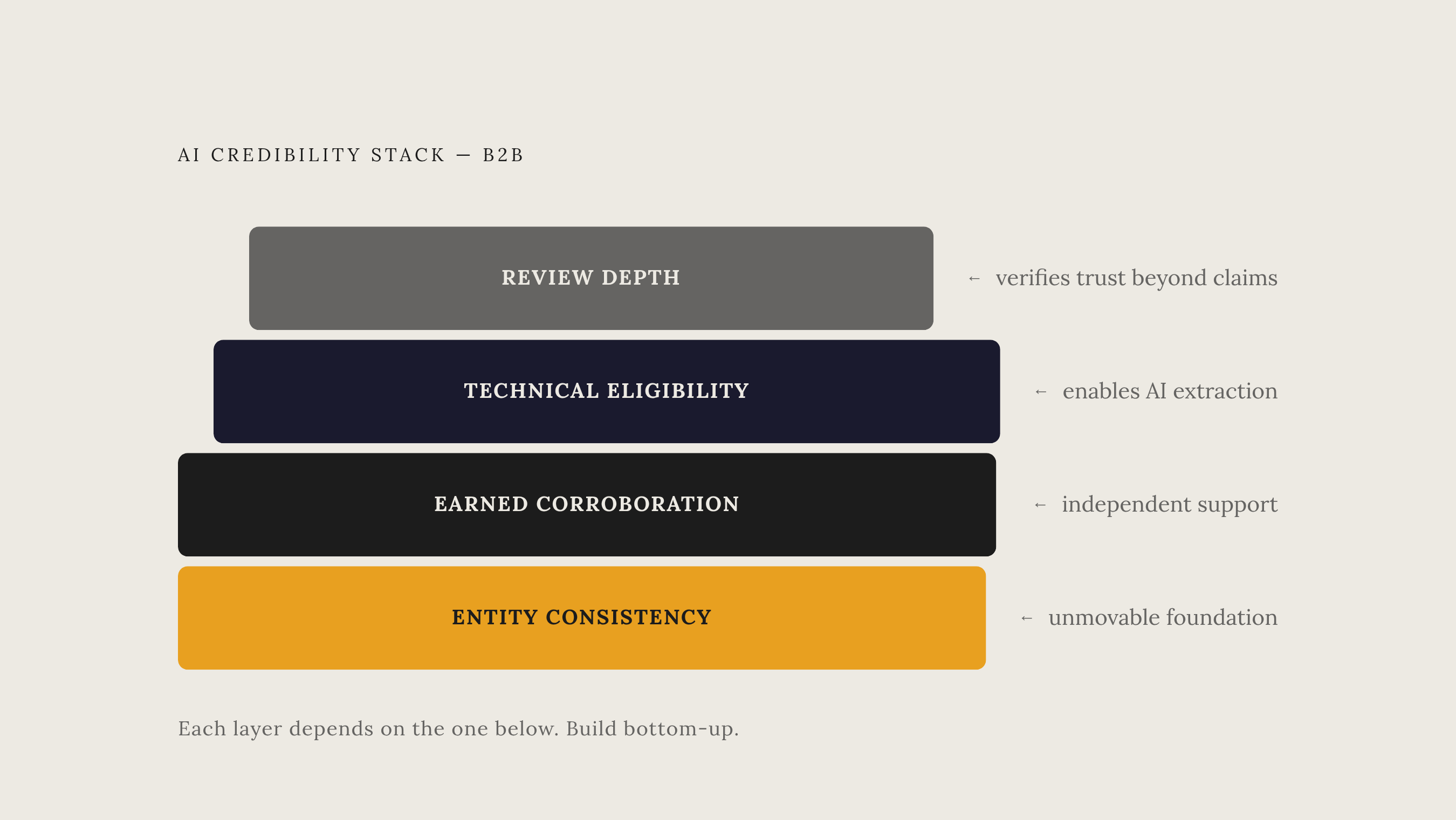
A team building these signals should begin with measurement, then sequence the work around the gaps it finds. The logical stack starts with entity consistency, followed by earned corroboration, technical eligibility, and review depth. Each layer has a different job. Consistency makes references attributable, corroboration gives them independent support, technical access makes content available for extraction, and reviews deepen the evidence beyond corporate claims.
Entity consistency is the foundation. Company name, founder name, location, and core expertise should match across the website, LinkedIn, review profiles, directory listings, and press mentions. Entity consistency requires stable facts so that different sources describe the same business.
Earned corroboration then gives that identity outside support. The recommended work is named expert content with specific, verifiable claims in a defined domain, supported by participation in expert roundups, analyst coverage, and practitioner communities. Generic commentary gives outsiders less to quote. Defined expertise gives those discussions a subject and helps connect their references back to the company.
Technical eligibility makes the resulting material usable. JSON-LD schema markup, clear header hierarchies, and direct-answer sections help retrieval-augmented generation systems extract content. Schema establishes entity eligibility but does not determine citation by itself, because factual density and the answer’s proximity to the question govern extraction. AI crawler access must also be explicitly permitted.
Review depth adds independent trust verification to this stack. Volume and recency on recognized B2B platforms provide evidence beyond the vendor’s account of itself, while an unmaintained profile becomes a stale signal. The sequence describes dependencies. An audit that finds blocked crawlers has identified a prerequisite for retrieval, so the actual work must follow the measured constraint.
How to measure AI perception before optimizing for it
A practical framework tracks how often a brand is cited, how often it appears at all, how often it is actively recommended, whether its cited content shapes the answer, and how the system describes it. These are different outcomes. A footnote does not have the same role as a source that determines the answer, and a mention does not necessarily endorse a vendor.
The same framework needs to cover different models and types of queries. Otherwise, a favorable result in one system can hide poor performance in another. Cross-model perception drift is a separate measurement problem. Systematic queries reveal whether a company’s expertise is represented consistently or changes with the assistant answering.
Competitor benchmarks then give those findings context. Comparing the leading alternatives within each query category distinguishes an absolute gap, where the brand is absent, from a relative gap, where it appears but is framed less favorably. That distinction changes the work to prioritize. Missing structured data, blocked crawlers, thin reviews, and inconsistent descriptions are fixable, but they need to be ranked by impact rather than by which team can launch a project fastest.
Evident scores brands across the signals and dimensions that determine AI, algorithmic, and human perception. That provides a structured baseline from which B2B companies can sequence signal-building work and validate its results. Without it, even a busy program of publishing, publicity, and profile updates can leave the original problem untouched.
Sources
- Building Brand Signals for LLMs: Strategies for AI Visibility - Hawk Web Marketing
- AI Search Trust Signals: How to Make Your Brand Safe to Cite by ChatGPT, Google AI Overviews, and Perplexity (2026 Guide)
- A Survey on Automatic Credibility Assessment Using Textual Credibility Signals in the Era of Large Language Models