Mapping the Competitive Landscape Inside AI Recommender Systems
Brands can now measure which rivals AI systems recommend instead of theirs.

Competitive AI visibility benchmarking shows which rivals LLMs recommend instead of a brand by asking buyer questions over and over and checking whether each brand appears and where it ranks. Measurement begins across engines and buyer needs.
Why AI recommendation engines are a new kind of competitive arena
A buyer asks an AI assistant to recommend a product that meets a stated need. The assistant returns a small selection, and brands outside that selection may never enter consideration. Omission makes a capable brand invisible to that buyer. Unlike search, where a user can inspect a ranked index, an LLM constructs its recommendation set at the moment of the query. There is no fixed shelf or category manager determining which brands appear.
Malthouse et al., researchers at Northwestern University and Boston University, establish this problem in their 2026 study, Evaluating Brand Retrieval and Ranking in Large Language Model Recommendations. The study finds that the potential recommendation set is neither fixed nor directly observable, while repeated requests can produce different brands and rankings. This changes the competitive task. A brand must earn inclusion in an answer, rather than simply improve its place in an existing list. Leaving its AI-visible information footprint unmanaged gives competitors an opening wherever buyers ask for advice.
How LLMs construct a recommendation set — the mechanism from the inside
LLMs synthesize recommendations from patterns learned during training, augmented in some systems by live retrieval. The process is opaque, but not random. During training, models learn associations between brands, topics, solutions, and trust from news, reviews, industry publications, and web content. The frequency and context of those mentions shape the model’s baseline associations. When unrelated sources describe a brand in similar ways, they give the model more grounds to form a consistent brand association than a lone claim does.
Retrieval-Augmented Generation, or RAG, gives the model a second source of information. Perplexity retrieves and cites live web pages as it writes a response, so it can draw on current content when making recommendations. ChatGPT’s browsing mode and Gemini’s Google Search integration also bring real-time web presence into the answer. Website accessibility therefore influences more than future training exposure. It can affect what a system finds and cites now.
These layers create two distinct credibility requirements, which are what the model has learned about a brand and what it can retrieve when answering. Third-party mentions that last help with the first, while fresh, structured content helps with the second. Neither layer guarantees a fixed position. The study shows that identical prompts can yield different selections and ordering, so recommendation position is best understood as a statistical tendency. This is why improving the inputs and measuring the outputs are separate tasks.
The signals that determine which brands surface — and which disappear
The signals shaping AI visibility cluster around information clarity, third-party validation density, and structural accessibility. Information clarity concerns how precisely and consistently a brand is defined across the web. When independent sources describe the same product in similar terms, they strengthen the model’s association with it. Vague positioning weakens that association before retrieval begins. Conflicting descriptions also leave the model with less consistent evidence about which needs the brand serves.
Third-party validation density concerns the breadth and authority of external coverage. Mentions across independent review platforms, industry publications, analyst reports, and technical documentation give the model more to draw on than content found mostly on a brand’s own domain. Source diversity is central to that distinction. Coverage on G2, Capterra, and recognized industry sources provides external validation that a polished homepage cannot supply by itself. When reviews are consistently positive across platforms, they add evidence that the brand is reliable.
Retrieval systems need structural accessibility to extract the information at all. Important content behind JavaScript, paywalls, logins, or crawler restrictions can be functionally invisible to the retrieval layer. FAQ schema, comparison tables, and clearly separated knowledge-base content make it easier for systems to find and cite the information they need. A brand with broad external coverage and extractable product information therefore presents a different evidence base from a competitor whose presence consists largely of its homepage.
Why brand popularity is a poor predictor of AI recommendation prominence
The study finds substantial omission of established brands in category-only queries and limited evidence that recommendation prominence follows conventional brand popularity. Instead, prominence is associated with search interest and online brand conversation. The competitive landscape inside an LLM is therefore not a straightforward copy of the offline market or the search results page.
This creates an opening for smaller or newer brands. A business that has plenty of independent coverage, consistent positioning, and structured content can appear ahead of a larger competitor with a weaker information footprint. Size alone is a poor planning assumption. Funding and market capitalization cannot substitute for evidence that a model can associate with the buyer’s request.
How a brand performs in search still matters because organic search and AI citation signals overlap. But a brand also needs a clear structure, direct answers, and off-site authority, which its search position alone does not show. A strong search ranking is not an AI visibility measurement. Established brands must demonstrate their position in generated answers, while less-prominent brands can compete on signals they can influence.
How query framing changes who appears — and what that means for brand positioning
A brand’s visibility depends partly on how the buyer describes the problem. The study finds that needs-based prompts, which include goals, constraints, and preferences, change the recommendation set and bring otherwise omitted brands into view. Category membership is only part of the match. A model may connect a brand more strongly with a particular use case than with the broad category in which that use case sits.
The study’s diagnostic positioning probes make this distinction especially useful. Brands omitted from ordinary recommendations can remain conditionally retrievable when prompts supply distinctive cues consistent with their intended positioning. Absence can indicate that the ordinary query leaves the brand associations needed for inclusion inactive. This separates a broad visibility problem from a narrower mismatch between positioning and buyer language.
For practitioners, the lesson is to map the needs-based questions target buyers actually ask and compare results with generic category prompts. That comparison reveals where a brand already has a contextual foothold and where its associations remain weak. Definitive language such as “X is excellent for” expresses a stronger association than “X might be suitable for.” Positioning work must therefore link owned and third-party descriptions to specific buyer needs as well as name the category.
How do you find out which competitors AI assistants recommend instead of your brand?
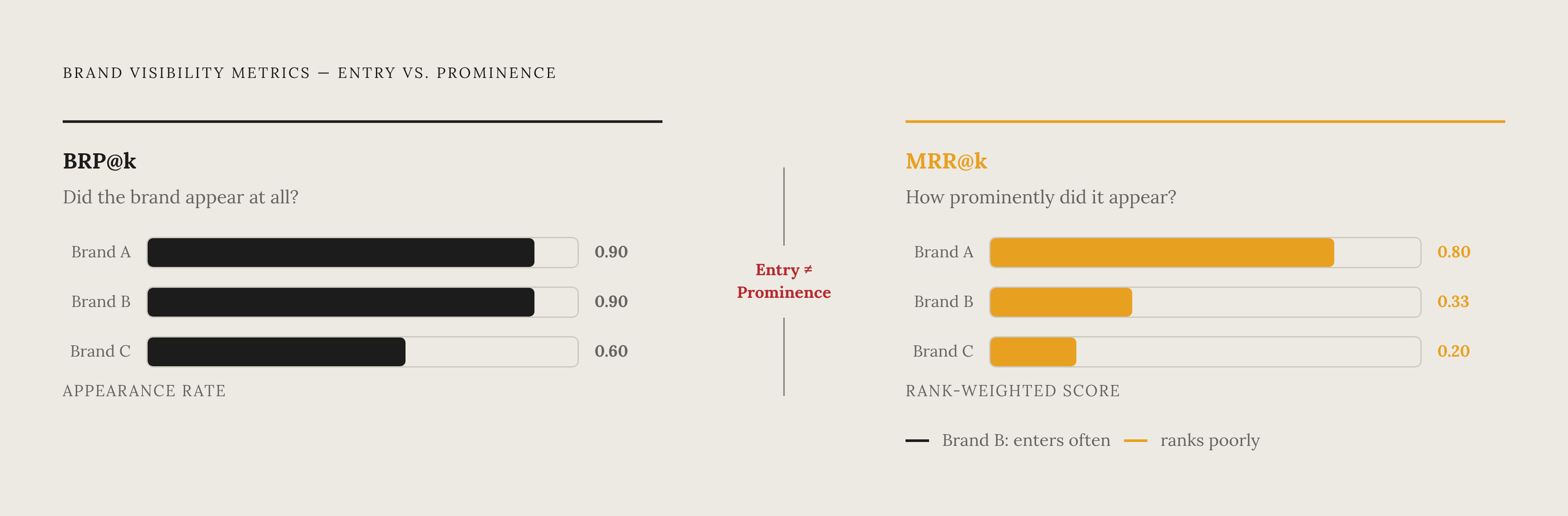
Competitive benchmarking means running relevant prompts over and over and checking which brands appear in each response and where they rank. The study introduces Brand Recommendation Probability, or BRP@k, to measure the probability that a brand appears among up to k recommendations. It also adapts Mean Reciprocal Rank, or MRR@k, to capture prominence through both appearance and position. These measures answer different questions about the same responses. One concerns entry into the recommendation set, while the other distinguishes more prominent appearances from less prominent ones.
The study’s framework defines the competitive set independently of model outputs. This prevents a benchmark from treating only the brands already recommended as the entire market. Omitted competitors belong in the comparison as well. Repeated sampling across category queries and needs-based prompts then shows which rivals appear, under what conditions, and with what prominence. A single generated list is one draw from a distribution.
Platform differences also need to remain visible. Strong inclusion on ChatGPT and weak inclusion on Perplexity indicate a platform-specific gap, because the systems’ retrieval mechanisms differ. Conventional review and social listening tools do not fill this monitoring need when they track external mentions without sampling AI answers. Evident addresses that AI-answer measurement gap as a monitoring solution.
The concrete actions that improve a brand’s position in AI recommendation sets
Once measurement identifies the gaps, remediation should begin with structural access because content improvements have little retrieval value when systems cannot reach them. Teams should verify that robots.txt does not block relevant AI crawlers and that servers or CDNs are not rejecting their requests. Important content should be server-side rendered so that reaching it does not depend on JavaScript execution. Access comes before polishing the content itself. Logins, paywalls, and interactive elements also require attention where they prevent retrieval agents from reaching essential information.
An llms.txt file can be considered as a curated map to important site content. It is not a substitute for accessible pages. With access addressed, the next step is to make product information easier to extract through comparison tables, FAQ schema, and structured knowledge-base content. Regular refreshes of cornerstone content support RAG-enabled engines, for which recency influences what remains useful. These changes build the owned information footprint that live retrieval can draw upon.
Third-party coverage then strengthens the footprint with independent validation. Teams should get the brand covered on independent review platforms, by industry analysts, and in technical documentation on recognized domains. When unrelated sources make consistent claims, they give the model grounds for a consensus that owned content alone cannot establish.
Positioning alignment makes those investments relevant to the queries being benchmarked. Teams should connect owned and third-party descriptions to the specific goals, constraints, and preferences expressed by target buyers. Content that describes only the broad category may leave those links unstated. The diagnostic probe finding shows why a clear use-case association can bring an otherwise omitted brand into a needs-based recommendation. After remediation, repeated measurement is necessary to establish whether inclusion and prominence have changed under those conditions.
Why AI recommendation position requires ongoing measurement, not a one-time audit
A brand’s recommendation position can change without any action on its part. Model updates and new training cycles can redistribute prominence, while competitors can improve their information footprints between audits. An earned position is not a permanent entitlement. A one-time assessment therefore describes a period of performance. The same signals that create an opening for a challenger also allow another competitor to displace it.
Platform fragmentation adds another source of movement. ChatGPT, Perplexity, Gemini, and AI Overviews have distinct retrieval mechanisms and training pipelines, so performance on one does not establish performance on the others. Cross-platform sampling exposes differences that an isolated audit misses. Because responses also vary within a platform, repeated observations are needed to distinguish a competitive tendency from an individual answer. The study’s probability-based framework gives teams a method for doing that work over time.
Evident fits this requirement as a practical answer to the AI-answer monitoring gap. Ongoing measurement supports competitive judgment by making a rising rival an observable signal for response. A team that keeps sampling can spot that change before the gap becomes built in, while a team that relies on an old audit has no such early warning.