Credibility Signals That Determine Which B2B Vendors AI Assistants Recommend
Four credibility signals determine whether AI assistants recommend your vendor.

LLMs evaluate B2B vendor credibility through four signals, which are consistency of definition, corroboration across independent sources, demonstrated expertise, and structured data clarity. These signals help an assistant explain a vendor confidently and recommend it for a buyer’s need. Becoming the answer depends on building coherent, accessible evidence.
How AI assistants have become the first filter in B2B vendor selection
A buyer asks ChatGPT, Perplexity, Gemini, or Google AI Overviews to define requirements, identify providers, and compare options before contacting sales. The assistant returns a synthesized answer with a handful of vendors, and the buyer may proceed without visiting their websites. The shortlist forms before the vendor sees demand. This changes the role of digital content from attracting a visit to supplying the evidence used in an initial selection.
Paid visibility complicates the picture but does not erase that distinction. Perplexity and Claude have no sponsored slot inside an AI recommendation, while Google AI Overviews and ChatGPT include labeled paid placements inside or adjacent to their generated answers. Ad budget can therefore influence visibility on some platforms, but paid exposure and an evidence-based recommendation are different outcomes. Absence is harder to detect than either. A vendor omitted from the answer has no referral log showing that a deal began and ended without it, making the central question what the assistant actually evaluates.
Why AI credibility is not the same as brand popularity or search rank
AI credibility is a function of corroborated, parseable evidence across independent sources rather than brand scale, advertising spend, or search position. A high-ranking page does not, by itself, establish a coherent account of the company behind it. Recognition alone does not settle category fit. The assistant needs evidence that supports an explanation of what the vendor does, whom it serves, and why it belongs in the answer.
Consider a vendor described across its channels as an AI platform, consulting company, transformation partner, and software provider. Compare it with a vendor using a single category definition across its website, media coverage, and directories. The second is easier to understand and explain. A smaller company with consistent messaging can therefore earn a recommendation over a larger competitor whose descriptions conflict.
In this context, trust is a probability weight. Repeated appearances across credible, topically aligned sources strengthen the association between a vendor and its category. A homepage claim has less support than one reinforced by a G2 profile, a trade publication, and a podcast transcript. This makes credibility a learnable system of signals rather than an automatic reward for market prominence.
How LLMs evaluate B2B vendor credibility through a signal hierarchy
Content from experts is among the signal types that carry the most weight. Named practitioners, concrete specifics, and attributable claims provide stronger evidence than generic brand copy because they make expertise visible and explainable. Broad assertions offer less for an assistant to use. Educational content and detailed explanations need to expose the knowledge behind the vendor’s positioning.
Tier 2 is the structured evidence on a website that helps machines understand what the vendor offers. Clear product and category data make the company easier to parse, while a site built only around visual navigation leaves that task less well supported. Structure makes evidence usable. A well-built website helps, but the vendor still needs authoritative off-site citations.
Tier 3 is the breadth of brand mentions across independent sources, including media coverage, business directories, review platforms, podcasts, and partner websites. The assistant draws on many smaller signals that agree, since a single account controlled by the company is not enough. Breadth works best when the descriptions agree. Its practical value comes from reinforcing the same category, use cases, and capabilities across the sources that discuss the vendor.
Tier 4 is topical consistency and category depth over time. Repeated coverage of a specific category across credible publications strengthens the association between the brand and that subject. The implication is that category depth needs continuity, while contradictory coverage introduces uncertainty even when the vendor receives substantial attention.
The four specific signals that most directly determine whether a vendor is named
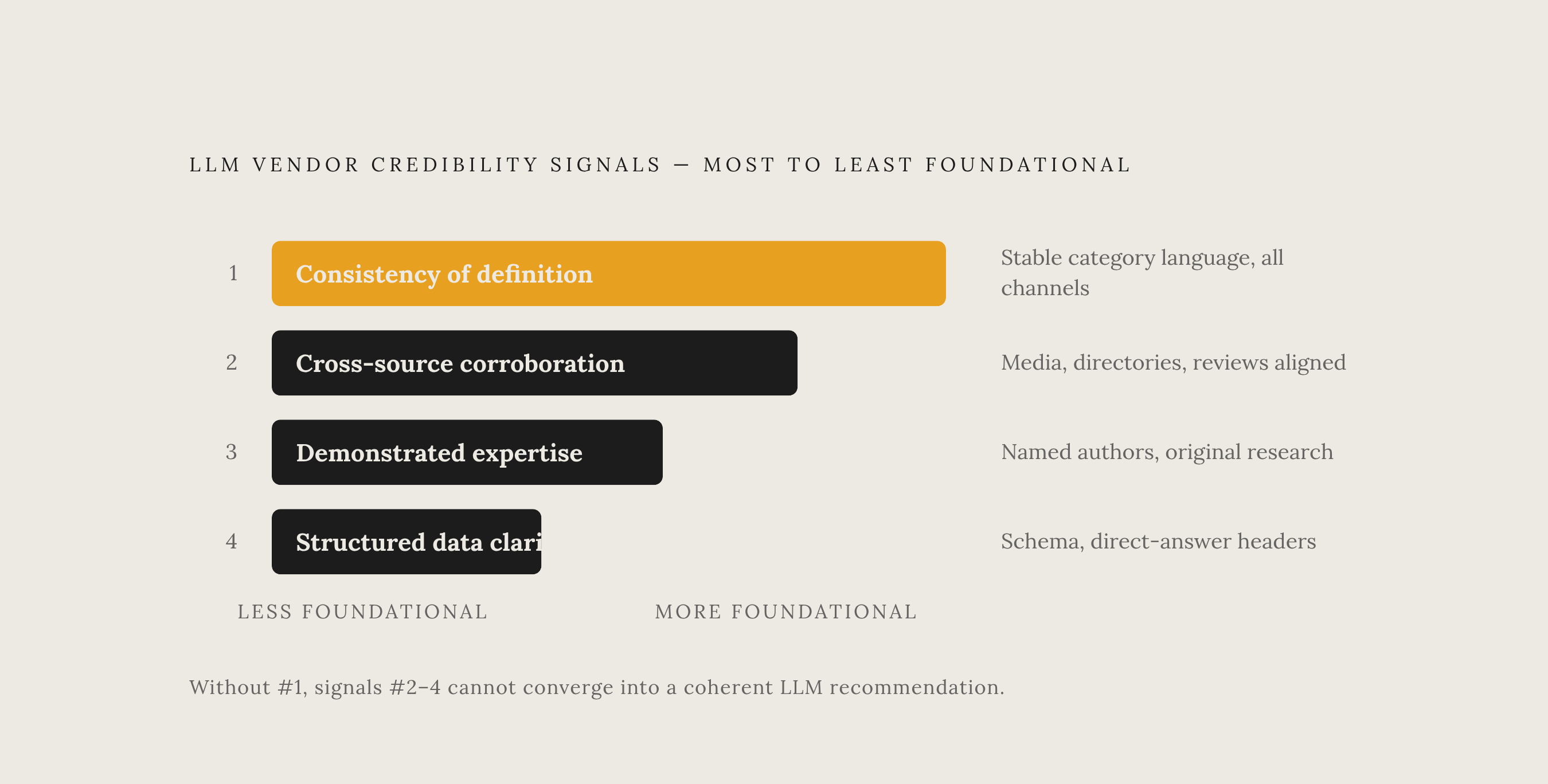
Consistency of definition gives the assistant a stable account of the company. When category language, buyer problems, use cases, and competitive context agree across channels, the model has a clearer basis for placing the vendor. Category confusion weakens that basis quickly. Each description needs to support the same understanding of what the company does and where it fits, with room for variation in wording.
Cross-source corroboration tests whether that definition extends beyond the vendor’s own website. Media coverage, directories, partner sites, podcasts, customer reviews, and LinkedIn profiles can reinforce the same claims or pull them in different directions. Even a polished website and a detailed partner profile make the evidence harder to piece together when they describe different capabilities or place the company in different categories.
Demonstrated expertise gives the model something substantive to explain and cite. Educational content, industry commentary, detailed product explanations, original research, and thought leadership make domain knowledge accessible. Knowledge confined to client projects, internal conversations, and sales presentations cannot support an answer in the same way as published material with named authors and concrete claims.
Structured data clarity makes that accessible evidence easier to understand. Schema markup, named-expert attribution, and direct-answer headers help present product and category information for machine parsing. Accessibility and presentation are separate requirements here. Visual hierarchy, benefit-focused copy, and gated technical specifications may support a human sales journey while failing to provide usable evidence for an assistant assembling a shortlist.
Why review profiles and peer-validation platforms function as AI trust infrastructure
Assistants draw on review language to characterize a vendor’s category, differentiated value, and fit for a buyer’s problem. Ratings alone cannot provide those distinctions reliably. The words customers use describe what the offering does in practice, giving the model evidence beyond the vendor’s preferred account of itself.
That mechanism makes specificity more useful than volume alone. A lot of vague reviews tell the assistant less than a few that spell out what happened and what results the buyer saw. Outcomes described in a buyer’s own words are highly citable because they connect a capability to an experienced result.
If customer descriptions reinforce the category and use cases found on the website and partner pages, they strengthen a coherent interpretation. If they diverge, the language ecosystem becomes fragmented. Vendors need to actively shape the clarity and consistency of that ecosystem through meaningful peer validation.
How B2B vendors appear — or fail to appear — across the three modes of AI visibility
A brand mention establishes presence in an answer by showing that the assistant associates the vendor with the topic strongly enough to name it. That is useful but limited evidence of progress. Mentions depend on category presence, while the value of any appearance also depends on where and how the name enters the response.
A citation gives the vendor’s content a different role. The assistant uses that content to explain a topic, allowing the vendor to influence how buyers frame a problem before comparison begins. Here, the content becomes evidence for the answer. This mode requires material that directly addresses decision-stage questions in a form the assistant can use, rather than content that only announces a product’s benefits.
A recommendation goes further by naming the vendor as a provider to consider for a specific need. It is the highest-value mode because it leads directly into buyer evaluation and requires demonstrated fit for a high-intent query. A vendor used as the main example, included in a heading, or introduced at the opening has different prominence from one named at the end of a list. Vendors therefore need to work toward all three modes, since a single appearance is not enough to count as success.
Why AI credibility is volatile and requires continuous measurement rather than one-time optimization
Citations change across models, and a vendor’s interpretation can weaken or drift without producing a visible warning. Strategy&’s research on LLM brand visibility shows that AI mention citations change a lot from month to month. A successful appearance is therefore only a snapshot. Even when a vendor’s digital presence fits together, it needs to be measured over time to check whether assistants still use and understand it as intended.
Faruk Tugtekin’s AI Perception Index 2026, published on SSRN in February 2026, found a substantial cross-model perception gap for the same brand. A vendor represented favorably in one system may be described differently or omitted in another. Coverage across platforms is therefore necessary for measuring how assistants represent a vendor.
Visibility and perception also require separate evaluation. Visibility records whether the brand appears, while perception concerns narrative favorability, message pull-through, competitive positioning, factual accuracy, and supporting source quality. High visibility can coexist with poor perception. A measurement approach therefore needs citation rate, share of model, and sentiment, together with an audit of the sources behind the answers. Share of model records how often the vendor appears relative to competitors across relevant queries.
Without that baseline, vendors cannot distinguish a weak presence from an inaccurate one, or know whether improvements survive changes across systems. More content does not resolve that uncertainty. Measurement must precede optimization.
Building a credibility signal audit — where B2B vendors should start
An audit of existing signal consistency should precede another round of content production. Contradictory descriptions can suppress credibility, and new material may amplify the wrong message if the underlying definition remains unsettled. The audit should establish which signals agree, which conflict, and which are missing from the accessible record.
For consistency, compare the core category definition across the website, G2 profile, LinkedIn, directory listings, and press coverage. The corroboration check should count high-authority sources that describe the company in matching terms and assess whether those sources agree with each other.
For expertise visibility, assess how much domain knowledge has become accessible, citable content and how much remains in internal decks or sales conversations. This separates having expertise from exposing evidence of it. The structure check should then examine whether product and category information uses schema markup, named-expert attribution, and direct-answer headers. The diagnostic is whether the material supports machine parsing or depends exclusively on a human navigating the site.
To set the response baseline, ask ChatGPT, Perplexity, and Google AI Overviews the category and use-case questions that buyers ask. Record whether the vendor appears, its prominence, and how the answer characterizes it. Keep mentions, citations, and recommendations distinct during assessment. Tracking sentiment and the sources used as well helps prevent a growing count of appearances from concealing inaccurate positioning. Repeating this measurement turns the audit into a managed metric.
Evident’s perception intelligence approach gives this work a system by scoring the algorithmic, AI, and human-audience dimensions together. The combined assessment identifies where credibility signals are strong, where they fragment, and what needs correction first, rather than leaving teams to infer the whole picture from separate channel reports. That gives the audit an ordered starting point. Measurement separates vendors that manage AI credibility from those that discover their absence after the buyer’s shortlist has already formed.