How AI Hallucinations About Your Brand Damage Credibility
AI systems confidently generate false brand claims that users rarely verify before acting.

AI hallucinations about a brand damage credibility because they turn incomplete or conflicting information into confident claims that users may act on. These distortions are not simply random glitches. They arise from predictable weaknesses in how AI systems reconstruct brands, which makes AI perception a dimension of brand health that organizations can measure, monitor, and correct.
Why AI systems generate false brand information by design, not by accident
Brands may see hallucinations as technical failures that happen now and then or as problems for AI providers to solve. The mechanism points to a more persistent exposure. Large language models generate text by predicting plausible sequences rather than verifying each claim against a ground truth. Foley's 2025 analysis explains that this process optimizes for fluency and relevance, without a built-in fact-checking layer. Even accurate training material can produce false statements when the model recombines facts into a new answer.
For brands, the conditions that invite these errors are often identifiable. A website may contradict itself across pages, structured data may leave attributes unresolved, or outdated third-party sources may conflict with current positioning. Those weaknesses create ambiguity precisely where the system needs a clear account of the brand. Exposure also runs on two timelines, namely information absorbed during training and information introduced through real-time retrieval augmentation. Correcting a website can improve the current source without immediately displacing the older account embedded in a model, so remediation requires work beyond a single edit.
How LLMs actually evaluate and reconstruct a brand when answering a query
When answering a question about a brand, an LLM does not simply reproduce the company's chosen description. It constructs a composite from source authority, mention frequency, review sentiment, query-context fit, and structured data legibility. Each signal contributes to whether the brand appears relevant and whether its attributes can be stated confidently. Content without clear, verifiable proof points loses the persuasive framing that might influence a human reader. The resulting profile is closer to a structured feature vector than an emotionally resonant identity.
A customer may feel loyal to a familiar brand and give it the benefit of the doubt, while an AI system weighs the evidence it has without that bond. Strong reviews therefore may not make up for missing structured data, editorial coverage, or verified entity presence. The signals work multiplicatively rather than additively, so a weak category can undermine an otherwise strong profile. Evidence spread evenly across categories can give the system more confidence than strong evidence in one category and gaps in the others.
That reconstruction also varies by platform. The same brand can receive substantial citation coverage in one system and be nearly invisible in another. Favorable representation in one answer environment is therefore not evidence of consistent representation elsewhere. Across these environments, explanatory content gives the system more usable material than unsupported persuasion. Superlatives and broad trust claims can make a brand less likely to be cited because they give less concrete evidence of what it offers.
The distinct types of brand damage hallucinations produce
Trust bleed occurs when users accept AI-generated sentiment as synthesized authority rather than weighing source bias as they might with a social post. Invisible propagation occurs when negative descriptions circulate through private AI conversations without leaving a tweet, review, or other public item for social listening dashboards to detect. Attribution collapse occurs when customers treat an AI-generated falsehood as a failure by the company it describes. A downstream cascade happens when false claims get into published reports or training-adjacent material and are used to produce later outputs.
The severity of these harms also depends on how users judge the error. Consumers can judge AI mistakes more harshly than human mistakes because they expect greater accuracy from the system. Hallucinations that produce defamatory claims can lead to lawsuits, adding legal and financial risks to the loss of trust. Samanta and Chakraborty (2026) document severe reputational, financial, and ethical damage affecting both organizations and consumers. These are separate detection problems as well as separate harms, since a visible published error and an unseen private answer require different forms of scrutiny.
What large organizations have actually lost when AI misrepresented their work
Google Bard shows how quickly a factual error can hurt trust in a company. Its first public promotional ad incorrectly stated that the James Webb Space Telescope took the first pictures of an exoplanet. The claim was false by more than a decade. Foley's 2025 analysis connects the error to immediate financial consequences for Alphabet. The mistake appeared in material intended to demonstrate the product, making factual reliability part of the public judgment of the company itself.
The same pattern affects consulting firms, whose work depends on analysis that people trust. KPMG, EY, and another consulting firm used AI-generated information without checking it well enough, all within a short time. The shared failure matters because it shows that organizational scale and professional prestige do not insulate published work from hallucination risk. In the most consequential incidents, errors remained undetected for months and spread through trusted channels before correction. Public correction could not fully reverse the resulting institutional damage.
In these cases, organizations published AI-generated errors themselves, rather than just being described wrongly by outside systems. That distinction does not separate them from the larger credibility problem. Both put false information into channels that audiences associate with authority. Published errors can also get into material used by LLMs, so mistakes by organizations can feed the same reconstruction process that produces false brand claims. The damage therefore includes both the immediate failure of trust and the possibility that the erroneous account will be reused.
Why users rarely catch hallucinated brand claims before acting on them
User skepticism does not provide a dependable correction layer. Blanchard, Garvey, and another researcher distinguish skepticism, verification, and reliance as separate behaviors. A person can recognize that an answer might be inaccurate without checking it. The same person can still let that answer influence a decision. Awareness of hallucination risk is therefore not equivalent to protection from it.
General warnings have the weakest and most mixed effects among the interventions examined. Telling users that AI can hallucinate does not reliably make them check outputs more carefully. Scrutiny is more likely when a response contains something implausible or when the user recognizes the subject as an error-prone category. Brand claims often escape both triggers because they sound specific, authoritative, and internally coherent. Their plausibility conceals the reason to investigate them.
A user who asks another AI system may get the same false claim because both systems draw on the same pool of sources. Confident delivery further obscures uncertainty because the answer lacks the hesitation that would normally invite doubt. The system can generate a plausible error, the reader can accept it, and a warning or attempted verification may not interrupt that sequence. Brands therefore cannot depend on users to surface inaccuracies before those inaccuracies affect decisions.
What the signals are that determine how AI systems represent a brand
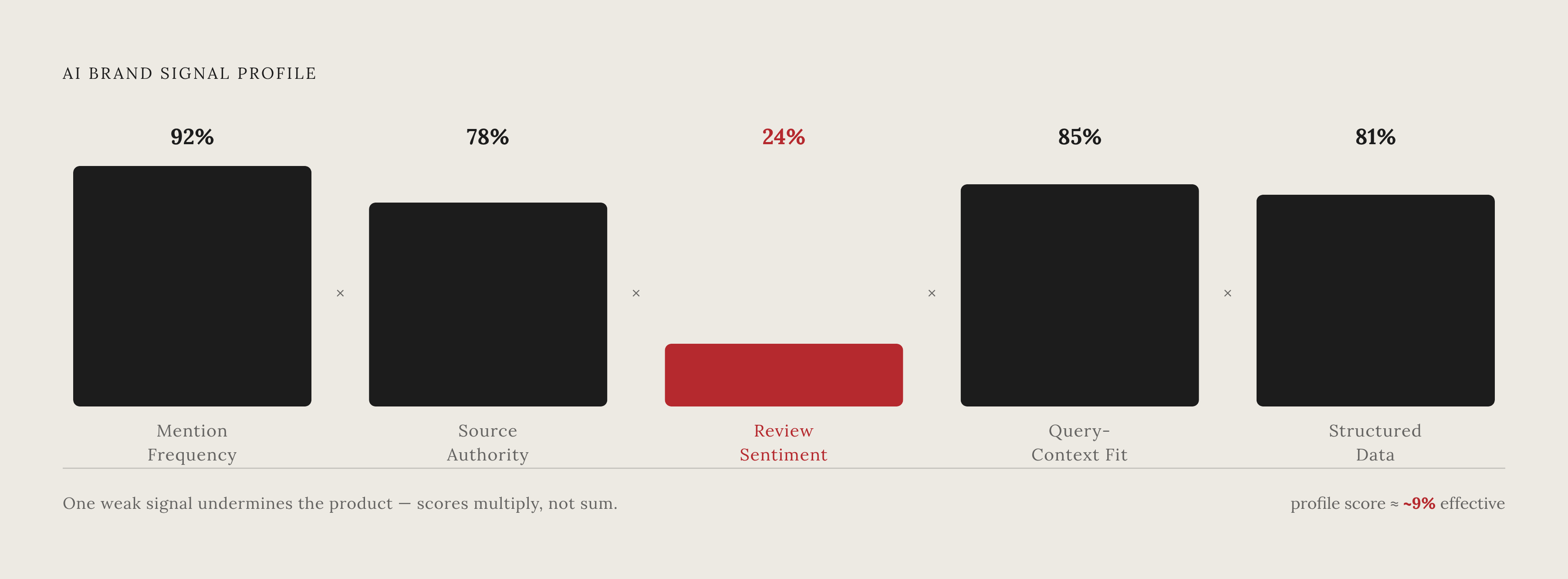
The practical response begins with understanding the evidence that governs representation. Mention frequency determines how often a brand appears in training material and retrieved pages, while source authority reflects how much those sources are trusted. Review sentiment captures the words customers use as well as their overall rating. Query-context fit reflects how well the description the system has fits the question it is answering. Structured data makes the brand entity and its attributes legible to the system.
These categories explain why visibility alone is an incomplete diagnostic. Frequent mentions do not resolve contradictory attributes, and a high star rating does not erase recurring negative language in reviews. Structured data reduces the extraction cost of identifying what a brand is and what it offers. Without it, the system has more to infer from unstructured material, increasing the opportunity for error. Both the amount of information and how clearly the evidence converges on one account matter.
Freshness adds another constraint to that account. Retrieval gives priority to content from the past year, while a profile whose signals all date from two years ago can suggest an inactive or unreliable business. Erlin's 500+ brand study found that traditional search ranking does little to explain which sources AI cites compared with fact density, third-party validation, structured data, and recency. A page can rank first in search yet remain absent from an AI answer to the same question. Search performance and AI representation consequently measure different things, even when they draw on some of the same pages.
Treating AI brand perception as a scorable, monitorable dimension of brand health
Measurement must precede optimization because a brand cannot close a perception gap it has not defined. A useful baseline establishes what AI systems currently say, how that account compares with intended positioning, and where the largest discrepancies sit. That baseline must cover more than one platform because systems can differ sharply in how often they cite a brand and the sentiment they express. A favorable result from one platform cannot stand in for the whole. The purpose is to make representation observable before an isolated error becomes a public crisis.
Ongoing measurement needs to distinguish presence from accuracy. AI mention rate records whether the brand appears, while sentiment trends show how the tone of what systems say about it changes across platforms. Share of voice in AI-generated responses measures how much a brand appears in synthesized answers, a measure distinct from how many times the media mentions it. Attribute alignment measures how closely the qualities AI associates with the brand match its intended positioning. Together, these measures separate absence, negative treatment, and factual misalignment instead of collapsing them into one visibility judgment.
Evident's scoring platform gives brands a structured baseline that covers the signals used in algorithmic, AI, and human evaluation. That baseline gives organizations a way to identify representation gaps and prioritize the underlying signals that need attention. Brands that establish ongoing measurement beyond a one-time content cleanup can detect recurring distortions and close gaps before errors compound. That gives them a structural advantage over organizations that wait for a crisis as AI becomes a primary channel for discovery and evaluation.
Concrete signal fixes that reduce a brand's hallucination exposure
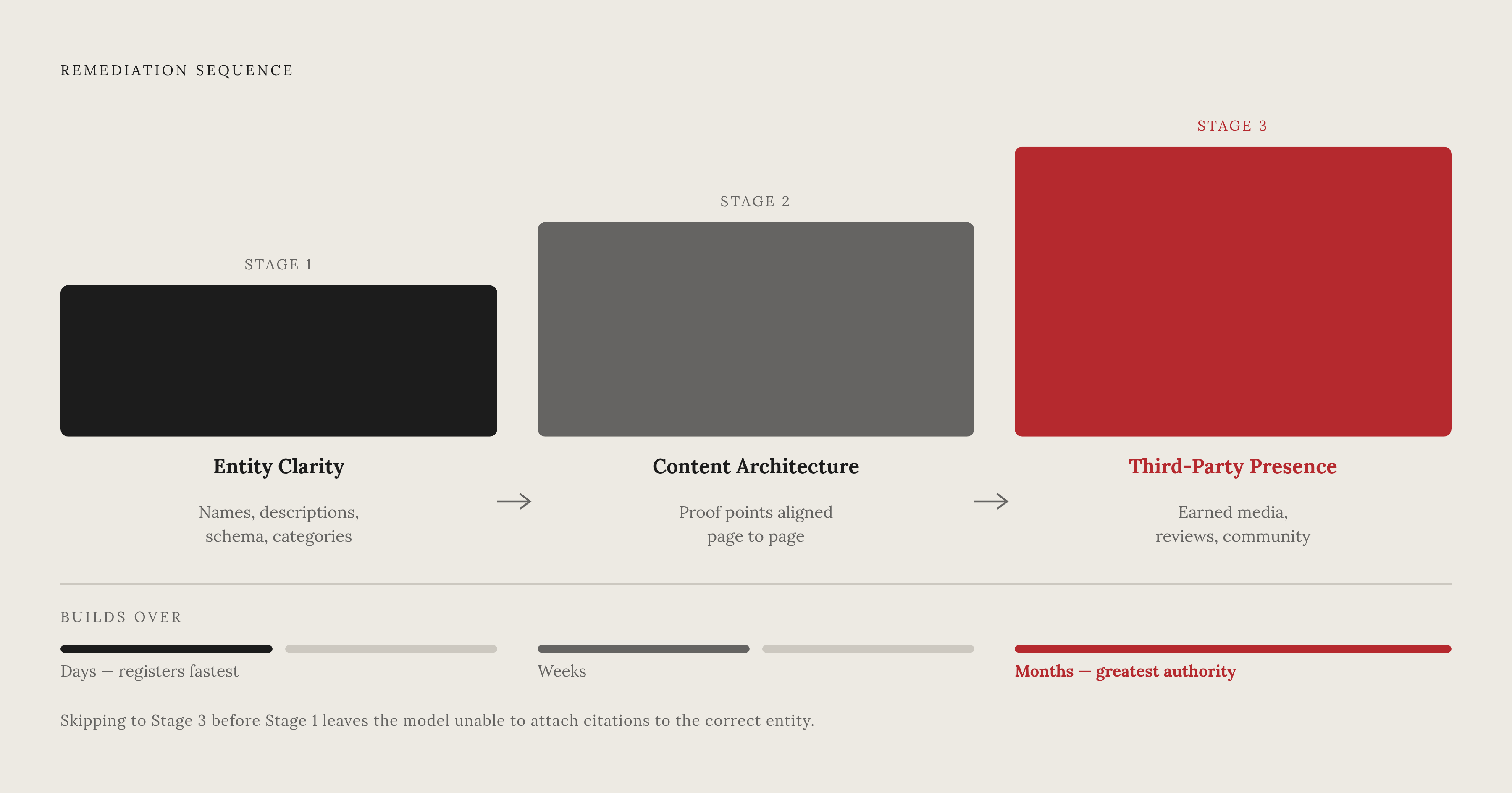
The correction sequence starts with entity clarity and structured data because these changes register fastest. Erlin's research shows that brands can gain citation coverage fairly quickly by improving structured data. The objective is to reduce extraction cost so that the system does not have to infer basic attributes from scattered prose. Brand names, descriptions, categories, and key attributes should match across the website, schema markup, and third-party profiles. Resolving contradictions gives later evidence a clear entity to attach to.
Content architecture comes next because a clear entity still needs a coherent account of its capabilities. The attributes a reader or retrieval system finds should match from page to page. Clear proof points and explanatory language give that account more substance than superlatives or unsupported trust claims. This stage connects the basic entity definition to the information used to answer specific questions. Without that connection, greater visibility can bring more clashing material to light and leave the brand's representation unimproved.
Third-party presence takes longer to build but gives the brand a great deal of authority. Earned media, presence on verified review platforms, and community discussion add evidence beyond what the brand says about itself. Building those citations before resolving entity ambiguity wastes effort because the model cannot confidently attach them to the right profile. Audit recurring negative language and address the service problems behind it, since a higher rating can still conceal a weaker trust signal.
Freshness then becomes a maintenance requirement across the corrected profile. Consistent, current signals are more useful than bursts of activity followed by long silence. This is not a separate campaign that begins after the other work ends, but the upkeep that prevents corrected information from becoming stale. The sequence remains entity clarity and structured data first, content architecture next, and third-party presence after that. Monitoring shows whether those changes improve the account AI systems give, so brands can manage this predictable threat to trust as part of brand health.